Mordred
Resident Experts
-
Joined
-
Last visited
Everything posted by Mordred
-
Anyways that should provide a good direction of approach. I've watched your other thread though I have to catch up to where your at with it when I get time lol to know how serious you approach a topic and have a measure of your skills in that topic. Quite frankly its fun to study with all the relevancy to the topic. Hope this helps... note to above yes graviton as a gauge boson would likely be massless. One still need to correlate the possibility under group. One also sees the [latex]D_\mu[/latex] above this is the Differential matrix , and it correlates the difference between the covariant and contravariant terms. It will change in values as per the application applied in particular in different field treatments.
-
Yes the four momentum is instrinsic in GR however it requires the use of indices that follow the Einstein summation for covariant and contravariant terms. see here to see how this can apply in the above https://en.wikipedia.org/wiki/Four-momentum the remainder of the equation that you are trying to fill in the relativity section is in the 4 momentum, 4 force and 3 velocity format. This way you have the same coordinate relations throughout the equation. Though it is assumed direction of motion would be in the [latex] x^1 [/latex] direction this isn't always the case. Now I am going to ask a related question :How much affect does gravity play on the path integral relations that the first equation describes in its particle to particle scattering ? (side note the other portions are already Lorentz invariant). https://en.wikipedia.org/wiki/Lorentz_covariance https://gdenittis.files.wordpress.com/2016/04/ayudantiavi.pdf see here for further details on the Lorentz group and Lorentz invariance with ( you will see that the RHS of the [latex]\underbrace{\mathbb{R}}_{relativity}[/latex] is already Lorentz invariant in the terms. (side note QFT does this via the Klein Gordon equation as opposed to the Schrodinger ) Which brings to mind another question one can ask. Why was the [latex]\underbrace{\mathbb{R}}_{relativity}[/latex] left unfilled ? personally my feelings on this is that we haven't got a working quantum theory of gravity that doesn't suffer the renormalization problem sufficient to extrapolate the hypothetical graviton interactions (the graviton isn't yet part of the standard model of particles). Although if such a graviton could be possible with the spin 2 being the more likely (under research) spin 0 is also plausible. This in turn affects the degrees of freedom required to determine the gauge group representations. One must account for all effective degrees of freedom. see here for an example equation 36 for an example of the QCD Langrangian. https://cds.cern.ch/record/935622/files/p27.pdf This articles has pertinent details to understand a large portion of the equation in the OP. (the last article should provide a sufficient answer to the question of whether your Langrangian attempts suffice). Keep in mind the line from the introductory, the remainder of the article should hone in on how complex it really is.... In final note an effective Langrangian for the relativity portion should correlate to all the effective degrees of freedom that define the spin 2 statistics. A source of observational evidence is the graviton waves (quadrupolar ). So I would start here. [latex] g_{\mu\nu}=\eta_{\mu\nu}+h_{\mu\nu}[/latex] if you research these groups you will find much of the work in terms of the Langrenians is already done. see this example on massive spin 2. gives other spin examples also https://arxiv.org/pdf/hep-th/0609170.pdf equation 21. Which reflects that the [latex]\underbrace{\mathbb{R}}_{relativity}[/latex] will correspond to something similar to this. [latex]\underbrace{|D_{\mu} D_{\nu}|\upsilon_{\alpha}}_{relativity}[/latex] ROUGH EXAMPLE ONLY>>>>one lack being massless particles...
-
going straight from Newton to a relativistic Langrangian by simply adding gamma isn't sufficient by itself. You must also preserve Lorentz invariance which will require the use of proper time given as [latex]\tau [/latex]. Recall different observers will measure the variant quantities differently this includes time. Even then its not complete, as you will need to include the 4 momentum and 4 velocity. See here, it mentions some of the issues I didn't https://en.wikipedia.org/wiki/Relativistic_Lagrangian_mechanics Another related reference here http://fma.if.usp.br/~amsilva/Livros/Zwiebach/chapter5.pdf A primary goal is to ascertain from the Euler-Langrangian the geodesic equation. http://people.uncw.edu/hermanr/GRcosmo/euler-equation-geodesics.pdf This wiki link has a good breakdown of how to employ the Euler Langrangian to derive the geodesic https://en.wikipedia.org/wiki/Geodesics_in_general_relativity
-
LOL I created a monster... Unfortunately I do not have the pdf I got that formula from, I had a copy of the original pdf on my phone which I had lost a while back but had the equation written down. Lately I decided to break it down to identify the various terms in the equation and see how encompassing it is. Here is what I have thus far. I will simply cut and paste what I have however keep in mind much of it will be in a note to myself format including related formulas. (in a real sense personal study notes) lol I screwed up on the quote section ah well the details are there. Anyways in a sense I have been trying to in essence reverse engineer the equation. Some of the links you have posted may come in handy in my endeavor I have to agree with this, in so far as to locating any proof for the equation itself.
-
Several reasons for that, many are due to most ppl want removable legs for moving and storage purposes. The second being many ppl look for the easier and quick put together methods even to the point of sacrificing solidity. Still if you can do that joint the dovetail shouldn't present much more challenge and dado joints are always easy.
-
Excellent work, very well crafted you don't often see those joints used today but they are solid joints that last years.
-
Section is too tight for anything but a come-along tied to a fence grrr
-
lol
-
I much prefer to recieve my wifes rewards lol. This is her gift to fulfill a promise to make her one. I have enough material to make another to see if I can sell one. However my first priority is making raised planters to fix the yard of the place I moved to 4 months ago. Still digging up bush roots along the side of the house. Yeesh 10 hours digging for three bushes so far....
-
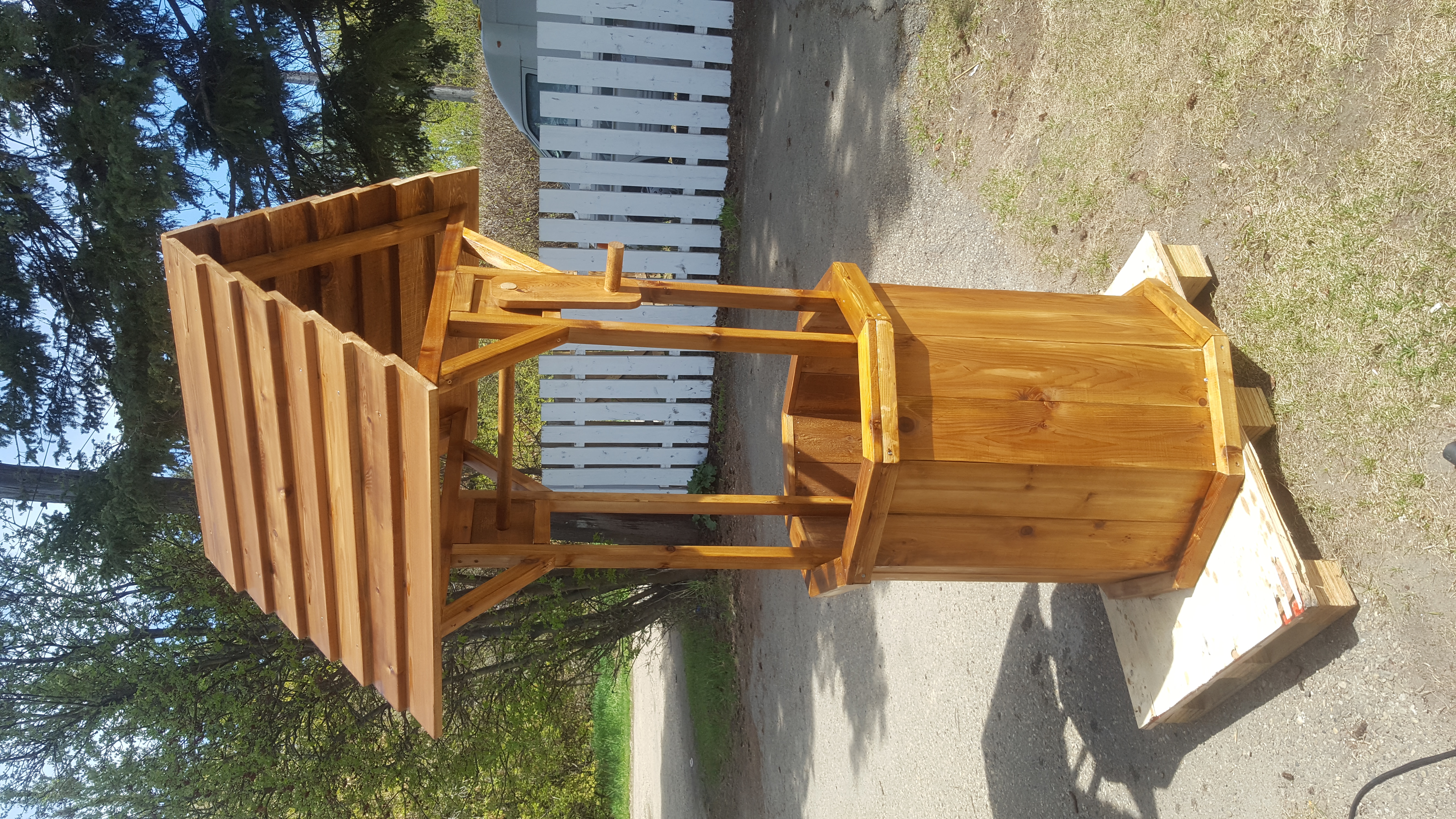
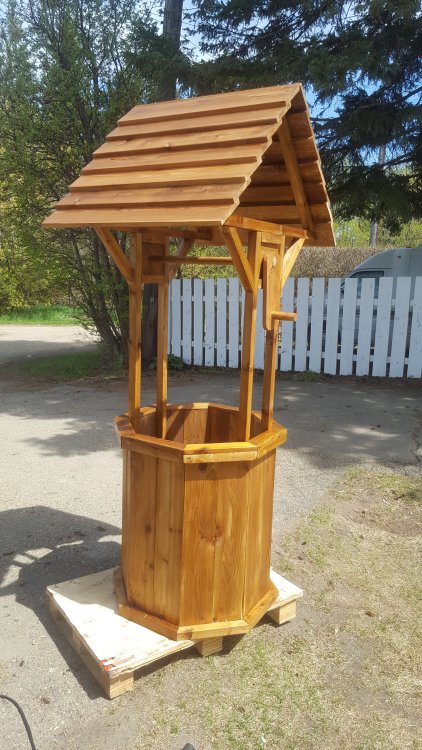
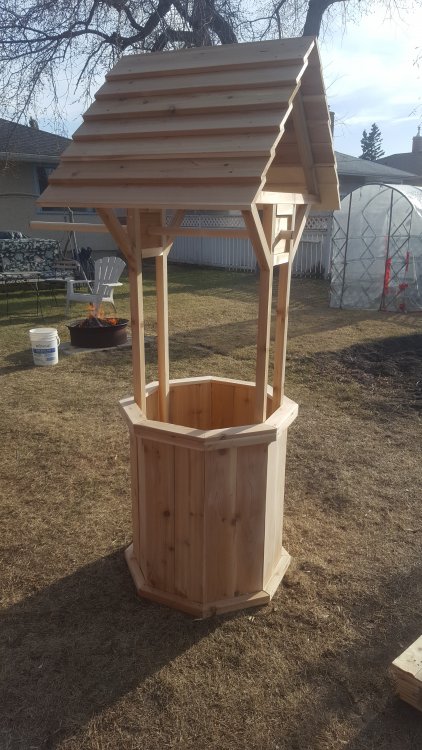
Here is the finished product used a light oak stain with an outdoor gloss protective coat
-
Another well answered post +1
-
Potentially on deck sealer with gold oak tint. Only wish I owned a lathe but one can modify a drill...
-
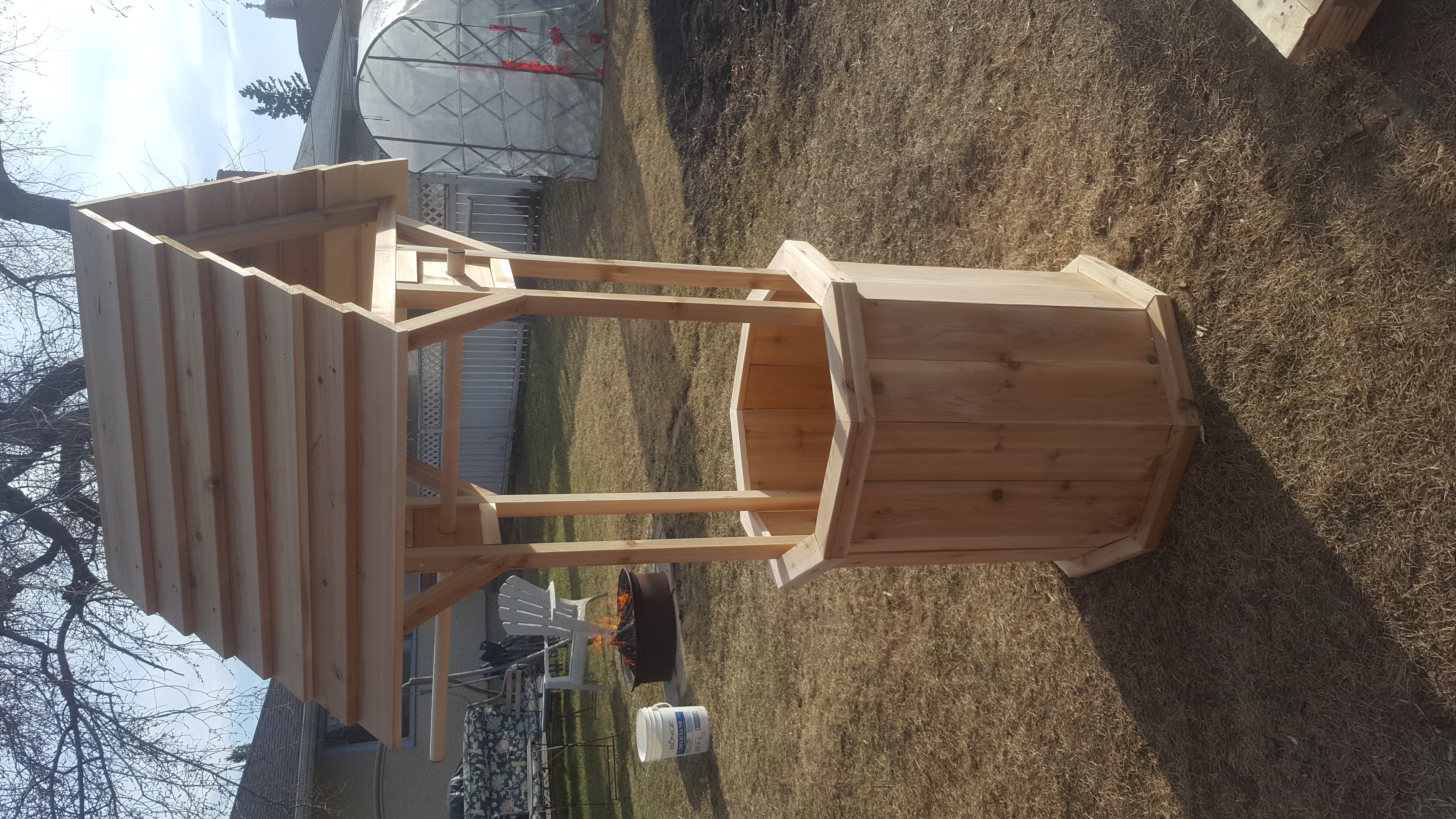
lol not that complicated just cut the handle base out of the 1×6 with a bandsaw hole at each end. One for shaft, the other for crank handle. Glue two layers same base shape to hide end cuts. Also allows a higher radius edge rounding. This also provides greater gluing surface. End cap other side two layer circle cut with smaller circle ( 1" dowelling) other layer caps the end cuts. P.S. currently enjoying that fire in background lol.
-
1×6 cedar cut into the handle with two glued hole for the 1 inch Dowling rod. One for the main shaft the other the crank handle. Then wife wants to hang a planted pot on rod. Routered (rounded) corners on crank bases. Haven't decided on protective coat but looking at tinted (Gold oak, )outdoor all in one tinted clear coat.
-
progress report on Well just need to finish the handle then prep for staining and outdoor protection.
-
On my planer I remove the blades with an allen key, then I clamp them with sheet metal pliers and sharpen on a whetstone first. (relatively new as they develop unevenness over time. For the honing I use the adhesive sheets and glass. In essence its the same aa a chisel though I follow the angle they come in. The main trick is clamping the blade with sheet metal pliers. Unfortunately you can't do too often as the more modern planers have disposable blades but you can extend their lifetime a bit. Many ppl use belt sanders but I prefer doing by hand but this vid shows the procedure https://www.google.com/url?sa=t&source=web&rct=j&url=https://m.youtube.com/watch%3Fv%3DWx0shUhRguc&ved=0ahUKEwjKrpP5r8_aAhUE32MKHXktAMcQtwIIMzAE&usg=AOvVaw0RvM48V2lNXzUk4yCjcPHD The end of the vid shows the limit signs to the amount of sharpening.
-
One of my favourite purchases is my electric handplaner. I do a lot of smaller work with pallet wood and its a huge time saver though tend to have to sharpen the blades often lol.
-
For honing I prefer the sheets on glass works extremely well
-
Never force wood excessively beyond light placement taps. Glue does take up spacing but more likely it is a case of placement from dry test to glue stage. I typically place alignment marks when matching pieces together to ensure the same placement from one stage to the next. Such things do occur regardless of how diligent. As mentioned before this thread. A good craftsman isn't one that never makes mistakes but knows how to hide any mistakes. ALL Too often joints can be too tight, it should only take light taps to get a tight fit, excessively tight fits are as you noticed problematic. If you find gaps a trick to to mix glue and the same sawdust as the material used as a filler. Its not perfect on blending but better that many store bought fillers in matching coloration (use a stain ready glue). PS the very statement "You hammered the $$$$ out of the boards" tells me your fit was misaligned on gluing stage and possibly too tight. Once glue has already started to set even if not completely dry it is too late to realign. Practice chisel skills as well on joint and levelling corrections/blending. Chisel skills can oft remove unwanted material as well as save a lot of time in coorections. For fine detail slice not tap or force. I've found that one truly learns to understand the strength in the different grains of different woods when chiselling joints. For example oak is easier to fine tune chisel than maple. Teak one must take extra care on cleaning the natural oils from tools and hands as you work. Speaking of maple you will also want to develop your chisel sharpening skills.
-
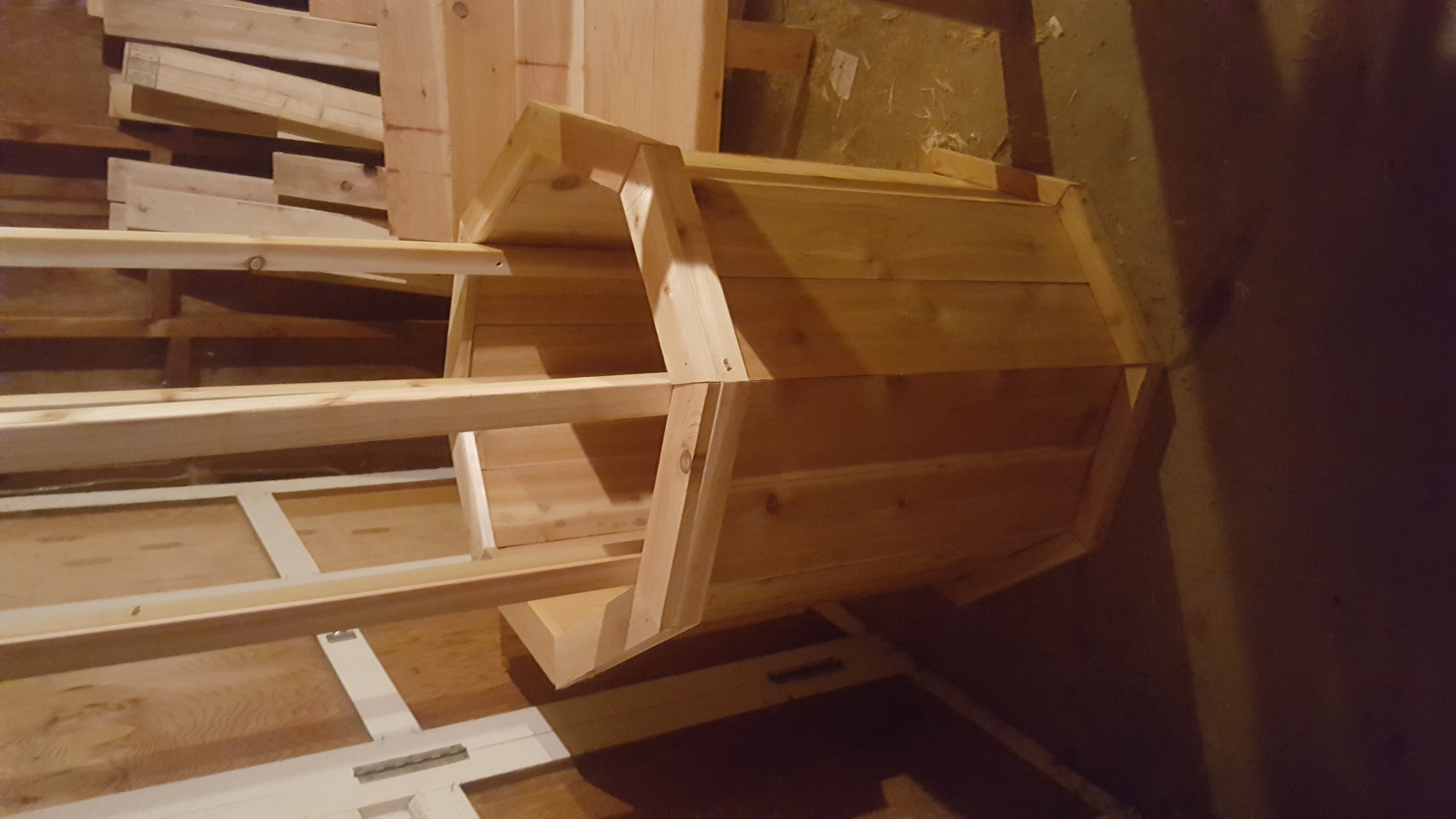
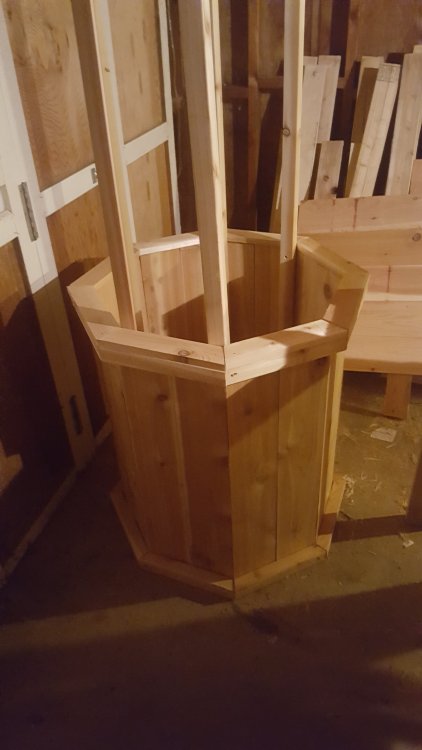
The angles and ensuring precise 22.5 degrees took some scrap pieces to fine tune. For the other cuts I usually make sure I am within 1/16 of an inch. That often requires some chiselling to fine tune the joints. For squaring up each side I used a tape measure diagonally from corner to corner.
-
Dowel joint on the trim pieces, with glue of course. Further strength is added by the bottom base inside with screws hidden by the bottom trim.
-
My current project wishing well made out of cedar, Dimensions 30 inch diameter, height of bucket 30 inches. Costs roughly 150.00 Canadian for the wood. Magic angle for the hexagon 22.5 degrees
-
Welcome aboard.
-
Yes different spin rates would allow for different radius ratios.
-
Yes you can use multiple modules to counter spin.