Ken Fabian
Senior Members
-
Joined
-
Last visited
-
Currently
Viewing Topic: Recycling lithium batteries ?
Everything posted by Ken Fabian
-
What should we be doing that we are not already? I am all for education, healthcare and availability of contraception. And economic security and prosperity for all. All of which tend to lead, through providing enough freedom to do so, to choosing reduced family size. Population reduction other than by reduced birthrate and attrition over multiple generations across multiple nations seems especially problematic. Regulating which people can and can't have children and under what circumstances - rather than who lives and who gets murdered - has serious ethical as well as practical issues too. Education and encouragement is fine - let's do more where we can - but I am not convinced we should be trying regulation and enforcement. I think some of our more serious population related problems won't give the time for population reduction to help even if we could force it and I feel a sense of foreboding about that. An aside is I don't think global warming is primarily a population problem - I think it is a dirty energy problem and per capita emissions problem. Good governance is essential, yet the worse the external conditions the more likely it seems that we will get all that bad governance can give - blameshifting and divisiveness and conflict. Things going badly seems to enable and encourage exploitation and corruption; desperation leads to looking out for no.1 and life becoming a zero sum game and that is not conducive to good governance.
-
Surely storing DNA is the easy part; it is the rest of using that DNA as backup of Earth life that we are not capable of. ie turning frozen samples into live, independently capable organisms. I suppose it would have to be many species, sufficient for working ecosystems. Capable because some animals will fail to learn necessary survival skills without parental care within a working ecosystem. Or is it just homo sapiens and species we know we depend on that we would be seeking to preserve? I expect it to be a lot more complicated than just having the dna of humans and food species; the interdependencies get complex. I keep coming back to the requirement for a comprehensively capable advanced economy independent of Earth for surviving beyond Earth; being able to support advanced biotechnology beyond what the most advanced nations are currently capable of is no small thing, on top of supplying more immediate needs. I think just immediate needs will be so extremely challenging as to be prohibitive.
-
No, my assumption is it isn't feasible. If it were close to feasible -and I do think the economics of it is indicative - maybe but it isn't anything like close. That thousand fold lowering of costs - more like 10,000 fold to get near across the planet ocean shipping costs underpinning global trade - makes a barrier that wishful thinking cannot overcome. That there are real extinction risks is why I support meteor defense as an enduring space program objective. If drastic cost reductions emerge then we can reassess where that line for feasible is. Space is not the place for depending on improvising or any go there then figure it out "bootstrapping" - everything needs foresight, planning and preparation. I don't think that is true, even leaving aside just how out of reach "once you conquer colonising space" is. Sure, you can throw a stone in space and it will keep going but getting it to reach a specific destination is a whole lot harder; getting to and from actual destination in space is still hugely energy expensive and technically challenging. Just going from low Earth orbit to Geostationary costs about 1/3 of the delta-v ie fuel requirements and wear and tear of what it took from ground to low orbit - that is still a LOT - and requires a lot of reaction mass as well as energy to do it. From low orbit to moon takes 2/3rd of what reaching orbit did. To Mars from Earth orbit it takes about as much as reaching Earth orbit, but without atmospheric braking to save fuel. Solar power does seem to offer some potential where low accelerations suffice - I'd suggest very high temperature vaporisation, maybe to plasma, of (probably) water rather than attempting to turn it into chemical fuel, but the reaction mass to payload ratio is still going to be very high. There are some useful resources in great abundance out there, with nickel-iron the pick of them, with 10's of ppm of platinum group metals included, if you can refine them, but not every resource is abundant. For example I struggle to see how fission rockets can be fueled in space without accessing fissionable materials from Earth - which may be in high demand. Fusion is still a work in progress. But even with such energy sources there is a lot of reaction mass needed. I'm not opposed per se - just think it is a lot harder than the optimists like to think.
-
On the other hand I remain unconvinced and very pessimistic about space colonisation - that without commercial profitability to enable a colony (which I think has to be at least equivalent to an advanced industrial economy to have a chance) to pay it's way and be self supporting human habitation of space won't happen and without extraordinary transport cost reductions - far beyond anything in progress, at least 1/1000th current best or better - commercial profitability that can make it an opportunity will remain out of reach. I also have the unpopular view that uncrewed exploration delivers more with much better value for money than crewed and the greater scientific/exploration achievements will continue to come from that. But, being Australian my influence - posting opinions on science forums - is minimal, even less than the vote an America gets.
-
I do think planetary meteor defense is an excellent long term goal for space agencies, one that can be international and cooperative in nature and large scale, long running and wide ranging enough to support significant ongoing space technology R&D. Like national defense or insurance there is no innate requirement to have a self supporting commercially viable basis, whilst still having the potential for spin offs that do. But I suspect the pursuit of defense industry relevant technological excellence and international rivalries will remain greater drivers of space programs than any shared "common good" type goals.
-
Here in Australia I've seen a pattern where increased labour productivity was not matched by increased wages and wage increases persistently remained below inflation, all whilst corporate profits were still high - often exceptionally high - and the salary increases for executives (aided even more by tax cuts) were far above inflation. Other issues contribute, like rising interest rates and supply chain constraints but one standout was outrageous fossil fuel prices - and not for the sake of saving any economy from the impacts would the gas and oil producers cut their war inspired hyper profits down to mere exceptionally good profits. Renewable energy costs would supposedly be economy wrecking but extreme gas and oil prices with high volatility, plus climate impacts isn't? But of course business owners, their associations and lobbies blame wage increases... they always, as a matter of principle, oppose wage increases, a bit like denying and pleading not guilty even when you are guilty when facing criminal charges. Low and declining wages do not sustain a healthy economy or even, ultimately, longer term growth in corporate earnings. The micro impacts - a company is more competitive and makes more profit by reducing their workers' pay (or restricting their rise in the face of inflation) - are accompanied by the macro impacts when every workers' pay is reduced - ie it results in economy wide reduced demand. Yes there is a balance that needs to be kept within bounds but the spending power of ordinary workers is a powerful source of demand for businesses. Increasing profitability and by reducing wages - giving businesses what they want - can be more economically damaging in the long run than not giving it to them. There are examples in the world of nations that sustain livable minimum pay rates, with strong union participation and companies paying taxes too, all without being economy wrecking. Or even preventing capitalist wealth accumulation. I strongly suspect intolerance for corruption - including of excessive corporate influence - is a significant factor in finding a healthier balance.
-
There would be evolutionary advantage to language that is changeable over language that is fixed. One of the things shared language does is make social connections and shared slang is shared social connections.
-
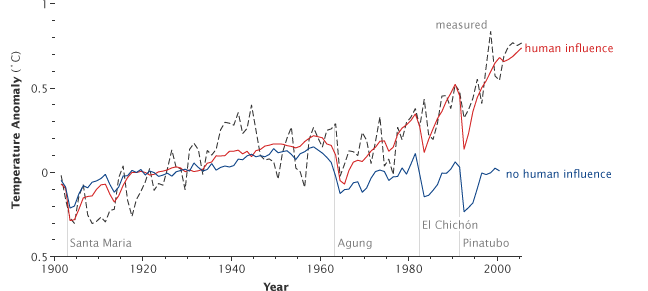
I am not impressed with your start/end point choices for the red arrow, which use the extremes of variability to make the "trend" look steeper rather than using any kind of running average (between the troughs and peaks) would. Unlike the black arrow that does seem to start between the ups and downs. Doing it like that makes the red rise greater than it actually was compared to the later black rise. Like the notorious "cooling since 1998" arguments that start from a record hot year with a super el Nino and used the results of ENSO changes after to claim it was the end of global warming. Some climate scientists do consider modern global warming to have "started" (begun rising above the natural variations) from around 1970. And climate science doesn't claim human influence on climate for late 19th and early 20th century was positive, they have concluded it was negative - quite different from your "incompetent" interpretation. From NASA - Overall your comments across as bog standard Don't trust climate scientists complete with false or misleading rationales, which feeds into Don't trust "activists" (ie don't trust people who trust climate scientists).
-
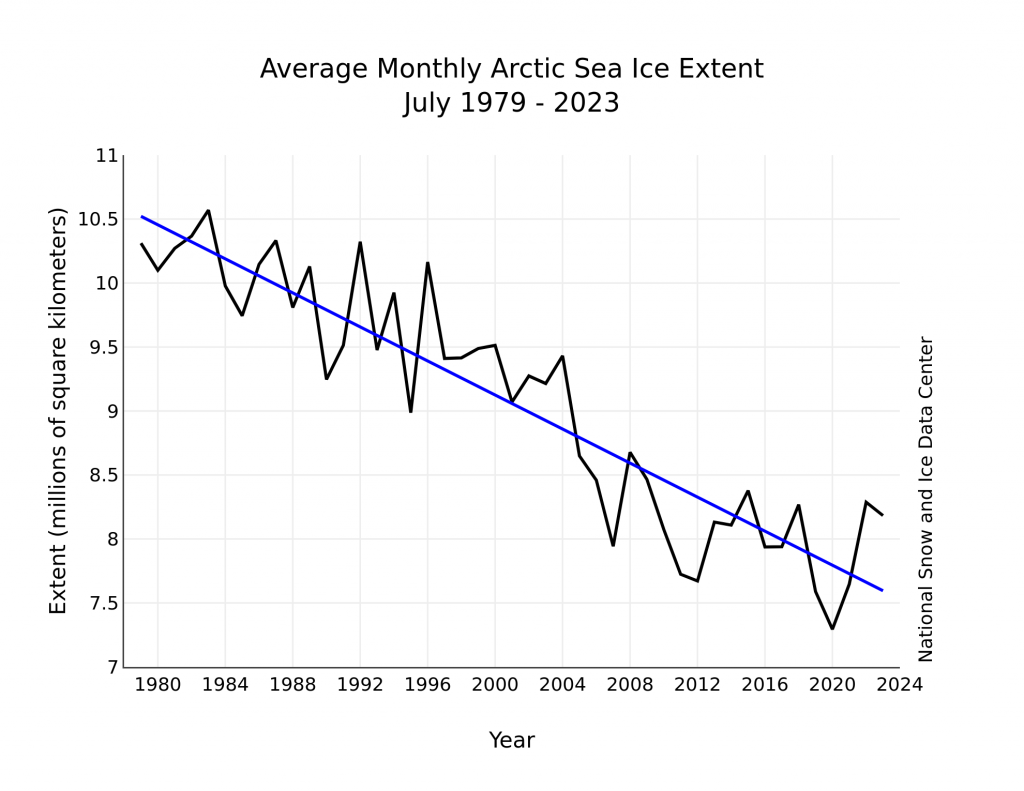
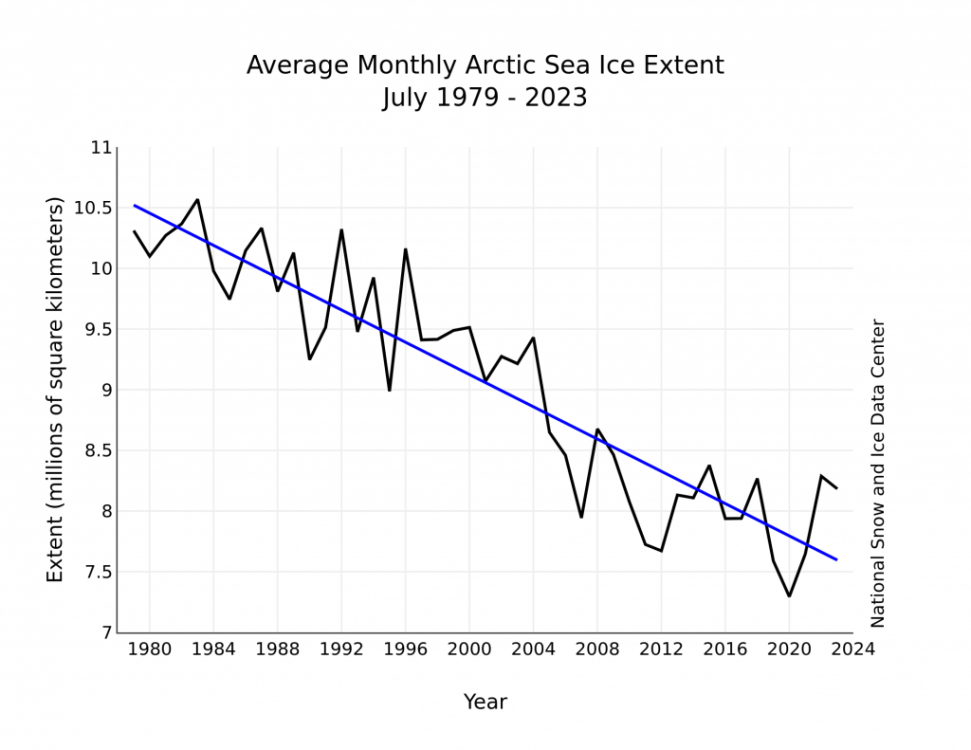
Good. Followed by - Rather than convinced scientists? Not so good; it implies unprofessional bias rather than says it but that suggestion is in there. Which predictions? Sure, people have said many things over the years - considering worst possible scenarios from information available at the time as well as the most likely is common practice for addressing risk on one hand, with falsely interpreting the positive swings of sea ice variability as "recovery" on the other. The latter has been shown incorrect by subsequent ice decline. I don't think a decade or two either way reduces the global climatic significance of an Arctic with ice free summers. I don't see how you can legitimately interpret this as showing a serious and rapid decline isn't happening or is not serious -
-
That implies that when similar combinations of natural conditions occur again the temperature rise will greatly exceed the projections. But 0.7 C looks like an overstatement that is dependent on start and end point choices. Could it be possible that people studying these things have looked and found early 20th century changes are within expectations given all the known factors and that they have not found room for any significant unaccounted for factors? Could it be that they are both competent and honest?
-
It would take the sulfate aerosols in combination with an absence of CO2 emissions to do so. My understanding is that aerosols from fossil fuels are short lived - a lot less residence time than from volcanic eruptions that send it into the stratosphere - and their cooling effect depends on the ongoing rate of emissions of them and diminishes within days to weeks of cessation. CO2 is long lived and the warming effect depends on the accumulating total, with it diminishing only slowly after emissions cease - centuries to millennia to find a new equilibrium. Or look at it the other way around - start a whole lot of fossil fuel burning and the near term effect is global cooling, which reaches its maximum within days to weeks and stays there as long as the aerosol source continues. The enhanced greenhouse effect starts at zero and gradually increases over time. At some point the cooling will be equaled by the warming and will be exceeded by it after that. Cease the fossil fuel burning and there is a fast temperature rise equal to the prior cooling effect - back to no cooling - in addition to the full strength enhanced greenhouse effect that persists.
-
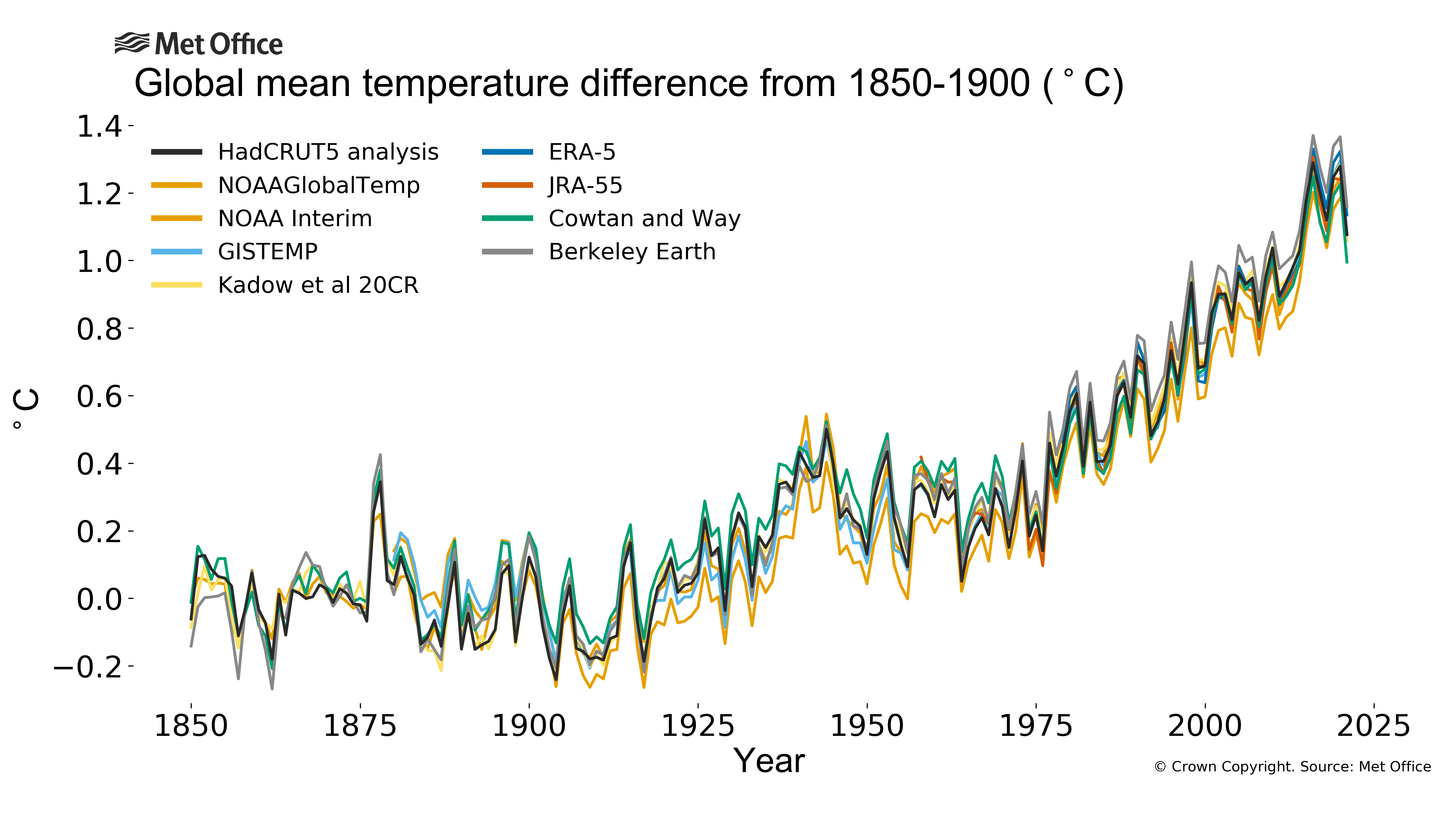
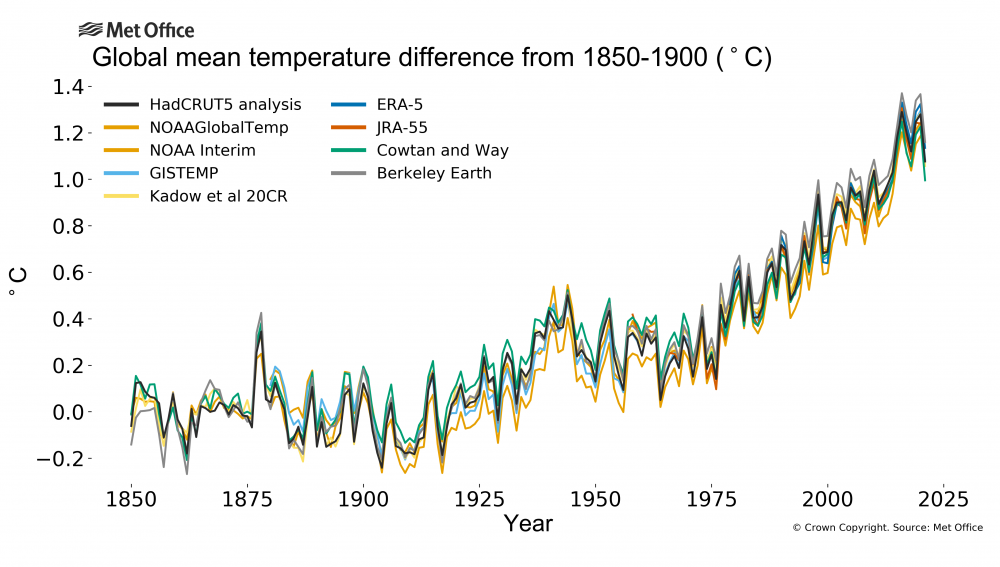
All the datasets that go back that far show similar for late 19th century, including the "made by skeptics" Berkeley Earth -
-
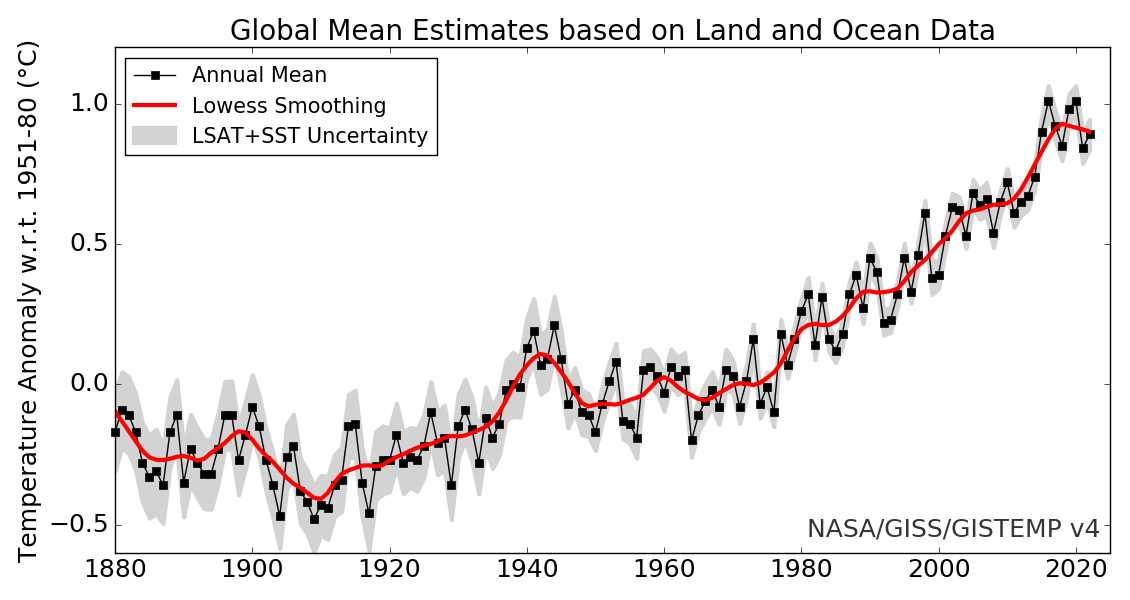
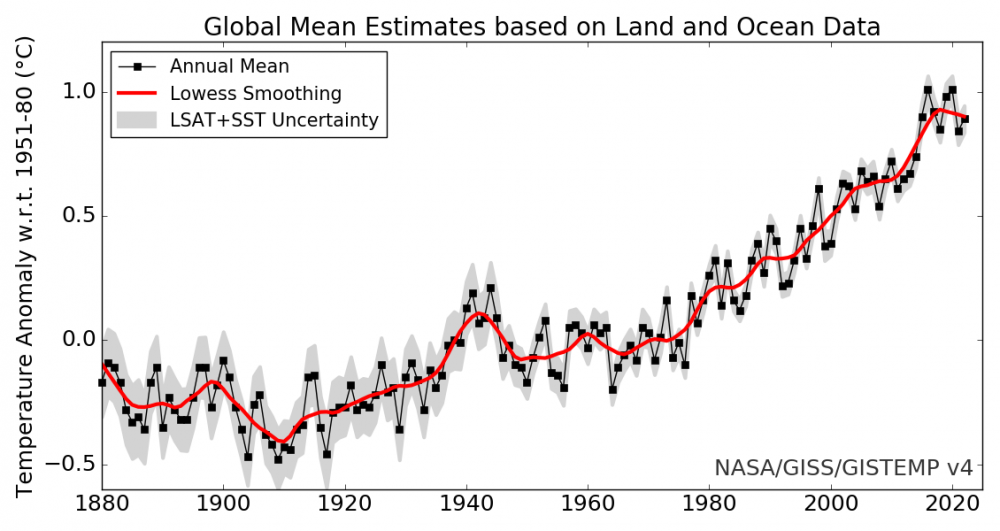
Not that substantial - there has been three times as much warming in the 70 year 1950 to 2020 period than during 1880 to 1950, which began with about 3 decades of global cooling. I don't see much room for significant missing natural elements that would support doubt of the attribution of current global temperatures and weather consequences of that to raised GHG's. The warming trend increasingly stands out above natural variability and adds it's influence to the weather events we experience - and attribution studies are confirming the expectations that were based on shifting the bell curve distributions of extremes.

-
I don't see any of course about it given the extreme distance, extreme costs of transport and the extreme conditions. We don't even have an inventory of what minerals are essential vs which are available there let alone what it would take to exploit them cost effectively - cost being about how much time and work people there must do to produce what is needed, which inconveniently includes what colonists can exchange for what they import. It is possible that nations would make a space colony and commit to supporting it in perpetuity in the hope it can become a self reliant Planet B in order to preserve an independent remnant of the human race from distant global catastrophe but that is not currently the case and I am not convinced it would have widespread support - although I expect there are some with bunkers intended for preserving a remnant from much nearer term catastrophes. Having to rely for day to day survival on large scale taxpayer support from very far away, that must persist unbroken for unforeseeable lengths of time doesn't sound like a sound plan.
-
I think that for wealthy and powerful - industrialists etc - the nation's good usually pares down to what is good for the near term profitability of their businesses and their interactions with politicians are largely transactional, making deals towards that end. Not surprising, they tend to oppose regulation or taxation and anything that they perceive as negatively affecting them (but they aren't necessarily good at the bigger picture and longer term; giving them what they think they want can end up worse, even for them, than not giving them what they want). Which makes politicians and parties that espouse such things - Right leaning - usually more to their liking, but not always if the deals others offer are good enough. The transactional nature of mixing politics and business has a "soft" corruption element (legal means of influence - advertising, PR, tankthink, lobbying, strategic donating, tactical lawfare, post politics payoffs) ultimately means influencing the making of the rules including ensuring the nature of legislation intended to limit corrupt influence doesn't limit their influence. I think corrupt influence and the inability or unwillingness within political parties to address it is one of the greatest impediments to improved governance - and we need governance that is capable of dealing with the profoundly serious challenges we collectively face.
-
It got noticed and exposed. In a roundabout way that has to be good news. Science is built around documentation and making it widely available for evaluation and critique by their peers. In fields with few participants and little outside interest I suppose data tampering can go unnoticed for longer but cheaters who have to document their lies will always be at risk of exposure.
-
We are adding CO2 at higher rates than ever - and would probably be even higher without growth of renewable energy - so I am not surprised that we see the scale of real world impacts growing. Whether this el Nino brings record global temperatures with it isn't certain but if not this one, the next one probably will. I do think we are on the cusp of achieving zero growth of fossil fuel use but a lot of economic dependence on it is built on so reducing it's use is still dependent on a lot of still relatively new power stations aging before reaching retirement. But whilst renewables are cheaper to build for electricity generation - I think most of the growth is because they are cheaper, not for emissions reductions - that circumstance may not persist; we still need the kinds of commitments to actions that may make things more expensive in the near term in order to avoid the costs of climate impacts in the medium to longer term (not just longer term anymore).
-
Much like how I don't believe in gods, I don't believe in exponential progress either. I expect the progression is more like an S-curve. They can look very similar... for a while. Let us hope it is not a U-curve. I don't want to die - although that may change as my body and mind deteriorates from age - but not enough to set aside experience and reason in favor of religious faith in an afterlife. I doubt a technological version is possible but I'm not much attracted by it; seems that whoever it is achieves consciousness in that body won't be me, even if he thinks otherwise. So I struggle to feel any attachment to his fate, apart from a vague "good luck". Better medical care for the life I have - with or without a capability to extend it - will remain a better goal in my view
-
With a Mistermackian classification scheme there is just one species - everything living is descended from it and by that definition is all the same species and it takes abiogenesis to have a different species. But I think it is arguing etymology - what the word species means - rather than biology. For convenience we go with the usual definition - which isn't as clear cut as "can interbreed". We have a lot of (unfortunately named) homo erectus DNA, that lives on in homo sapiens - we are indeed descendants - but sapiens has significant differences too, more than enough to rate being a separate species, the naming of which is to some extent a judgement call. Actually would not surprise me if sapiens and erectus could interbreed - no living apes are nearly so closely related - and the successful variants on the road to a different species would have done so with gene flow as an evolutionary mechanism. Like wolves being able to breed with dogs it doesn't make them the same species. Erectus had descendants that had significant differences and ultimately those survived whilst the descendants that stayed much the same did not. We are descendants but we are not homo erectus.
-
For technological progress I expect S-curves, not exponential ones - they just look similar... for a while. Even aside from the physical impossibility of endless exponential growth there are limits - like limits of physical properties of materials, like limits to return on investment. Aircraft can exceed the sound barrier - it is not an absolute limit - but it costs too much to become widely used. We may get working fusion power plants but if the engineering requirements are too exacting they may be too costly. We can launch people and materiel into space but as long as it costs too much and delivers too little there won't be space colonies. I suspect we are already overshooting the environmental limits of our world and unless clean energy tech advances a lot more (and quickly) the economic impacts of climate change will impose limits on how much nations can afford for far reaching R&D. Those impacts are going to get a lot more serious over the next few decades given total emissions are still rising and opposition (out of ignorance and apathy and out of being misinformed) to taking sufficient aggressive action remains strong. Living within our means means setting aside some aspirations whilst some are just made a lot harder.
-
Funny, I was thinking maybe you are right and I have been wrong! At this point I think there is a negative pressure effect above - a negative pressure/suction - but it isn't equal to the pressure increase below. Take a falling weighted piston (thanks) with a tight fit and slow liquid flow past it and that effect will be very small; the growing weight of water above would act more like you said, being (I think) very close to the "normal" static state pressure. Close because I think there is a suction effect, but it is not going to be equal to the positive pressure in a vessel open to air, not without making it a closed vessel. Depth dependent? But I need to think about that some more. Huh, @zetetic56 's topic has engaged my brain (even though I'm still stuck on the initial scenario) and I am not there yet but I think I will get to some better comprehension in the end.
-
@Genady I need to think about it. I note there is pressure reduction behind an object moving through water, at the extreme you get cavitation, but I don't know, your reasoning seems sound too.
-
Interesting. Initially I thought that scenario was too different to be instructive. After thinking about it I decided it is too similar to be instructive. Posit a liquid filled open vessel in air or posit it in vacuum and they are much the same. A perfect piston would not sink but the point is it isn't perfect and it does sink; the liquid flows around it as it falls and there will be liquid above it, with pressure; it displaces vacuum (or air) above and it starts being liquid above as per the initial scenario - with the pressure within the water above the question. It may simplify things to have a flat top/bottom piston with vertical sides - there will be no pressure gradient zone; I think the pressure around it as it sinks will be "normal", ie what it would be in it's initial or steady state. I still think what happens with an immersed piston in motion making positive pressure below is that the inverse happens above, like a piston working in reverse, lowering the pressure. Whilst the top of the vessel looks to be open the liquid is contained, by gravity and as long as the piston is moving/sinking the pressure above will be lowered and below will be raised.
-
I don't see how the overall pressure can be higher whilst the ball falls than when at rest. But I stand corrected; it is not like less weight in a falling lift - as you say that depends on accelerations ie occupants of a lift falling at a steady rate will experience normal gravity - but I do think it will create suction above as it falls.
-
@Genady Firstly I expect there is a kind of conservation of pressure applying - that the total pressure within the container whilst the ball (or piston) drops is equal to the total pressure at rest. Above the ball appears to me to be a case of the falling ball sucks - or perhaps better described as a case of reduced gravitational pull on that part of the water column whilst the obstruction below it is falling, a bit like we experience less weight in a lift as it falls. I'm not getting this from an external reference (or I would link) - it just seems (given the very basic things I have learned about gravity and fluids and pressure) logical to me - if wrong I am willing to be corrected.