Ken Fabian
Senior Members
-
Joined
-
Last visited
Everything posted by Ken Fabian
-
You are right. Some blanks are not going to be as significant as others. Some people will be less fearful of the unknown or not need explanations for the inexplicable. But it can be socially disruptive to have competing beliefs or for dangerous beliefs to spread unchecked. I like to think I am rational but I still have the emotive responses to the strange and unexpected. Superstitions I learned as a child can still be triggered, even though I dismiss them as irrational. We are susceptible - our powers of imagination can be a vulnerability as well as a powerful tool to provide understanding and predictability.
-
Yes, people will fill in the blanks with something, right or wrong.
-
A community that shares language and beliefs and rules of behavior has advantages. I think the human imagination and propensity to dream and fear the unknown combine to make having shared beliefs, even wrong ones, better than having none. The need for sharing beliefs came long before it was clear what was rational and what was not. The power to evoke strong emotions does make humans vulnerable to manipulation - but makes it possible for leaders to unite and inspire them to a great task or a Cause. The power of unified belief to aim people in the same direction have made societies strong. Having unified beliefs that are all evidence based and rational ought to make societies stronger but I don't think anyone's ever actually tried it. I'm not sure humans are even capable of agreeing on what is evidence based or what is rational. If you come to that question with beliefs already in place they probably seem evidence based and rational.
-
Insecticide impregnated mosquito nets work well where humans are the attractant. Impaling is not an effective way to kill mosquitos. A lot of thinking and a lot of work has already gone into mosquito control; better to review what has already been done before attempting new and unusual methods. Mesh works quite well to keep mosquitos out of water tanks but it requires good design, construction and ongoing maintenance (cleaning mostly) as well. We usually have a mosquito proof strainer set into the top of water tanks, but there can be gaps if not screwed down. But leaving them not screwed down makes lifting them out and emptying accumulating leaf and other debri easier, so they often aren't. Also the overflow outlets have mosquito mesh - but can get clogged, so the water level can sometimes rise above the level of the (sunken) strainer. Mosquito eggs laid in that water can be small enough to pass through - which isn't a problem so long as there is no way for an emerging adult to get out.
-
Well, that is a surmise, but one that seems sound. People like Nina Jablonski who have made skin evolution their area of of study think dark hair over light skin came before (misnamed) hairlessness - that being the usual pattern within related apes. She does thinks dark skin probably developed as a response to raised UV exposure in prior furless hominids, before homo sapiens, ie the earliest homo sapiens were dark skinned. In reality no-one knows. But yes, the variations of skin colour we see in modern humans came after the earliest homo sapiens, as did variations of adult hairiness. The absence of variation of juvenile hairiness across our species was probably present in the precursor species and (I think) probably preceded us, but the variations in adults is a secondary sexual trait that came after. No it doesn't make sense. The genes and traits every member of a species share go back to common ancestors. The genes and traits we don't all share - the variations that make different groups different - will have developed later. The earliest homo sapiens didn't have (all) the genes of every "nationality", mutation will have introduced new ones, the ones that make them different to their ancestors. Yes there are genes they had that everyone has. Those are for the traits we share in common.
-
I think we are arguing over terminology. The first post claimed it is an example of an Elastic Fluid, but I'm not convinced that it is what the phenomena described is. That may have led me astray. "Elastic fluid" seems to refer to compressability - Elastic waves - Surface waves that appear in a brandy bowl may indeed be examples of "elastic waves" in a fluid; something I wasn't aware of - I stand corrected. I had been thinking there was flow of matter involved - but I may have been misunderstanding "flows", ie where a container wall moves back and forth and displaces water without compressing it. It will involve wave propagation by compression and release (elastic fluid) but most of what we see in that bowl will be water physically moving rather than being compressed and uncompressed. Introducing the topic with reference to elastic waves rather than elastic fluids may have avoided confusion.
-
@SuperSlim -As long as you use the term "elastic" so broadly and wrongly you will mistake phenomena that have nothing to do with elasticity for phenomena that do.
-
The combination of container and gravity makes the shape of that water in it's hypothetical undisturbed resting state. Other forces make waves and motions, like vibrating the container to create standing waves. Friction damps those motions. It isn't elasticity - that is a misleading misnaming of why, when external forces cease it reverts back over time to it's resting state.
-
In Singapore it is illegal, because of mosquitos and malaria. Here in Australia rainwater is commonly collected and used for both household and garden use and usually tanks have mesh to discourage mosquitos (but unless well maintained, not always preventing their larvae getting in). Most of our own personal household water supply is water collected from our roofs, but we are rural, outside any municipal water supplies. Some places there can be reasons to avoid them - eg having big overhanging trees with bird and fruit bat populations can make the water unsafe to drink. There were widespread restrictions on household tanks in urban areas in the past, in part to support the viability of municipal water supply systems. Roof and other rainwater runoff is usually directed to "stormwater" drains that (usually) feed directly into creeks and rivers. Increasingly with some "pits" to catch rubbish. Oil, rubber and other contaminants etc off roads isn't separated. Of course when there are floods waste of all kinds ends up in floodwater. Rivers are most often the source of irrigation water for farms, without any specific water collection or diversion; specific collection tends to be on-farm (earth dams) or part of larger irrigation schemes, based around existing rivers and catchments and dams. Economics is probably the biggest impediment. Water isn't often diverted large distances unless part of larger schemes, like the Snowy River hydroelectric diversion of coastal flowing water inland, in combination with the Murrumbidgee Irrigation Scheme built around those flows. Even now it is unclear whether such schemes (minus the electricity) were ever cost effective but psychologically they were and are reassuring to have in a nation with climate that swings from extremely dry to wet and back again; political careers have been bolstered by vocal support of grand schemes that have been repeatedly shown to be unrealistic and economically wasteful. Agriculture is usually where it is because it has the soils, the climate, the rainfall, the rivers so additional water resources like urban rainwater runoff, that need a lot of investment and infrastructure to be useful are rarely that significant. Unrealistic and economically wasteful is why catching and diverting urban stormwater to rural irrigation isn't done.
-
Neither the disturbing force nor the dampening requires or is a result of gravity, but I would expect the experiment to play out very differently without it.
-
Gravity holds it in the container but wouldn't make motions within the water stop. I would expect friction within the water will be what dampens any motions. Plus some dampening from internal friction within the container itself, which would have to flex to pass vibrations to the water and would be flexed in turn by water motions.
-
This field that affects high velocity electrons appears to be entirely natural and doesn't prevent spacecraft or people from leaving Earth. I have formed my own opinion that this discovery by a team at University of Colorado Boulder is not evidence of aliens having turned Earth into a prison. That claim is nonsense.
-
Two objects tethered together will be intrinsically stable rotating around a shared axis. More than two will be unstable. Not impossible to have more but active control of some sort would be essential. Rigid structures would defeat the purpose of reducing structural requirements. The engineering challenges for building a rotating structure for pseudo-gravity on - or perhaps in - Mars or Moon (or an asteroid) probably aren't that much greater than building in space, but engineering the transport system to commute between orbit and Mars or Moon will greatly increase the overall difficulties. For asteroids that part would be easier but building inside an asteroid would give plenty of radiation shielding, which a station would have to carry as mass. Asteroids at least offer the potential for trade in bulk physical commodities, which Mars and Moon do not. But to get across the line and be economically viable I expect any attempts to mine asteroids will be based around remote robotics and will ruthless in eliminating any unnecessary dependence on astronauts. The economics are not incidental - for grand space dreams like permanent, independent human habitation commercial profitability based on sound business plans look essential to me.
-
I suspect the issue is the use of the word "elastic" is a bit elastic. Like The Greenhouse Effect doesn't actually work like a greenhouse, compression and release of fluids - Bulk Modulus Elasticity - isn't the same as "elastic" as used with respect to solids. Enough similarity that borrowing "elastic" seemed appropriate to whoever named it despite being very different phenomena.
-
Thanks for that. And scienceforums.net isn't Congress. Cultsmash can feel vindicated about being oppressed whilst remaining free to express his/her opinions in a variety of ways without restriction, but somewhere else - sounds like win-win to me.
-
@beecee - be aware I did some edits while you were typing your comment - I changed some of what you quoted. Which hasn't really changed the meaning of either comment.
-
Some interesting and worthwhile comments - from pretty much everyone except cultsmash, who seems to want to pre-emptively play the victim card despite not having been prevented from expressing his views here. I think lots of people want limits on freedom of speech for a variety of reasons - often to limit hateful and violence provoking speech or malicious falsehoods generally, which I agree with. But many also may support limiting access to opposing opinions for partisan purposes, which I don't agree with... so long as it isn't hateful, violence provoking and promoting malicious falsehoods. Freedom to tell the truth is not equivalent to freedom to promote falsehoods. There are also all those nations and communities where criticism of governments and institutions and officials and policies are indeed illegal - and yet those laws can still enjoy wide public support, perhaps influenced by social conventions and misinformation and not entirely "freely" - but in the absence of credible alternative government, they may be perceiving harms to the govenment's reputation as hurting them. Here in Australia we get "culture war" arguments that rosie glasses views of history should be defended for the sake of national identity and pride and "black armband" views that might induce shame or regret (like teaching about brutalization and massacres of aboriginal people in schools) should be left out - much like the US and learning about historic slavery and current institutional inequality via "Critical Race Theory". As for US constitutional "freedom of the press" aka "freedom of expression" - it appears to me (from outside) to be about the freedom of "press" owners (nowadays, media owners) to promote whatever political causes they like, without any direct requirement for what they say to be true. The US still has civil law remedies for slander - for falsehoods that cause harm to reputations and incomes but those are only for those who can afford to pursue them, after the lies have done the rounds and done them harm. I suppose some jurisdictions do include criminal laws against slander - limiting the right of citizens to spread lies about people - but I am not familiar with any.
-
@SuperSlim- The actual water molecules are constantly moving and do not returned to where they were. Irrespective of examples of "elasticity" in fluids (interesting, thanks studiot) water returning to the shape of a container after being disturbed - what is described in the original example - is not demonstrating elasticity.
-
Small differences between virus strains mean vaccines for one strain can still improve resistance against other strains. Where they don't then altering existing vaccines or creating new ones becomes necessary. WHO says -
-
Despite some outward similarities that is not elasticity. It isn't settling into that bowl because water is elastic, but because it is a fluid in a container, affected by gravity. The absence of other factors, like vibrations of the container allows the water to become still again. Other factors will matter - any variations in temperature within the water will result in water movement by convection and if in open air, the surface likely will be cooled by evaporation, so there will be continuing movement. Water has surface tension as well, affecting it's shape in a container, but if the water were elastic the bowl wouldn't matter - the water would retain the bowl shape without the bowl. It doesn't.
-
Truisms. They sound so right... yet can be so wrong; most people operate within the law because there are legal and social consequences to breaking laws aka behave badly. "Bad people" don't always find ways around the law. It may be imperfect but the rule of law has been profoundly beneficial. I think we have laws because people are more likely to be cautious of consequences than be good. Going by Plato's truism there would be no point to the rule of law - although I'm sure he had more to say about law and governance, with more nuance.
-
It is interesting as a thought experiment but I am doubtful of the actual viability of such "machines". The obvious answer is asteroids and comets but the practicalities of actually mining and refining them are pretty much entirely hypothetical. Without the active geology including liquid water of a planet (and often biology too) essential materials may not exist as usable ores. Complex machinery tends to require a wide variety of materials and we currently draw on a multitude of specialties to produce them - multiple specialties for just one material. Requiring mining on planets to obtain them greatly increases the difficulties. And what kind of energy sources will they use, especially at any great distance from a star? There will be high energy requirements and low grade ores are likely to require ever greater energy inputs to get the required amounts - with potential diminishing returns. I think it possible that energy requirements outside an inner solar system can exceed what is needed for the essential infrastructure, including energy production capability - ie there may be physical limitation (which would also apply to space colonies). Are these machines going to be building and running fusion power plants? Fission would be easier (but not easy) but whilst fissionable materials almost certainly exist there they are going to be at very low concentrations except on geologically active planets. Seems like these won't be merely machines somehow reproducing themselves - the requirements for interstellar space probes being anything but simple - it will be advanced machine economies made of multiple industries reproducing themselves. I think so unlikely as to be indistinguishable in practice from impossible. I am not sure what is required can be pared down sufficiently to work in the absence of a large and advanced industrial economy - where essential but difficult to refine and produce materials have a sufficient variety of uses and levels of demand that industries can be commercially viable providing them. When it comes to manufacturing machines to make machines that can manufacture themselves it seems we might be able to bypass those limitations but I suspect in reality there are physical limitations that cannot be readily overcome.
-
Once we move into the realm where salaries become a matter for negotiation rather than a set hourly rate do women earn as much as men? It seems to be a common claim that they do not, although I don't have links to demonstrate. They also appear less likely to be employed in those senior positions - some of which will, on the face of it, be her choice, possibly in negotiation with her husband, to not pursue such careers, in favor of more traditional roles such as child raising. But some won't really be choosing freely. I also think they don't get career advancement equality when they do choose such a career path. Some of those jobs seem to require an absolute job before family mentality and I suspect just being female leads to doubts (in predominately male selection processes) that they will in fact let someone else... care for sick kids or whatever, so the male applicants will be preferred.
-
@cultsmash - There is a big difference between truth and truisms - I see little of the former, lots and lots of the latter. What hasn't been demonstrated is any deliberate or systematic denial of freedom of speech. So far no-one here has prevented you saying anything, nor prevent others from disagreeing with you - although if the unprovoked insults keep coming (this forum has rules you are expected to abide by) and the discussion goes downhill far enough you might have to freely say things somewhere else. I expect people here will honestly and sincerely and freely (sometimes quite passionately) discuss and debate the benefits, harms, limits etc of free speech if that is what you want. Is that what you want? If you want everyone to agree with you - you won't get it. I personally draw the line at wishing people I disagree with harmed or dead and I avoid crude and gratuitous insults but will criticise freely where I think appropriate - freedom of speech means you have to put up with people disagreeing with you.
-
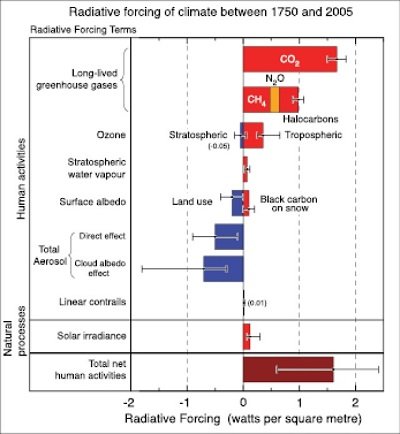
Well, this thread might omit things like milankovich cycles and I'd be surprised if climate modeling includes it - after confirming it is insignificant at the time scales they work with. Climate science doesn't focus only on CO2. But it is the biggest forcing, second only to the atmospheric aerosol pollution that masks a large part of how much we've been enhancing the greenhouse effect. In their role of advising the likely climate consequences of economically significant activities climate scientists are right to make CO2 the headline act - without neglecting the others - (a bit old, but.. Given the dominant role CO2 has in current warming, it's propensity to exceed the capacity of vegetation and ocean carbon sinks and accumulate, along with the susceptibility of carbon sinks to stop being sinks and cross tipping points to become sources aka carbon feedbacks (aka CO2 driven warming preceding rising natural releases of CO2) it is right for policy making to give it high priority. It is not the greenhouse potential of relevant atmospheric gases that is presenting challenges for improving climate change projections. In that sense climate science is a lot less about CO2 as about the internal climate responses and feedbacks. The overall, ongoing gain of heat in air, land and water is not in doubt. It is clearly evident, eg in the ocean heat content data, so "no change" has stopped being a valid null assumption. How that heat gain plays out in terms of the weather and climate we experience is challenging climate modelers; itmay be hard to pin down precisely but climate models are doing it more than well enough to on with.