Ken Fabian
Senior Members
-
Joined
-
Last visited
Everything posted by Ken Fabian
-
@arc Are you attempting to explain away global warming without the greenhouse gases or other human influences? Any expectation that you have done so in your presentation here seems naive. Gavin Schmidt quotes are out of date - saying 2023-24 is unexplained is out of date. Studies have been done since then that suggest it maybe shouldn't have been so surprising. Hindsight is like that. I'm fairly sure 1997-98 and 2015-16 seemed unexpected and inexplicable at the time too. An el Nino ENSO state, above average extra-tropical heat, in part from reduction in NH tropospheric sulfate aerosol cooling (less pollution from cleaner shipping fuels) and some reduced cloud cover (in part from less of those aerosols). And the continued accumulation of global warming since the last record breaking year explain it. The big Tonga eruption did less than expected. The aerosol cooling is not a good thing, especially not when tied to ongoing fossil fuel burning and CO2 emissions - it masks the full extent of how changed the climate system already is and whilst that cooling effect stops when the fuel burning stops the warming from raised CO2 persists. Emerging studies are showing acceleration in the underlying rate of global warming - in hindsight looking like the underlying rate of warming had already increased in the decade leading up to 2023. but was not incorporated into expectations. Acceleration of global warming isn't unexpected - the opposite - just hard to identify at close range. If you are hoping for a point by point response to your post... not me. We know what the drivers of climate change are and it isn't changes to solar magnetic energy. 2023-24 was a surprise at the time but not so much of one in hindsight. My own view is the science based understanding of Earth's climate system is a jewel in the crown of human achievement; that we appear to have largely squandered decades of the priceless window of opportunity that climate science has given us - opportunity to decarbonise our ways - wasn't and isn't the fault of climate scientists or their communication. Governments commissioned the science agencies and studies in order those in Office make informed, appropriate policy decisions. Perhaps naively I think those holding such Offices have duties of care; the reality of extreme negligence, with malice aforethought, is deeply dismaying
-
@exchemist I seem to recall suggesting precursor chemical rich meteorites impacting in shallow seas and near hydro thermal vents might be significant to abiogenesis in another thread - but I'm struggling to find my older content in this version of the forum. Whilst that occurred to me independently I think it seems kinda obvious - over hundreds of billions of years such coincidences become more likely than not to happen.
-
Sounds unsurprising to me. Already existing air and water borne micro-organisms (and macroscopic ones too) will very rapidly re-colonise a disturbed environment. A meteorite creating a hydro-thermal vent system where none previously existed is more interesting but wouldn't there would have to be hot rocks or magma there? An existing aquifer but no surface vents? Would the existing underground water have life in it? I am imagining shattering of rock strata that allows water to flow where it hadn't before, releasing and extending existing aquifers (which may have inflows of life-contaminated water from elsewhere) or perhaps a crater would be a catchment for rain that carries microorganisms down the vents, even creating a new aquifer where none had existed in hot rock.
-
Showing scientists get something wrong doesn't mean all science is wrong, just that that specific thing is wrong. I think they need to provide examples of science being wrong that have not been challenged by scientists and faced correction rather than a history of poor science being challenged and corrected. The infectious agents (germs) example is especially weak; it didn't replace wrong science, it replaced miasma, humors, God's punishments, karma. ie superstition. Granting the possibility a widely held science based understanding could be wrong as a means to identify error is an error correction methodology but that kind of skepticism can only hold the possibility of 'wrong' as a hypothesis; it is not the same as knowing (demonstrating with evidence and reason) that it is wrong. There are areas of science where uncertainty is high and there are competing hypotheses - science as a work in progress. There are areas where there is no real uncertainty; the confidence is that high. But the very willingness to subject existing scientific understandings to challenge can be seen as lack of confidence, ie a state of perpetual uncertainty. Not that I think there is much successful arguing with religious devotees using evidence, logic and reason; they will be hard pressed to provide evidence the fundamental nature of the universe enables supernatural phenomena and will reject evidence, logic and reason that conflicts with their dogma. And their dogma may not allow admissions of 'wrong'.
-
They need to demonstrate the reality of their supernatural stuff - and/or of the universe having a fundamental nature that enables it. But don't expect such minds to be changed with evidence and reason. Examples of 'science was wrong' from nearly 2 centuries ago - haven't they got something more current? - are examples of scientific methods working. The disease example was not even a case of an existing science based understanding being shown to be incorrect - Miasma and Humors, God's punishments and Karma as causes were never science based. It took an improved and demonstrably more correct understanding for the previous incorrect 'knowledge' of how diseases work to be deemed wrong and abandoned. If they can show a specific science based understanding is incorrect then they can claim that one is incorrect; it doesn't work as a way to reject other unrelated things, let alone reject scientific methodologies entirely. Claiming the supernatural stuff 'proves' science is wrong is kinda weak when they can't demonstrate the supernatural stuff.
-
I was thinking that was a shallow dive and I'm not equipped with scuba... those waters run deep and aren't quite as cold as ice (apologies to JJ Cale fans). Warming Southern Ocean water appears to be the greatest driver of ice mass loss via under-melt of those ice shelves (the main cause of thinning) and subsequent loss of 'buttressing' increasing glacier outflows. Direct surface air temperature warming with surface melt flowing down to glacier base and 'lubricating' (lifting the ice base above the underlying ground - another variation of loss of buttressing - where ice flow is less impeded) - seems less of a factor there than for Greenland. The Arctic including Greenland does have much greater Surface Air Temperature rise than Antarctica - than anywhere else. Greenland will be getting under-melt of ice shelves in addition. Without diving as deep as this deserves - Antarctica is more isolated from the rest of the global climate system than anywhere else, not only because the Southern Hemisphere has more ocean and is warming a bit slower than Northern but from that huge surrounding buffer of Southern Ocean. From the linked Nature article it sounds like that loss of buttressing and raised glacial outflows is effectively irreversible even (if it were to occur) with persistent increase in snowfall; the lag between snowfall increase in the catchment and glacier outflows will be too long to affect the near term acceleration of outflows - and it will take a LOT more sustained snowfall to keep ahead of that. The possibility that warmer Antarctic air temperatures would result in greater snowfalls (and rising Antarctic ice mass) did seem a realistic possibility to earlier scientists but reality is not heading that direction. Some regions are indeed gaining ice mass but others are losing more. I still expect Antarctica to throw up some surprises.
-
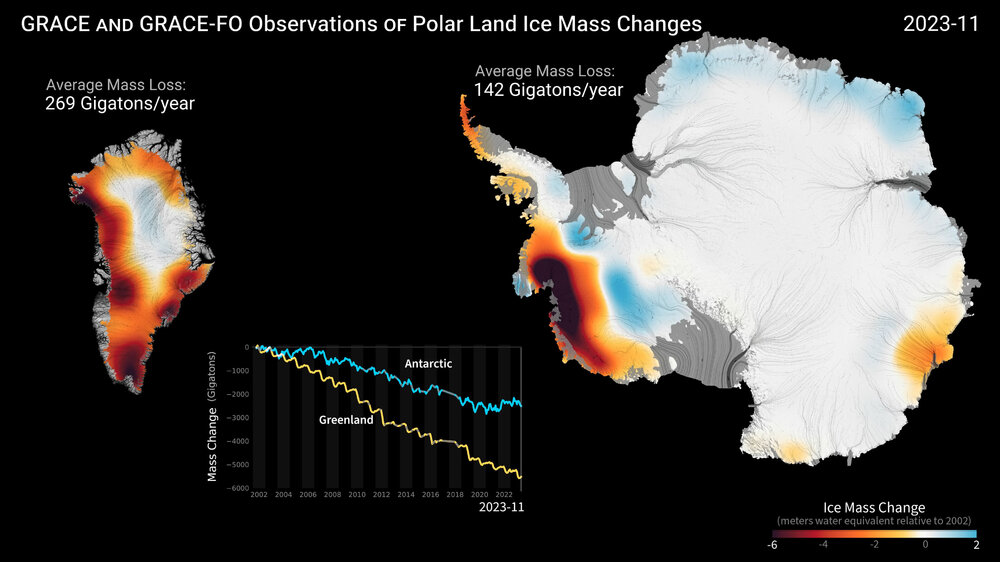
There has been no overall 'accumulation at a steady pace', only a few years of rebound within a longer decline, that in very unlikely to persist. Antarctic ice mass has been declining at an average of around 140 Gigatonnes per year since Grace satellite measurement began in 2002. https://earth.gov/sealevel/rails/active_storage/blobs/redirect/eyJfcmFpbHMiOnsibWVzc2FnZSI6IkJBaHBBc2dKIiwiZXhwIjpudWxsLCJwdXIiOiJibG9iX2lkIn19--cb8a3a0bbedbda841e308fad122db622593644ac/ais_gris_with_vel_i_200204-202311_2160p25.mp4?disposition=inline Yes there has been some rebound in ice mass since 2021 from some years of higher than average snowfalls. Ice mass loss is effectively the difference between snowfall and glacier discharge and there are a lot of factors in play.. Ice shelves are glacier/ice sheet discharge. There has been a trend of ice sheet thinning and loss of underpinning contact with seamounts, resulting in acceleration of ice flows from the loss of buttressing. https://www.nature.com/articles/s41586-024-07049-0 Sea ice is frozen seawater and isn't a factor for sea level rise.
-
I think re-vegetation has many benefits including contributing in some ways to climate solutions, but I am not convinced your maximum growth mono-culture with coppicing and pyrolysis for making chars or poles model is viable at large scales. Which isn't the same as opposing doing so - best wishes to those who try - but I don't see how it can be economically viable or necessarily the best use of resources - land, human and economic. I think it will fail for poor economics. It isn't forest restoration - which might plant as many as 100 seedlings with the intention of achieving one long lived forest giant a century later. Mostly restoration excludes harvesting. I think funding restoration via taxes is more popular (but probably still not popular enough) than funding forest farming, that can be expected to be financially self supporting. The biomass recovery aspect happens quite well without human intervention; simply taking away the grazing livestock will do result in re-vegetation, if not growing from surviving seeds in soils (where de-vegetation is relatively recent) then by wind and animals bringing them. Cost-wise I suspect that will add global biomass the cheapest and easiest, but won't be restoration and still needs to limit harvesting to maximise biomass retention. Your way seems very labor and equipment intensive. Cool burning of forest understory can add char to soils. with much less labor and equipment. If not using the output of gasification for energy it becomes polluting, as 'smoke' or becomes waste heat and CO2 - which, yes, gets 'recycled' by subsequent plant growth. If used for energy it seems to require a lot of dedicated made-for-purpose equipment; I know people who've tried to build such systems - eg converted ICE generators running off gasifiers - but none have worked well or stood the test of time. At larger scale, one local example exists, primarily for making bio-char as a soil additive and does tap 'emissions reduction' funding but not sure it is cost effective without that or is suitable for massively scaling up. As someone with solar panels on roof with home batteries and have found it easy, versatile, reliable and convenient it is hard to see gasifiers as a better alternative. Carbon Offsetting and CCS funded by levies on fossil fuels depend on extracting and burning fossil fuels for ongoing funding. which isn't a climate solution. Or it must be taxpayer funded. Both ways are fiercely resisted. I don't think it is a waste of time but I don't see doing it your way is going to scale up and become widespread.
-
@worldwoodproject For climate and emissions purposes there look like 3 ways involved - permanently increasing global average biomass by re-vegetation of areas with little vegetation, by using pyrolysis/gasification products as sustainable bio-fuels (trees drawing down CO2 and releasing CO2 by the burning the gases produced and what is used by the pyrolyzer) to be drawn back from the atmosphere again, over and over in a sustainable way and third, by adding chars/charcoal left after gasification to soils. Increasing global vegetation to achieve a permanent increase in global biomass helps, but it tops out and stops being a carbon sink over time ie cannot continue to draw down CO2 indefinitely; there will be finite land area suitable, they will be susceptible to weather and climate and fire, and susceptible to changes to land use and carbon 'sequestration' policies. It makes no income in and of itself - rather, it requires external funding. It seems likely to have high labour and equipment requirements. Who pays for it and what the pay and conditions for those employed will be is going to matter; poor people deserve better than to be exploited as cheap labour. The chars can be added to soils but that too is likely to get diminishing returns and have high production and distribution costs. And perpetually taking from some areas and spreading the chars in others seems likely to have longer term consequences to vegetation health. My own view is that at best such 'emissions reductions' apply to land use sector practices and do not in any way 'offset' fossil fuel emissions. When a new, higher global biomass balance is achieved it stops doing even that much - and getting there looks more like a sustained recovery of biomass lost to land clearing and forest harvesting than reducing the climate problem. Without the cessation of fossil fuel burning any 'reductions' in CO2 are going to be overwhelmed; no matter that there appear to be potential for large stocks of locked up Carbon, ongoing flows have to stop. Forest biomass as sustainable biofuel, using pyrolysis/gasification probably does have some uses, but I suspect more as forest fire risk management, gasifying dry dead vegetation as an alternative to burning it in place. And I think it won't compete as an energy source with much easier, cheaper energy like solar PV - that once in place require low levels of ongoing maintenance; gasifiers have to be fed and maintained on an ongoing basis.
-
Sounds like operating those trains has already been happening (since 2018?). A diesel-electric converted to battery-electric rather than full electric (pantograph or electrified rails) to batteries - which is being done elsewhere (in Europe iirc) - was being done even before climate and emissions concerns, simply as the cheaper alternative to electrifying tracks between electrified sections. Better batteries, faster charging seem possible now. I think such solutions will work well for railways. For freight I expect swapping dedicated battery cars (or swapping container - without the shunting) would be an alternative to recharging on-board batteries. Rail corridors could also host a lot of solar - although transmission means locally isn't necessary a great advantage.
-
Having populist vote driven micro-managing when voters have no direct duties of care or accountability for their decisions/choices, have no obligation to be well informed and little or no skills in analysis and planning, where media have no overarching obligation to truthfully and accurately inform, let alone comprehensively inform does not sound workable to me, let alone an improvement. And commercially run news services can and do have self-interested political bias, for their own business interests as well as the interests of their principle customers, their corporate advertisers whom they seek to please for the sake of their shareholders. Their principle business model is very often inducing viewers/listeners/readers to buy what they don't need on behalf of those customers, to set aside deeper considerations in favour of immediate and superficial indulgence and pressing people's emotive buttons to get views and clicks and to influence their opinions. As poorly performing and subject to undue and corrupt influence as many governments and court systems are populism making things worse is far too easy, whilst making things better by good governance remains hard work and rarely fully appreciated. The remarkable thing is the extent to which many of our political representatives really do try to do their best.
-
An illusion; the complexity and capabilities of the underlying industrial economy has to grow to make that possible. Large scale economic demand makes investment in advanced mass production possible - that makes low unit prices possible. A lot of R&D and long running investment is needed to develop new technologies and a lot of that is indirect, ie having a variety of advances across multiple industries for a variety of reasons, which can be turned to new purposes. Overall large size and continuing growth of such economies makes that more likely. None of it happens in isolation; model T Fords didn't arise until metallurgy was making more consistent steels and alloys, as bar, sheet, tube etc of higher and consistent quality and selling it in large quantities and cheaper. Workshop machinery of better quality and capabilities and less cost were being manufactured and marketed widely. The marine and railway sectors probably drove a lot of that. The supporting, enabling economy and infrastructure has to be there. That is not present on Mars.
-
It doesn't seem more ethically problematic than what is done routinely to convicted criminals to me - which often includes physical and psychological torture as well as forced labour. It is usually intended to teach a lesson ie change thinking and behavior in ways not so different than A Clockwork Orange - ie crude and unscientific application of aversion therapy. In some cases that works, although I think it sometimes makes future behavior worse. In some jurisdictions agreeing to undergo some kind of behavior changing therapy is an alternative to imprisonment or gets reduced sentences. It may be presented as a choice although perhaps too often of the can't refuse sort of volunteering. Pre-emptively gets more ethically problematic but criminal justice systems have never been much concerned with the ethics of criminal justice systems.
-
I can't see this working - it takes an advanced industrial economy to make advanced machinery. Robots and machines more advanced than anything in current use will be even harder to make. What materials are needed? How many mines, refineries, factories and roads, railways, power stations, power grids to produce them? Can they build those before they break down or wear out? We don't even know if (just one example) any usable copper deposit exists on Mars. Copper refining can be amongst the least complex (in an oxygen rich atmosphere and availability of fossil fuels or bio-fuels) but it is still no simple matter. A lot of different minerals and mines and refining and manufacturing processes would be needed for a complex robot. Robots that eat dirt and shit out refined metals might make interesting stories (Benford's Galactic Center SF stories come to mind) but it takes extraordinary imagination. One thing for wealthy AI robots on Earth with a healthy bank account to order tools, workshop machinery, materials and parts online from competitive suppliers - seems unlikely enough - but making all those themselves in a desert far, far from any specialist suppliers? Specialist suppliers only exist because economies are very large and markets, even for specialist items, are large enough to support them.
-
This sounds wrong. Changing the angle a laser pointer is aimed changes where it hits - it isn't moving the position of the laser pointer that is important. If you move it across and keep the orientation angle exactly the same - parallel - where it hits will move the same amount. But change the angle a laser pointer is aimed and that changes where it hits even without moving it. However the idea that changing the direction (not position) of an asteroid is moving a small amount when it is far away will change where it hits by a lot is correct. Ongoing efforts for identifying and tracking asteroids/comets with potential to hit Earth continue - at least so far, don't know what Trump's interventions will do to that. NASA has been aiming to find every object of sufficient size and orbit to do serious damage. Nothing dinosaur killer sized within the solar system represents a threat - those objects are big enough to find relatively easily and have already been identified and their orbits determined. It is the ones not that big but big enough to do serious damage, that exist in large numbers. that have not all been found. Identify them, track their orbits and we can have a lot of advance warning. Something coming from outside the solar system would be much more difficult; they seem likely to have higher velocities than any solar system objects, making the damage they can do greater. Those would be the most difficult to do anything about because of very little warning time between seeing it and hitting, whereas those within the solar system have orbits around the sun that can be determined a long way in advance. That gives a lot of time to prepare and act. Early warning is essential and something interstellar probably won't give it. Fortunately those appear to be very rare. Dealing with asteroid/comets seems to require either deflection - changing the trajectory - or explosively dispersing them. You can't do the latter too close or the cloud of debris will still hit and it won't require the pieces to be large to be dangerous and damaging; a whole lot of small pieces hitting the atmosphere will heat it up. But a few weeks away is a long way. Done far enough out very little will hit. (It is thought the Chicxulub impact threw huge amounts of debris into space and it rained back down and that caused so much atmospheric heating that it set forests on fire even around the other side of the world, just from radiant heat.) Deflection of an object can be done by throwing mass at it (like the Dart experiment). This can work by adding momentum in the direction of the impact, but also, with high enough velocity impact, explosively throwing material outwards from the impact site, ie sideways to the direction of the hit. (If I understand correctly a lot of the energy converts to extreme heat and the effects of that are independent of the direction of the impact.) Deflection can be done by rockets - either pushing directly or 'gravity tractor' style, which keeps the thrust at what is needed to balance with the gravity. The gravity of the rocket itself pulls on the object but needs to have a lot of mass to do much. If has a lot of mass it needs more power. Given that moving anything around in space typically uses a lot more fuel than payload fueling rockets to push or pull something very massive is logistically problematic. Proposals for 'mining' the object and shifting mass to the rocket have been suggested but I am doubtful. But I am doubtful of the effectiveness of using rockets to change any dangerously large object's trajectory, whether pushing or pulling. A mass launcher and robots loading rocks into it, throwing them out to space would be another hypothetical option. But without a very long time to work that too seems unlikely to be effective to me. There is pushing with explosive detonations that throw material outwards without blowing the object to piece and the use of explosives to shatter and disperse. Radiant heat and light from a nuclear detonation above the surface can be expected to cause 'outgassing' that will impart a push as well. One thing human ingenuity has been good at is explosive detonations and delivery systems. I'm inclined to think this will deliver the best results; nuclear explosives can deliver more energy for the payload than any other option. A solid mass of nickel-iron will probably resist explosive dispersal whereas it may work with 'rubble pile' type objects.
-
@studiot Not knee jerk - my initial comment may have been (off the top of my head and not researched) but after some looking I'm not convinced it has been shown to be wrong. Mars gravity is a lot less than Earth but isn't zero/microgravity; there is no actual experience to go by for that, even with mice, rats or other animal models. Even floating in water or suspending someone by a harness to take weight off legs does not fully mimic low gravity, which will have other effects, including on internal organs and blood (and lymph?) circulation. I note that just maintaining bone health in zero gravity requires serious persistence at resistance exercise - and can only slow deterioration. Without a spinning orbital habitat to mimic Mars (or moon or other) gravity the effects of partial gravity the medical outcomes remain speculative. Not the same as Mars gravity but in zero gravity some mice were tortured surgically given broken bones to see how they heal - and had worse outcomes than on Earth (even before the 'euthanasia' bit). The Effects of Spaceflight and Fracture Healing Another source (the source paper "Fibular fracture healing in a chronically unloaded condition is impaired when compared to the healing response in a weight weight-bearing condition") has a broken link (something becoming more common for US science sites) but I came across this quote from it, (possibly derived from the same experiments in orbit?) - Not Mars gravity but given the vast array of medical problems (besides bone breaks) it seems very possible, even likely that some may get benefits exceeding the harms - but I think it is getting ahead of ourselves to claim it as fact.
-
@studiot The 38% figure isn't mine but seems correct for Mars gravity vs Earth. Better recovery outcomes with gravity? I admit where that came from was subjective and anecdotal rather than researched and referenced - based on my experiences and those of people I know. The sooner you can be back on your feet and are active the better the recovery seems to be the more usual post op medical advice. Where it is not there will usually be some options, like specialised beds, use of pools for exercise or other kinds of supporting devices - including that amusingly named 'anti-gravity' treadmill that looks like it suspends you by your waist to take weight off the legs. But, yes I grant there may well prove to be advantages to some kinds of medical care in low gravity in some cases, if that were an available option ie been tried and tested. And the travel to space is less like an extended extreme amusement park ride, ie not traumatic. And not hugely expensive.
-
I'm like Pinball - the gushing commentary, the dramatic music, the paucity of much that is new or interesting to me (having some long running interest in human evolution, I've read a lot) combine to make these kinds of doco's far more irritating than enlightening. That I don't watch much TV/video at any time and generally prefer the written form when I am seeking 'informative' might be contributing cause for inability to keep on watching. My feet are the wrong size for these shoes. I couldn't persist and we didn't get summary of the salient points so I don't know how well this one informs or inspires those starting from ignorance.
-
Isn't it the other way around? Taking away the resistance of being active in gravity leads to worse health and recovery outcomes. You would want to be in very good health to attempt a trip to Mars - and you will arrive in poorer health after that trip. Not sure of it, could be wrong, but I thought the less stressful/easier on the body/aging more slowly meme was something Robert Heinlein came up with in his "Man Who Sold the World" story and it got taken up by other space optimist SF writers - the 'whatever it takes' space mogul determined to reach the moon started claiming people would live longer in low moon gravity to help promote his space program - an appeal to older rich people who had money to invest - not because it was true but because no-one knew what prolonged low gravity would do so he could say it because it might be true. But the whole Mars colony thing is science fiction - fiction being the important word. (But it might be true). It seems to appeal to a primitive human urge to seek out new, resource rich lands in times of stress and trouble... and conquer them. A rerun of European colonisation. And perhaps you too can become a Founding Father. Except Mars isn't resource rich, it is the antithesis of resource rich, a global wasteland. Earth is littered with the remnants of failed dreams in the barren places - and none of those were anywhere near as harsh and as barren as Mars. We don't even know if the great many essential mineral ore deposits an advanced industrial economy (the barest minimum for survival) even exist on Mars, let alone economically viable and accessible to any colony site. There are worthwhile things to do in space and some are very ambitious - the capability to divert big asteroids or comets on collision course would be good. Much better to save Earth for everyone like that than build a bolt hole on Mars for a few and letting Earth die.
-
Here in Australia we have to participate - it is our civic duty and a legal obligation. But that obligation is to turn up at voting place, get issued with and put ballot papers in the appropriate receptacle or submit mail in ballot papers - at the risk being fined if not. We do not have to fill out the ballot papers (equivalent to "I don't know" or "I don't want to") and staff at polling stations are explicitly NOT permitted to look to see whether you have. Rude remarks or drawings are not unknown along with 'donkey votes' - what we call simply numbering the candidates in the order they appear on the paper, a small advantage to candidates at the top and a valid vote nonetheless. Only a few percent of votes are ever invalid, ie most people do vote. Specific ballot papers are numbered as they are passed out but cannot be linked to specific voters; names on the electoral roll get a strike through line at the time, but which voter got which one is not recorded, nor is the order they came and voted. We also have ranked choice voting, where the candidate with the least votes gets eliminated and their ballots are recounted with their second choice. And around again until one candidate gets more than half the valid votes. None of this is a cure for voter disinterest and being uninformed or misinformed. Pressing people's buttons on one issue whilst downplaying other, often more significant issues remains an effective way to induce voters to vote against their own best interests.
-
@studiot No, the emissions still get counted where they happen, where the fuels are used. Australia's policies in practice give support to renewable energy domestically - more get out of the way of a solar boom already happening and taking credit - in parallel with giving support to apparently unlimited expansion of fossil fuel extraction as long as it is for export. With gas there are big and problematic production emissions, which are counted as Australia's, especially from low grade raw gas high in CO2 that has to be got rid of, for which there are a lot of CCS promises and carbon offsetting and accounting games with land sector emissions that fluctuate hugely) to maintain a pretense that Australia's emissions are declining in line with climate commitments. This is from the 'side' that presents as committed to Net Zero - the conservative side is currently regrouping after election loss and busy working out new ways to better present and market opposing and obstructing climate action and renewable energy. Call me cynical. @sethoflagos I could be wrong calling it virtual spinning inertia but the Hornsdale Power Reserve battery trialed a virtual machine mode for providing inertia. https://arena.gov.au/assets/2023/09/HPRX-VMM-Modelled-vs-Actual-Report.pdf My understanding it does now provide that service and how well it does being assessed although the grid operator is not yet ready to green light that in place of synchronous condensers. Nor yet prepared to create a market mechanism for inertia services; I think virtual inertial does involve holding back some storage and inverter power in reserve, ie does represent a cost to battery operators, as does for syncons and I suppose for FF plants. I think it is just a matter of trials proving it works, and overcoming any problems that emerge.
-
Seems to me newborn crying would provide early training in paying attention for the parents, especially mothers. Achieving the sort that goes right up the spine is probably getting it right. Not using it unnecessarily has to be learned.
-
Heading in the right direction. China's coal use peaking 5 years earlier than their 2030 commitment under existing international agreements has to be a good thing if it turns out true - their commitment to push ahead with economic development, lifting hundreds of million people out of poverty was why/how ongoing growth of coal use up to 2030 was justified, with nations like my own (Australia) happy to go along with that to sell a lot of coal - which emissions don't count against Australia's. All well short of what the global warming problem really requires but better in some ways than expected and a lot better than nothing but it does look like lots of people are being lifted out of poverty along the way - a greater good that unbridled capitalism rejects as their job and seems to oppose in their governments. The very large scale construction of not-fossil fuels the transition requires seems to be the necessary precursor to emissions starting to go down. It does appear that ongoing emissions reductions depends on renewable energy is being taken up preferentially primarily because it delivers least cost electricity rather than for the low emissions although high populations and coal energy has serious pollution issues beyond CO2. Ultimately not good enough but still looks like we are in a better place to do more than the gloomy doomist pundits defending going slow and doing nothing radical insist. I do think that introducing lots of solar and wind ends up bad for the economics of coal electricity - eating it's lunch so to speak, making it harder to recoup costs because more hours each day coal power doesn't make money yet cannot turn off. They end up competing outside those times with more flexible generation and with battery storage that is the most flexible of all - able to go from high levels of discharge to charging in milliseconds. As well as providing voltage and frequency control and virtual 'spinning inertia'. And then there is pumped hydro. I don't know that all the challenges of managing very high RE grids are fully worked out - I suspect for example we may need better, dedicated low latency data networks for system monitoring and fine control.
-
@CharonY PS - It may not be correct usage but I think 'species' is an arbitrary concept, versus shared traits as evidence of ancestry - homology that applies to clades - that looks sound. Clade - a grouping of organisms with a common ancestor and all of its lineal descendants.
-
I could be wrong about the term - my understanding is that a morphology shared by all members of a clade would be considered homologous - thereby showing ancestry in common - and that this would apply within a species. It may be a different term within a species - a fixed trait maybe - versus sub-species variants. I may need to re-read and refresh.