
DanMP
-
Joined
-
Last visited
Posts posted by DanMP
-
-
1 hour ago, swansont said:
How does DM form a system? Now you need two particles, you have to have an interaction to form the bound system, and you have to be able to virtually absorb photons but not have resonant absorption or dissociation, and you need electromagnetic interactions.
5 hours ago, DanMP said:Don't ask me how, because it's like asking Koch when he just discovered bacteria about its DNA. Take it as a definition of my model. Let experimental tests I proposed to decide if the model is good
4 hours ago, Mordred said:the refraction angles (emission of photons will be frequency dependent on an equivalent refraction index.
On 11/23/2024 at 5:50 PM, DanMP said:Quasi (or failed) absorption immediately followed by re-emission is not scattering. The definition of scattering is: "the process whereby a beam of waves or particles is dispersed by collisions or similar interactions". There are no collisions ... and the change in direction at re-emission is very limited, because the time between quasi-absorptions and re-emissions is too short. Normal matter, as opposed to DM, can form atoms and molecules, structures able to use (actually absorb) the photons if the photon energy is the one needed by the electron to "jump" to a higher energy level. So, the time between quasi-absorptions and re-emissions is longer, giving the time for the electron to move around (Bohr model) and emit in other directions than the original. The time needed to "decide" if the photon can be used depend on its energy, therefore light/photons travel at different speeds in transparent materials and the refraction is energy/frequency dependent
For DM particles, as I wrote above (see especially what I underlined), the photons "inside" time is very very short and the same for all frequencies, unlike the "inside" time for atoms and molecules. So, the index of refraction in DM gas is the same for all frequencies. No different speeds and no "rainbow" at the refraction responsible for gravitational lensing. Also, the change in direction (dispersion) is very limited.
I'll be busy next days, so I won't be able to reply for a while.
-
19 hours ago, swansont said:
No, but that might just be an issue of imprecise terminology
Exactly (thanks), I just tried to describe what is happening.
22 hours ago, swansont said:There are absorptions to virtual states which accounts for light slowing down in a medium, but that presupposes a composite system like an atom, so there are real absorptions possible as well, and an electromagnetic interaction
I know it sounds silly, but I consider the DM particle as a very stable "system". When a photon gets in, the particle/ system becomes unstable and promptly "spits" the photon out. Don't ask me how, because it's like asking Koch when he just discovered bacteria about its DNA. Take it as a definition of my model. Let experimental tests I proposed to decide if the model is good.
19 hours ago, swansont said:If I measure the speed of light with the spinning mirror method, there’s nothing in that apparatus that relies on the speed of light being what it is, or on the interactions happening at c. The mirror spins at some speed, whose value is not critical to the experiment. Everything else is static. If c changed, nothing about the apparatus is affected
You need a clock to measure the mirror speed. So it's not much different than the Fizeau apparatus in the opening post.
9 hours ago, Markus Hanke said:This is my main point - kinematic time dilation is solely a function of relative velocity (ie it doesn’t matter where and when the experiment is performed), whereas the density of your proposed DM gas is at a minimum a function of position and time. So I don’t see how you can meaningfully relate these two.
You obviously didn't read what I wrote 6 years ago. I explained/proposed that, in the Hafele-Keating type experiments, kinematic time dilation is caused by the movement of the clock through Earth’s DM gas atmosphere, the reason being easy to explain with a light clock (the original use of the light clock). So, in very high orbit, where the instrument/clock can be surrounded by its own, comoving, DM atmosphere, there is no movement of the clock trough DM gas, hence no kinematic time dilation. Simply to detect but/and never attempted.
-
10 hours ago, Mordred said:
what is known as scattering
Quasi (or failed) absorption immediately followed by re-emission is not scattering. The definition of scattering is: "the process whereby a beam of waves or particles is dispersed by collisions or similar interactions". There are no collisions ... and the change in direction at re-emission is very limited, because the time between quasi-absorptions and re-emissions is too short. Normal matter, as opposed to DM, can form atoms and molecules, structures able to use (actually absorb) the photons if the photon energy is the one needed by the electron to "jump" to a higher energy level. So, the time between quasi-absorptions and re-emissions is longer, giving the time for the electron to move around (Bohr model) and emit in other directions than the original. The time needed to "decide" if the photon can be used depend on its energy, therefore light/photons travel at different speeds in transparent materials and the refraction is energy/frequency dependent.
6 hours ago, Markus Hanke said:we know that DM, if it exists, cannot be evenly distributed - it must be more dense in some regions than in others in order to match observations, so we’d see differing time dilation effects in different regions/directions, which we don’t.
DM gas atmosphere, like any atmosphere, is denser near the massive object it surrounds (like stars, planets, black holes) and, going upward, gets less dense. The gravitational time dilation is therefore greater near the massive object and smaller as we go up. No contradiction with reality.
6 hours ago, Markus Hanke said:all types of clocks, irrespective of their internal mechanisms and composition (or lack thereof), display precisely the same time dilation under the same circumstances.
They are all equally affected. Please read my explanations for the invariance of the speed of light in vacuum posted 6 years ago. I really have not enough time to write/explain everything again. When I'll have time, I'll try to cover/explain what I didn't.
-
6 hours ago, Mordred said:
DM doesn't interact with the electromagnetic spectrum so doesn't interfere with photons
That's well known so how would it affect c in regards to any test using photons ?
In rhst regards any far field test using stellar objects would have intervening DM and we do not see any evidence of scattering due to DM.
So any link I included using any methodology of far field stellar object examination is also testing any intervening DM.
Believe me I wish DM would scatter or influence photon path it would be far easier to detect
If you read what I wrote 6 years ago, you understand how. In short, I proposed that light, actually the photons, travel through both ordinary and dark matter, by quasi-absorptions quickly followed by re-emissions. DM particles never really absorb photons, so the tiny delay of each such interaction is the only effect (in fact this causes one more, a refraction, responsible for gravitational lensing). I initially used this idea for ordinary matter, successfuly explaining (with math and all) the Fizeau experiment and the Sagnac effect. You should read what I wrote 6 years ago ...
4 hours ago, swansont said:H-K does not show a preferred inertial frame
Maybe, but the Earth centered non-rotating frame is the one we usually choose (although the clocks at rest in the dragged frame would be the fastest ... while rotating - with respect to distant stars - and having centripetal acceleration ...).
5 hours ago, swansont said:Now it’s my turn to say you didn’t read/understand what I wrote.
Ok, I admit I didn't quite understand, so please elaborate. Also, my questions, even seemingly unrelated, still stand.
5 hours ago, swansont said:How does it slow light if there is no E-M interaction?
See the beginning of this post.
-
1 hour ago, Mordred said:
Or did you not notice for an example the experiment done in space and quite frankly if you do a Google search you would find related equivalence principle experiment done on the moon.
So don't tell me the effort I took is uncalled for or does the simple detail experiments are constantly being performed in dozens of different methodologies elude you.
I really appreciate you and your effort to find and offer links to interesting papers regarding relativity, but after following at least 3 of them, I realized that you didn't notice the requirment to prove/disprove my DM gas theory. We need to measure the time in a very high orbit, in a place where the Hill sphere of the instrument/satellite is large enough, because otherwise the instrument/satellite cannot have it's own DM atmosphere. If/when the instrument/satellite has it's own DM atmosphere, the kinematic time dilation dissappears, because the instrument becomes static in relation with the DM atmosphere surrounding it. That's it. It is a simple, powerful experiment, and it was never done. When there is no own DM atmosphere, there is absolutely no reason to disagree with GR.
As for the Moon and other distant celestial bodies, like stars, we only have indirect measurements, redshift observations, and the redshift is caused by many different things, besides kinematic time dilation. It is impossible to exactly tell how much of it is from kinematic time dilation. Also, the observations are flawed by the fact that we obtained our data considering the kinematic time dilation as existent. And, when the data disagree with our theory, we usually add a peculiar velocity ...
-
Edited by DanMP
15 hours ago, Mordred said:All the above clearly show that we are constantly testing c and Lorentz invariance those tests never stop and were constantly seeking higher precision tests. So nothing you have suggested above is new or hasn't been thought of already. In point of detail Modern tests have far far greater precision than what you have above
You obviously didn't read/understand what I wrote. I presented a thought experiment (there is no actual Fizeau apparatus) aiming to show why the speed of light in vacuum is invariable, not to deny it.
The title of this thread is wrong/misleading. It should be: "A thought experiment meant to show that c invariance and gravitational time dilation are caused by a dark matter atmosphere". Being now in the speculation forum, I can be less subtle.
Let's try again. In a box we have an imaginary device that is sending a pulse of light towards a mirror and receives the pulse reflected by the mirror. In vacuum, the total time from emission to detection is exactly 3 nanoseconds (as explained in the first post). The light clock is "ticking" exactly 3 times. The atomic clock situated on the same table agrees.
Now, we introduce a gas in the box, a gas that is not detectable (like DM), but makes the light travel slower, exactly as any known gas would do. The light clock would still tick exactly 3 times (3 ns) for a round trip of the light pulse in the measuring device, so, for the people in the box, the speed of light in what they think is vacuum, is invariant.
The atomic clock would measure more than 3 ns, and everybody is wondering why the speed of light in what they thought is vacuum, is decreasing. Not knowing about the DM gas, they declare that the space is warped, and this is what GR pretends to happen in the regions where in fact light is traveling slower due to the increase density of the DM gas.
In real life, the atomic clock is also affected by the DM gas, because, being made of extremely tiny particles, the DM gas cannot be contained. So, if you measure the speed of light in "vacuum" at the sea level, you get c, but only if the clock is also at the sea level, at the same DM gas density. If the clock you use is on a mountain top, at lower DM gas density, you obtain a value lower than c for the sea level speed of light in "vacuum".
14 hours ago, swansont said:You can devise experiments that don’t rely on the value of c to determine c, so I’m not sure why this matters.
You know any thing or device that can be used to measure the time and is not made of parts held together by a force that is transmitted similar with the light in vacuum? Even if you know one (the muon?), how can you be sure that the proposed DM gas has no influence?
14 hours ago, swansont said:And “maybe it’s air density” is not a rigorous objection without a model of how it should depend on air density.
You obviously didn't read what I actually wrote:
21 hours ago, DanMP said:This may suggest that an atomic clock situated at a high altitude (top of a mountain), where the air density is lower, is ticking faster than a sea level clock (as in gravitational time dilation) due to air density. Of course, this is not true, one reason being that there is no air inside the atoms of the atomic clock (the air is made of atoms and molecules, too big to get inside other atoms and molecules).
Read what I underlined. I wrote that it's not true and I presented one reason (there are more). So, your comment, although good and interesting (thanks), was uncalled for.
7 hours ago, Eise said:At the moment, we only know of 2 phenomena that have exactly that speed: light and gravity.
So, the electromagnetic force acts/propagates slower than light in vacuum?
6 hours ago, Markus Hanke said:Motion is merely a relationship between at least two chosen frames - meaning one can simultaneously be at motion wrt to one reference frame, and at rest wrt to another.
Ok, but you should notice that in real life there are preferred frames. See the Hafele-Keating experiment. The relevant frame there is exactly the DM atmosphere I'm proposing. It is a kind of aether, but one that not only agrees with Lorentz transformation, time dilation, and so on, but is also explaining them. Follow the link to my theory I provided.
I'm pretty sure that no one searched the experimental test I offered/mentioned, so here they are:
Thread 'Suggestion for 2 more GR tests' https://www.physicsforums.com/threads/suggestion-for-2-more-gr-tests.1056055/
Thread 'Time dilation in a planet-moon system' https://www.physicsforums.com/threads/time-dilation-in-a-planet-moon-system.1053613/
-
On 11/15/2024 at 8:39 PM, swansont said:
Simple math is still math. Simulations are not magic.
Yes, of course, but simple math/simulations are easier to master, as opposed to:
On 11/12/2024 at 5:21 PM, joigus said:In the case of physics, foundational or not, students generally have to master sophisticated calculational tools in order to tackle the simplest problems of the most modern theories.
On 11/15/2024 at 8:33 AM, Markus Hanke said:How do you propose to reassess this? The numerical value of c is ...
I wrote "the invariance of c" for briefness. I meant "the invariance of the speed of light in vacuum" and I propose the following way to reassess that:
First, you must make a step back, forget/ignore Einstein's space-time and equations. Remember only the facts, like time dilation.
Then, you should observe that we measure the speed of light in vacuum using instruments made of atoms and molecules, held together by the electromagnetic force, a force that propagates (is transmitted) with exactly the same speed we need to measure.
Now, I propose a thought experiment, with light clocks:
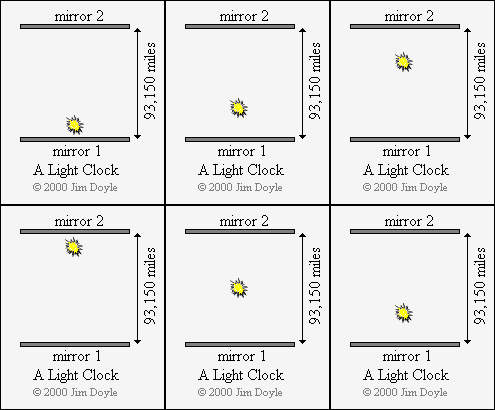
(the same clocks we used to explain kinematic time dilation).
We take one light clock with the distance between mirrors 14.9896229 cm (29.9792458/2). Then we put it in a box, together with a measuring device for the speed of light, something like the Fizeau apparatus:
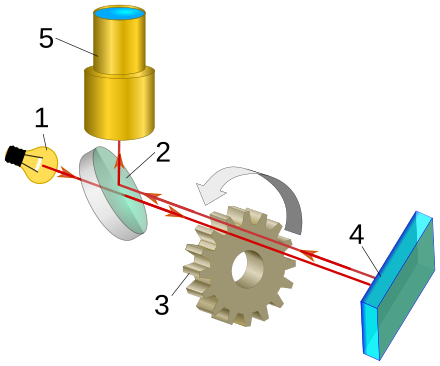
with the distance between the toothed wheel and the mirror 3 times larger: 3x14.9896229 cm (remember that this is a thought experiment ...).
Now we pump the air out of the box, creating a vacuum. The round trip from one mirror of the light clock to the other and back again will take the light pulse exactly 1 ns, in agreement with an atomic clock nearby. The light in the measuring device would need exactly 3 ns, 3 "ticks" of the light clock, to travel to the mirror and back, confirming that the speed of light in vacuum is 299,792,458 m/s, c.
Now we start to let air in the box. If we measure the speed of light, with the Fizeau apparatus in the box, using the time provided by the atomic clock nearby, the value gets smaller, but if we use the light clock next to it to measure the time, the speed of light remains c, regardless of air pressure/density. We can even insert water. It will take exactly 3 "ticks" of the clock situated in the same environment, for the beam of light to complete a round trip from the toothed wheel to the mirror and back.
So, the speed of light appears invariant when measured with instruments working based on exact same speed. Maybe the invariance of the speed of light in vacuum is a consequence not an enforced law ...
Furthermore, we notice that the light clock is "ticking" faster in vacuum than in air. We can clearly see this by adding an identical light clock that is kept all the time in vacuum. As we increase the air density in the first box, the respective clock "ticks" slower and slower (when compared with the one in vacuum).
This may suggest that an atomic clock situated at a high altitude (top of a mountain), where the air density is lower, is ticking faster than a sea level clock (as in gravitational time dilation) due to air density. Of course, this is not true, one reason being that there is no air inside the atoms of the atomic clock (the air is made of atoms and molecules, too big to get inside other atoms and molecules).
In Einstein's time, that would have been the end of the story (thought experiment), but now, more than 100 years later, we know that there is something called dark matter, something that is gravitationally attracted, forming roughly spherical halos around galaxies, exactly how a gas would do.
The fact that we cannot detect DM particles may mean that their mass/energy is very very small, so, in order to make more than 5 times the mass of ordinary matter, there should be in huuuuge numbers and slow moving (with small kinetic energy, "cold").
So, it is not impossible to exist a dark matter atmosphere around the Earth, made of particles small enough and plenty enough to fill the space inside atoms/molecules, and with densities decreasing from the sea level up ...
If you want to learn more, read what I wrote in Speculations, in august 2018, and search the experimental tests I proposed in Physics forums, as DanMP, just before I was kicked out (not because I violated their strict rules, but because they learned about my theories posted in this forum ... By the way, this is another reason why foundational physics is stuck: the high level physicists tend to reject not only different ideas, but also uncomfortable questions and experimental test proposals).
-
23 hours ago, swansont said:
GR did not come from Newtonian physics. GR was math and your position leaves that avenue closed. It would require Eddington’s experiment happen on its own, without being motivated by theory, to spur new theory development.
I don't quite understand what you mean, but the fact that "GR did not come from Newtonian physics" shows that a new theory may have a completely different approach. GR geometric approach was needed because at the time it was adopted it was not possible to find another, better one, because they didn't know about DM.
Usually, when you feel that the way you took may not be the good one, you simply go back a bit and try another route. This was/is my suggestion, to make a step back and retry.
23 hours ago, swansont said:A simulation requires that the math already exist, and real particles limits us to what we’ve already discovered.
How does that get us any new physics?
The simulations I envisioned require simple math and real particles. I don't know about you, but I consider DM particles as real, as opposed to virtual or invented. Their proprieties cannot be found directly, so the alternative is to imagine/define a model and test it. Something similar was done for quarks.
10 hours ago, Markus Hanke said:How do you propose to reassess this? The numerical value of c is a function of the permittivity and permeability of the underlying medium (this was known before Einstein), which of course don’t change just because some observer happens to be in relative motion wrt to some reference point. If they changed, he wouldn’t be in the same medium any longer, which creates physically unresolvable paradoxes.
I propose that c is invariant because the universe cannot contain such unresolvable paradoxes.
I'll explain it soon (within a week). Now I really have to go.
-
17 hours ago, swansont said:
Yes. But the “new” part is…new. Newtonian gravity did not give us GR.
I wrote that any new theory must be in agreement with all the old experimental data, in other words to be consistent (compatible or in agreement) with all that we observed and measured before (in that particular field). I really don't understand why your reply is "Newtonian gravity did not give us GR". Newtonian gravity and GR are theories, not experimental data. Experimental data does not belong to a theory. Ok, GR proposed new experiments, that were confirmed. This is why I wrote "and then to predict things that can be experimentally tested afterwards".
To give an example, MOND theories are able to explain the rotation curve of a disc galaxy, and more, but, being gravitational theories, they must also explain gravitational time dilation and gravitational lensing.
17 hours ago, swansont said:But you haven’t described a valid path to get there.
I proposed to reassess the things more or less explained long time ago, like the invariance of c, having in mind DM, etc., as opposed to "randomly and blindly groping in the dark by inventing maths that don’t seem to be motivated by any real-world data points, hoping to just stumble across that next breakthrough".
17 hours ago, swansont said:So it’s not part of theory, yet it’s a requirement of yours? Something that doesn’t exist and you can’t/won’t define or describe beyond the name? You might as well say we need splunge.
I can describe what I meant when I suggested to focus more on actual physics. I meant to work with real elements/particles (as opposed to virtual/invented), to define their behavior and how they interact, and then make computer simulations in order to check and refine the model.
GR is purely geometric and the fields are like Greek gods (they are invisible but very potent, they interact with each other, they have well defined tasks and magic abilities).
The situation in physics today may be similar to the one in medical science in Robert Koch's (one of the main founders of modern bacteriology) time. Before him, it was believed that illnesses are caused by bad air or by gods/demons (invisible, invented entities, like the fields are). Koch discovered bacteria and showed that not invisible, invented entities are causing the illnesses ... I think that DM particles can be used to explain things better than the fields we invented and the abstract geometry we created.
2 hours ago, swansont said:Any new atomic theory afterwards had to be consistent with the data from before
Yes, you finally got it (any new theory must be in agreement with all the old experimental data).
2 hours ago, swansont said:Rutherfords discovery was not precluded in any way.
Yes.
16 hours ago, studiot said:'All' is too bold a statement, which if true would have precluded many discoveries in Physics.
I meant all experimental data that concerns the new theory/model, not all the experimental data in all science, nor the previous interpretations of experiments.
-
Edited by DanMP
1 hour ago, swansont said:GR is 100 years old. It’s established physics, not new foundational physics, which is what this topic is about.
Any new theory must be, first, in agreement with all the old experimental data, and then to predict things that can be experimentally tested afterwards.
1 hour ago, swansont said:Physics tells us how nature behaves. Its job isn’t to explain reality. i.e. there’s plenty of stuff in physics that are calculational conveniences and don’t actually exist. (field lines and phonons to name two)
Yes, but this leaves room for new theories, theories that can explain more. Probably it's impossible to explain everything, but we can do more than we did so far.
1 hour ago, studiot said:You clearly haven't read many of my posts or you would know that I don't subscribe to the string hypothesis.
As a mathematician I would ask if you have any real idea what a field is because my idea is very different from yours and furthermore there are many posts in many thread here where I have explained my pov.
Yes, I didn't read many of your posts, so I really don't know/remember your pov. Anyway, my questions were not directed to you or any person in particular. I just explained why I think that it is still room for new foundational theories.
My understanding of fields is not good. Perhaps that’s why I don't like them.
1 hour ago, swansont said:Can you give some examples of modern physics models that are “physical”?
Unfortunately no. In fact this may be the sign that we climbed in the wrong fruit tree 😀
-
-
56 minutes ago, swansont said:
I don’t know what this even means. You have theory (which is math) and experiment. If there’s no experiment, there is only math.
You got it all wrong. The theory is (should be) a physical model. Yes, it usually includes math, but it isn't just math. And who said that "there’s no experiment" ?! I said:
6 hours ago, DanMP said:Once you have a viable model, one that is both logical and in agreement with all the observations, you must imagine/find ways to test it experimentally. So, yes, new experimental data is required
-
Edited by DanMP
44 minutes ago, swansont said:Check them against what?
Against reality (experimental data), of course.
44 minutes ago, swansont said:meaning it’s irrelevant to discovering new foundations in physics
Why?
39 minutes ago, studiot said:What make you so sure there is more fundamental physics to discover ?
The fact that current theories are not actually explaining the reality. Can you explain what a field is and how exactly a force is transmitted at a distance? Can you explain the invariance of c? Can you explain how a mass is warping spacetime? And no, I'm not asking how the model works, I'm asking what and how is really happening.
Also, in the string theory, why the strings are vibrating?
Anyway, it seems that I'm not the only one to expect more, better, models.
-
On 11/5/2024 at 10:32 AM, Markus Hanke said:
much of current work feels a lot like people randomly and blindly groping in the dark by inventing maths that don’t seem to be motivated by any real-world data points, hoping to just stumble across that next breakthrough. This isn’t really how science should work.
Comments, anyone?
My input was related to that, so I wasn't off topic. We need to focus more on physics and less on math.
-
-
39 minutes ago, Mordred said:
We already run very complex simulations example testing our mathematics involved for Cosmology.
Wow! Thank you! Very interesting and impressive. Of course, for such simulations math is very important, because simplification is necessary. The scale is too large.
The thing is that we may/should use such simulations to make similar ones. AI may also learn from such simulations.
Anyway, the simulations I have in mind are much much less complex, that's why they may be realized with less math.
42 minutes ago, Mordred said:None of these require AI.
Ok, maybe now AI is not used, but I'm pretty sure that in the near future it will be used.
1 hour ago, swansont said:That would require AI developing something that’s not based on what we know, which is not something it currently does
AI is crushing humans in Go (the game). We gave/teach it the setup and the rules and it quickly learned to outperform us. Something similar I had in mind when I said
2 hours ago, DanMP said:in the near future AI should be able to create a simulation based on our description of elements and interactions
-
38 minutes ago, swansont said:
Where does the math that’s in the code/simulation come from?
I said to focus less on math, not to forget about math.
Even now it's maybe impossible, in the near future AI should be able to create a simulation based on our description of elements and interactions. Until then, we still have to use some math and/or to ask a computer specialist to translate our thoughts into a computer simulation.
-
21 hours ago, joigus said:
In the case of physics, foundational or not, students generally have to master sophisticated calculational tools in order to tackle the simplest problems of the most modern theories.
In my opinion, physicists should focus more on actual physics and less in math, because nowadays we have computers, able to run simulations.
18 hours ago, swansont said:I don’t know how you find the better model without experimental data to push you.
I think that a good way to find the better model is to ask yourself why and how exactly things are happening, including things that are covered by the current theories but never really explained, like the invariance of the speed of light in vacuum. Once you have a viable model, one that is both logical and in agreement with all the observations, you must imagine/find ways to test it experimentally. So, yes, new experimental data is required.
18 hours ago, Genady said:The branches reached by Einstein, Heisenberg, Feynman et al are the new ground level, and the "higher" branches are not necessarily farther away.
Yes, they are not farther away, but what if that tree (path) is not the best one? New information, like the existence of DM, may lead you to a much better tree ...
18 hours ago, Genady said:I think that the fruit tree metaphor is wrong
Well, maybe, but I like it 😀
-
On 11/10/2024 at 7:36 PM, TheVat said:
There is also the fruit tree theory for innovative ideas slowing down in a field. Einstein, Heisenberg, Feynman et al expertly picked the fruit from the lower branches. Now there's the more difficult process of getting at the higher branches.
Interesting, but, in my opinion, the problem is that most of the physicists are interested in the higher branches (very sophisticated theories), ignoring that the "discovery" of dark matter opened the possibility for new/different "low branch" (simple) theories. This also means that the theories developed before/ignoring DM, like GR, may be misleading and/or a limiting factor, despite the fact that they offered very good results.
-
-
On 9/30/2024 at 2:28 AM, Airbrush said:
It's amazing and that is interesting because I never heard that 70% of matter that is not dark matter, is the CMG.
On 10/3/2024 at 9:03 PM, Airbrush said:These quotes I found are not consistent with "70% of the mass of a galaxy" is CGM. The Milky Way has far less mass in its' CGM, even less than the mass of the stars in our galaxy.
I searched in the article and in the referred articles and I didn't find why they claimed that:
Quote(CGM) contains ~70% of all mass that is not dark matter
Maybe a more thorough read is needed.
Also, the galaxy they investigated was:
QuoteIRAS 08339+6517 (hereafter IRAS08) is a starbursting disk galaxy with a stellar mass of log(M*/M⊙) ≈ 10 (where M* is the stellar mass and M⊙ is the mass of the Sun) is located at redshift z = 0.019 (luminosity distance (dL) ≈ 83 Mpc)
It appears that this galaxy is younger than ours, so it may have more circumgalactic mass.
On 10/12/2024 at 5:59 PM, Airbrush said:Do you ever consult with AI?
I tried Bard one year ago and now Gemini, Bard successor, and found that they are not reliable. Gemini is better than Bard, but still not reliable. I suggest to ask the AI for links to their source, or just search yourself.
Maybe the answer you received from ChatGPT is not wrong, but it is always better to double check.
On 9/30/2024 at 2:28 AM, Airbrush said:Why is the CMG never mentioned in discussions about dark matter?
Maybe because it has no effect on galactic stars rotation, being beyond them? When I opened this thread I also believed that this CGM would reduce the need for dark matter, but now I'm not sure that CGM affects stars rotation. Only if there is also more mass than expected between stars, the need for DM would decrease, but it seems that it's not the case.
-
1 hour ago, swansont said:
New things were discovered and the theory was expanded and fleshed out. It’s this way in all of science. It’s not static.
True. I recommend you (all) a documentary on Netflix: "Homo Futurus, the inside story". It is about a controversial(?) theory regarding the mechanism that drove the evolution of humans from primates to modern man, also speculating on humanity’s future evolutionary path. Everything, in this theory, revolves around the sphenoid bone. Very interesting.
-
19 hours ago, Mordred said:
It's doubtful it will affect the Hubble contention as a large part of the contention is due to local calibration issues which involves supernova and different types of cepheids rather than the galaxy itself.
We don't use luminosity of the galaxy for luminosity to distance relations as there is too many unknowns involved for determining the emitter luminosity frequencies.
Ok, but supernova and cepheids are in some galaxy, so you have to take into account all the matter between them and you when you measure their luminosity. This "new" circumgalactic matter may have some influence (scatter, absorb and/or emit light). Also, the distant/early galaxies may have even more circumgalactic matter then the closer/old ones, because in time this matter can be "absorbed" by the galaxy.
11 hours ago, Mordred said:Here is detail on the H11 region
Very interesting/helpful, thank you.
-
Edited by DanMP
22 hours ago, Mordred said:Typically and assuming the old boundary condition still holds but the boundary used to be considered as 100 times the mean average density of the void regions which can be calculated via the critical density formula as our universe is extremely close to critical density.
I still don't understand how the density of baryonic matter between galaxies can be inferred or accurately measured. They wrote about quasar absorption lines and integral field spectroscopy of [O ii], Hβ and [O iii] optical emission lines, but I don't know how accurate those methods are. At the second (and last) instance where "dark matter" was found in the article, they wrote:
QuoteThe ubiquitous emission around IRAS08 implies a large cool CGM gas mass. A key property required to estimate this mass is the electron density, ne. Quasar absorption line probes of the cool CGM4 and independent estimates from fast radio bursts28 estimate a low value of ne ≈ 10−3 cm−3. For our observations, only the central galaxy KCWI pointing had a spectral resolution that was sufficient to resolve the [O ii] doublet, where the line ratio can be used to measure ne. At the edge of this pointing (r = 7 kpc) the [O ii] line ratio is below the low-density limit29, indicating that ne < 30 cm−3. We therefore could not make a direct estimate of the mass, but we could use our Hβ luminosity profile fit and mass estimates from quasar absorption lines to place constraints on ne of the cool emitting CGM. To estimate a gas mass, we assumed spherical symmetry in all gas properties and that the Hβ SB power law from Fig. 2 holds between rbreak and Rvir (the rough outer boundary of the CGM). A constant ne = 10−3 cm−3 and unity volume filling factor gave a total ionized gas mass three orders of magnitude larger than the estimated cool CGM mass for galaxies roughly at the break in the galaxy luminosity function, L*, from absorption line estimates1,4,30 and, more importantly, larger even than the dark matter halo mass of IRAS08. When we instead assumed ne ≈ 0.3 cm−3, we inferred a total ionized gas mass of MRvir ≈ 1011 M⊙, which is similar to the absorption line estimate. The clumpiness (or volume filling factor) of the gas will further complicate this. If the clumpiness is high, then this allows even larger ne for the emitting gas. Overall, our observations—combined with the absorption and fast radio burst results—suggest a wide range of densities in the CGM, which was also seen in recent simulations31,32.
(I don't know if it's ok to quote so much text from the article. If it's not, please delete or reduce it.)
I wonder how this extragalactic/circumgalactic mass/medium is influencing the luminosity we measure in order to establish distances and if this influence is or is not important for the Hubble tension ...
Friendly Challenge, I want to see if someone could explain space time curvature in three dimensions without a density viscosity or difference in volume to account for gravitational affects on light and mass, better than I can with it, using defined terms.
in Speculations
·
Edited by DanMP
Adding the second question.
Ok, please explain why the speed of light is that speed and its invariance.
Also, please explain time dilation for a GPS satellite (kinematic and gravitational time dilation).