
sethoflagos
Senior Members
Everything posted by sethoflagos
-
 How reliable do you think those statistics are? I can't speak for Chad, but this is the online birth registration portal for Nigeria. Because reasons, I can't comment too much, but feel free to ask yourselves whether it is voluntary, free of charge, free of bureaucratic hurdles etc., likely to be taken up by the entire population? Similarly:

-
In the last two years. I used hard contact lenses from 1977 to maybe 2007 when my optician said I had some eye anoxia issues and should switch to gas permeable soft lenses. Since I stocked up during infrequent visits to the UK, there was a distinct tendency wear lenses somewhat beyond their serviceable lives, and eventually I began to get quite severe inflammatory reactions.
-
Hopefully someone who's lived for over 25 years in sub-saharan Africa, and has the odd bout of malaria now and then will chime in.
-
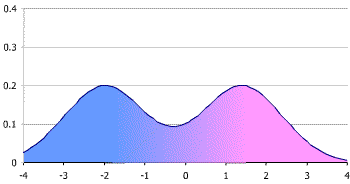
Multimodal probability distributions. The mean value may not be a particularly likely one.
-
That's sort of how statiscal averages work. What's your point?
-
There's significant well-documented evidence that Plato lived to at least 75. Aristotle deceased at 62. Pythagoras ~75. Socrates ~71. Aristophanes ~60. Thales of Miletus >=77. Archimedes ~75. Plutarch ~80. Epicurus ~71. Diogenes >=79. Zeno of Citium ~72. Zeno of Elea ~60. Zeno of Sidon ~75. Crates of Thebes ~80. All three score years and ten give or take. There are exceptions: Eudoxus of Cnidus appears to have died at the tender age of 50; Pyrrho of Elis and Hippocrates of Kos appear to have both reached 90 years. And 'all the classical Greek thinkers that spring to mind early on a Wednsday morning' is not exactly a random dataset. However, it does seem to indicate that during the first millenium BCE, if someone survived into their thirties and had a reasonably comfortable lifestyle, they had a reasonable chance of reaching 70.
-
Not at all. The thread has so far omitted famine and malnutrition which I would have thought outstripped any disease, even malaria, as historic causes of premature death. Btw Psalms 90:10 rather famously states the natural lifespan of mankind as 'three score years and ten', so the idea of individuals in their thirties or forties as being 'old' doesn't really tie in with the record.
-
So taste is the more basal sense? Hard to imagine how 'smell' operates in a marine environment where I presume both originated. Incidentally, I would have thought consciousness was an example par excellence of an emergent phenomenon, and therefore would not really have a 'centre' as such; it being a more distributed, non-localised product of the sum of its many parts. Though the crucial importance of the thalamus within the network seems to be... for want of a better word... emerging.
-
Might we expect those historically most significant threats to survival to leave some evidence in the genome? If so then conditions such as lactose tolerance and sickle cell anaemia point the finger of suspicion towards famine and malaria as persistent offenders.
-
A particular bugbear of mine is hydroquinone, particularly in the context of 'skin whitening' cosmetic products. I believe there are some controls on its use in Europe and the US. But not so in Nigeria, to the extent that when I buy soap for myself, I really have to scan the contents listing. I find its purpose saddening and definitely do not require its intended effects myself. I can certainly identify with this experience. After over 40 years of contact lens wear, I began to develop significant allergic reactions to the solutions (or possibly something else like protein residues) and had to give up and go back to wearing specs.
-
I'm surprised that olfaction and taste are routed so differently. A little research tells me that taste sensations are routed through the thalamus on their way to the gustatory complex. And yet taste and smell seem so closely coupled in our overall perception of eg bacon that they almost act as one. Very curious.
-
It doesn't generate a survival advantage to those populations who have to endure boreal winters.
-
Easy. Do a Magwitch. Decide what compensation would help ease your conscience and have a third party (eg a solicitor) deliver it to the wronged person anonymously.
-
I thought the vet's speciality was Pu... Cat.
-
Alas, red dwarves will evaporate before I'll stump up the Kobo to get beyond the Murdochian paywall blocking access to this link. So I'll take the science creds on trust. What's a Royal (Dick) School?
-
... = high sensitivity of system frequency to generation/load imbalance and thus larger maximum dips in frequency. Due in context to reduced tonnage of the rotating machinery that historically kept frequency stable via a large reserve of RKE. I think some people prefer the word 'damping' over the 'stiffness'. Especially in the context of Droop Control. (Old CEGB joke) Not sure what you mean by the inertia of a choke (or a transformer come to that). They're fairly static. Do you mean syncons? (= synchronous condensers as mentioned by @Ken Fabian )
-
You're not wrong in your understanding, and thank you for the reference - it was very illuminating. So VMM attempts to address AGC (Automatic Generation Control - ie basic electrical loading); RoCoF (Rate of Change of Frequency); and FCAS (Frequency Control Ancillary Services) all at the same time. Even ignoring Power Factor Control, it sounds like they have an almighty Degrees of Freedom challenge there! Nevertheless, I've learnt something new today, Thanks again. Timely intervention! Yes, some of the jargon does need an explanatory glossary. Thanks.
-
What do you mean by 'sweet'? Sweetness tends to lack any real meaning unless there is some bitterness to compare it with. Among novels written in the English language, Jane Eyre (Charlotte Bronte) and Pride & Predudice (Jane Austen) both end sweetly enough, though the journeys are less so.
-
I wonder if the mewling of babes and domesticated adult cats is pretty much the same thing (over and above sharing a similar frequency band). AFAIK adult wild cats don't mewl, and adult domestic cats only seem to mewl to us; not to each other. Personal impressions: no scientific references to support this idea.
-
Now that's an interesting concept! I would have thought the most cost effective means of simulating the frequency stiffness of a bunch of large synchronised turboalternators would involve a bunch of large synchronised alternators mounted on flywheels. Difficult to see how the magnitude of rapid energy interchange involved in this process could be handled by static components. Do you have more information on this?
-
Thy kingdom come. It's a wish for a blessed future. Not applicable to past or present.
-
See what is happening here from a particular perspective: UV photolysis (and 'electrolysis') is creating a survival advantage to those molecular species that are less susceptible to their effects and/or less exposed to them due to their depth in the atmosphere; the remainder being more prone to being broken down back into simpler species: Gravitation is creating a survival advantage for larger, denser molecular species by drawing them deeper into the atmosphere where they are better shielded from UV radiation and/or being lost to space. Add to these the 2nd Law of Thermodynamics which creates by purely statistical means, a survival advantage for molecular species that are new to the mix or existing in very low concentrations due to the higher entropy of more diverse mixtures. The overall effect of UV on a 'primitive' atmosphere can hence be seen as the spontaneous generation of an ever-increasing diversity of increasingly complex UV-resistant molecular species. The origin of species by natural selection? It's so very similar isn't it. And for my money, was very much a significant part of life's earliest origins here on earth.
-
The strength of the CN triple bond in nitriles (the main ones of interest are acetonitrile and amino acetonitrile) are considerable more resistant to UV photolysis than their corresponding carboxylic acid whatever the UV intensity happens to be. In cold dense molecular clouds where UV input is extremely low, their half lives are of the order 10^8 years whereas that for acetic acid is perhaps a tenth of that. Since they are precursors of amino acids such as glycine, they are significant in the production of a number of biologically important compounds within galaxies.
-
You're not going to the right clubs
-
The UK Environmental Red List comprises: Aldrin, atrazine, azinphos-methyl, all cadmium compounds, DDT and metabolites, 1-2 dichloroethane, dichlorvos, dieldrin, endosulfan, endrin, fenitrothion, hexachlorobenzene, hexachlorobutadiene, gamma-hexachlorobutadiene, Malathion, all mercury compounds, polychlorinated biphenyls, pentachlorophenol, simazine, trichlorobenzene, trifluralin, tributyltin compounds, triphenyltin compounds There was a time when the water authorities tested for all these on at least a weekly basis. That all went out of the window after privatisation of course.