sethoflagos
Senior Members
-
Joined
-
Last visited
Everything posted by sethoflagos
-
Does this seem to confirm my original post? It occurred to me last night that it implied that helium should therefore have three 'liquid' phases: Helium I (2.7K to 4.2K @ ambient pressure) - a normal cryogenic liquid phase. Helium II (superfluid part) Helium II (BEC part) 'Condensate' is pretty much a wastebasket category in my industry for any liquid that has emerged from a condenser, and I've been caught out before confusing the composition of one condensate with that of another. Perhaps I'd been caught out again. However https://en.wikipedia.org/wiki/Helium contains the following that seems to confirm that Helium II is indeed a mixed phase state, albeit a somewhat different mix to what I had in mind. Why on earth did they pick 'condensation' as a name for this phase change? In the case of Helium II it leads to a decrease(!!!) in density from what one would expect. It's confusing the hell out of me and I'll bet I'm not the only one.
-
Strictly speaking, no. It's more of a mixed state, part condensate, part superfluid. The two properties are not synonymous and the relative proportions vary with temperature. Is this right? Or have I wrongly been assuming that the term 'condensate' referred specifically to BEC when it was being used more generally (ie for 'normal' liquid Helium)?
-
I had much the same impression of New England when I worked there (Maine, mainly). For years, I tried to avoid using sugar entirely except for that naturally contained in the fruit and veg I was using, but that meant I was rarely successful with eg. piccalilli (which I love) which really needs the sugar to keep undesirable microbes at bay. As with most things, I think it's a question of balance. I tend to stick to the BBC and Indian or Nigerian cuisine websites for recipe ideas as these are less inclined to wander off into the sickly sweet territory of most English language foodie sites.
-
Strictly speaking, no. It's more of a mixed state, part condensate, part superfluid. The two properties are not synonymous and the relative proportions vary with temperature. Note that the helium 4 nucleus is zero spin and therefore readily adopts condensate characteristics at a relatively high temperature. In contrast, the helium 3 nucleus is a fermion and can only take on a boson character by forming a cooper pair with another He-3 nucleus. This can only occur at much lower temperatures.
-
Much clearer! Thank you very much!
-
Unfortunately, your 'simple' involves a notation system that didn't make it into Chem Eng courses in the '70s. Think crayons and picture books. That's more my level. 😄
-
Unfortunately, Nigeria doesn't meet the winter chilling requirements for apricot flowering. However, a 600g mango can be had for about 40p and has a similar texture, so I made a batch of flapjacks with some diced mango I'd let dry off a bit in the fridge. Really nice! The fruity taste and slight acidity certainly take it to the next level, so thanks for that!
-
Must have been a partridge
-
... so a particular unitary operator cannot switch between Model Ts, As, Bs etc in the same production line?
-
This would imply that it was possible to create multiple exact copies of the system - if you can do it once, then why not do it again and again? It works in the classical world - we can design an operation that takes in arbitrary states of raw materials and converts them to multiple 'copies' of a predetermined state (Model T Ford, von Neumann probe etc). But if we try shrinking this principle down to the quantum level, we start running into some issues with the mechanics. The erasure of arbitrary information in the input states implies eg a loss of entropy from the universe (see No-deleting theorem) and teleporting the output states to some storage destination has the potential to break causality (see No-cloning theorem). And that's just the stuff that I think I can almost get my head around.
-
If we're limited to the typical geographical literacy of US citizenry, how do we stand with say, Belgium? Ostend log forever of gold net so.
-
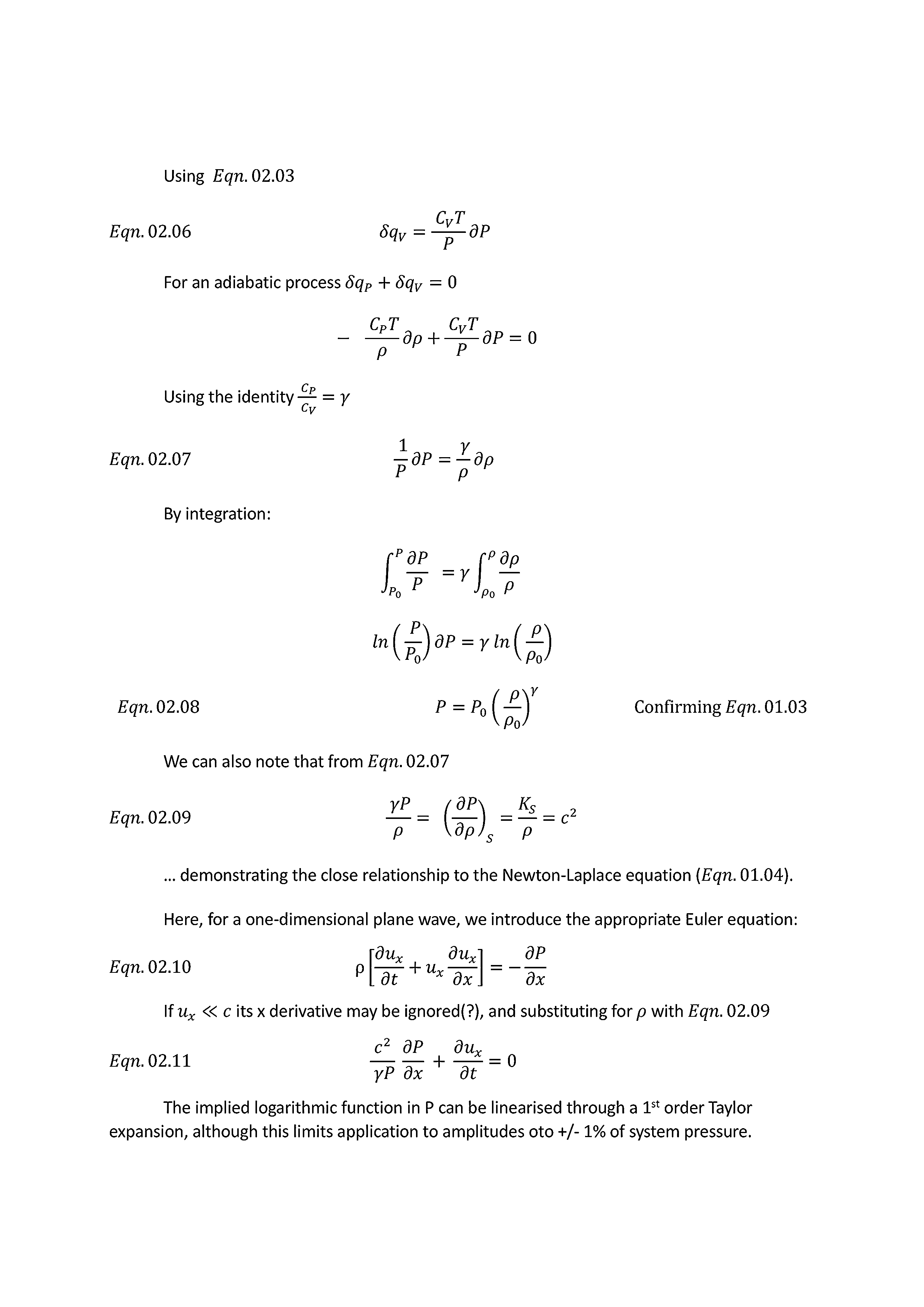
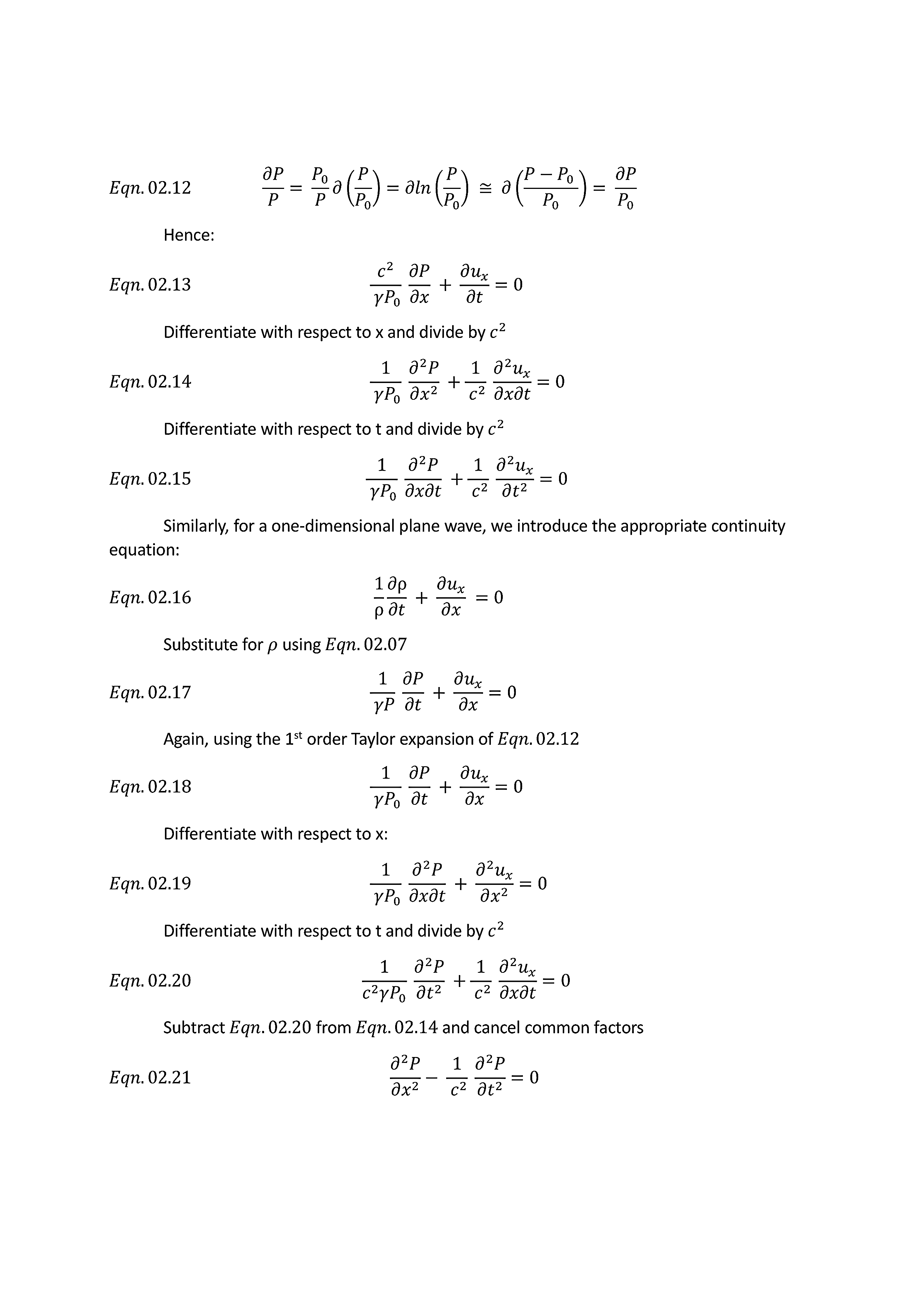
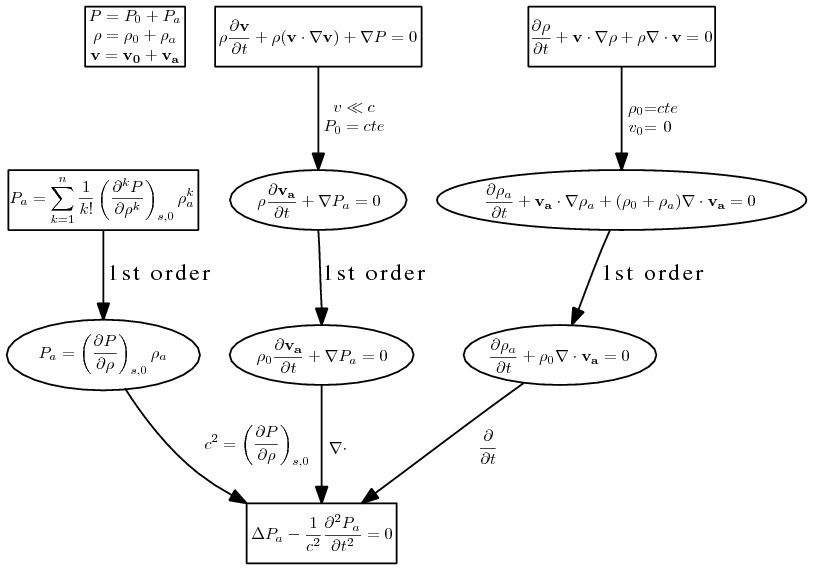
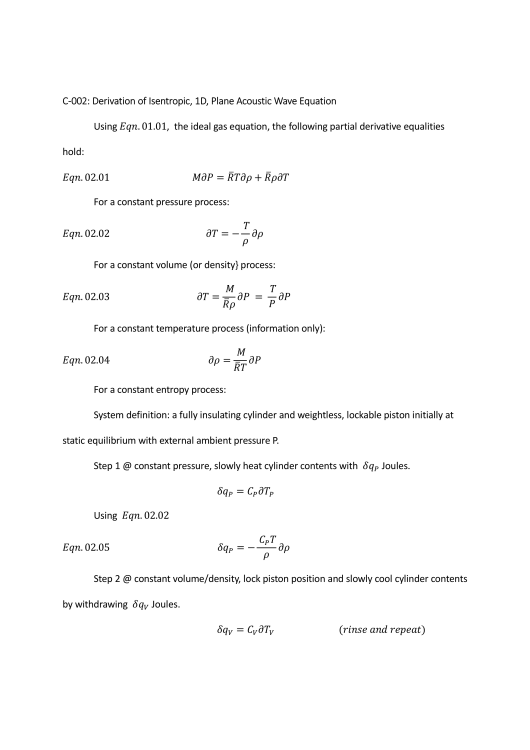
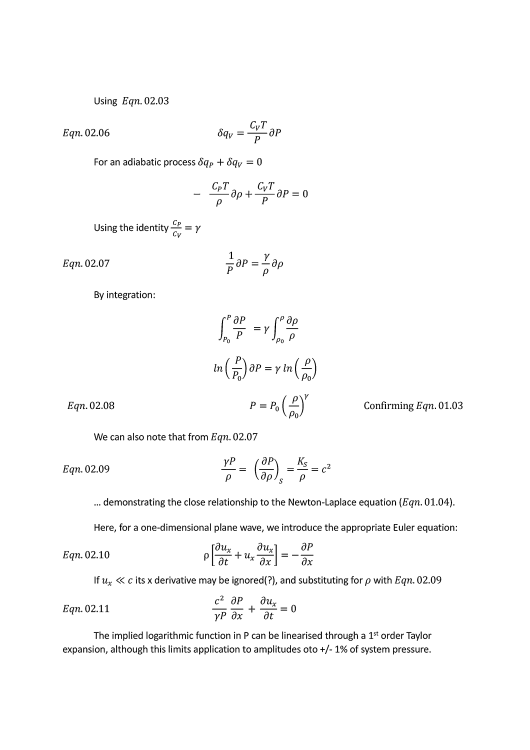
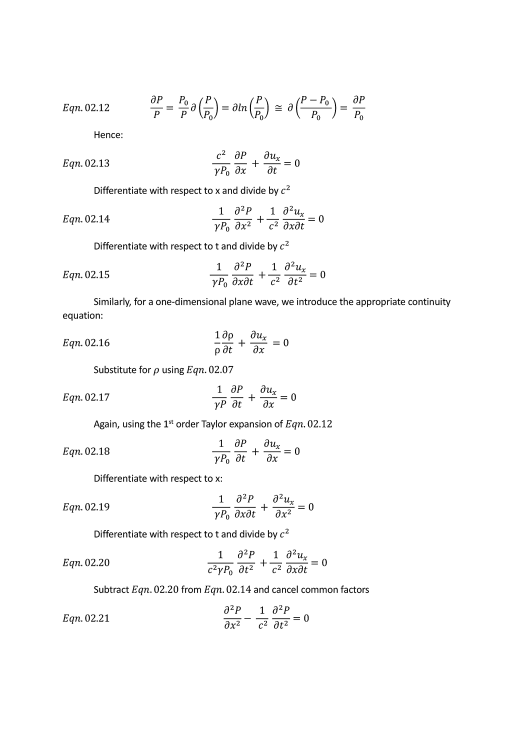
A recent thread on the d''Alembert Operator had me scuttling back to this thread intent on trying to reconcile my previous work with the apparently unrelated Acoustic Wave equation. Wikipedia ''explains'' it with the following graphic which I found a little hard to follow: So I went back to scratch (Ideal Gas Equation) and plodded through it step by step (I'd be very grateful if someone would check this. Symbology as OP but clear enough, I think) Leaving aside the issue of sonic velocity variability, there are still some issues that puzzle me. The assumption of uxdux/dx ~ 0 I buy principally by virtue of the desire to find an analytic solution, though it does set a limit on applicability. The Taylor approximation of dP/P ~ dP/P0 makes less sense though. What's the problem with the substitution Y = ln(P/P0)? You would still obtain the preferred form of wave equation albeit not explicitly in P, and lose a seriously limiting constraint. Good enough for some HiFi applications perhaps, but nothing more intense than that. Unnecessary? Above all, I thought this form of wave equation implied that the mixed derivatives d2P/dxdt and d2ux/dxdt both must equal zero, which would (via Eqns 02.14,15,19,20) zero all the 2nd order derivatives. A beacon in the fog would be much appreciated here.

-
Probably off topic a bit, but it made me chuckle.
-
... and has dark thoughts on ancient Persian rite of human sacrifice. Yo! Baste gnat fat on a cloven ox, one volcano Taftan gets a boy. (for the more squeamish amongst us, 'You' and 'buoy' also work but make even less sense) ... and remembers the active crater Narkuh? Shukran! Could possibly have worked that one into the first if I'd thought a bit longer.
-
You and me too! 😄
-
Ask yourself why no one else is all over me like a rash in the same way as you. Then research the meaning of 'Playing Devil's Advocate'. The others already understand. You clearly do not, and have allowed anger to cloud your judgment.
-
I never said nor implied any such thing. You intend persisting with your blatant dishonesty?
-
The one that never fails to isolate and expose the more autistic among us.
-
The complete opposite actually. It's about sharpening our arguments against those who are actively manoeuvring to put political power permanently into the hands of the few.
-
Agreed. But even then, La and Lu conspire to bring disorder to the boundaries of the rare earths and transition metals, don't they? Perhaps best to keep it simple and leave the wrinkles to those qualified and remunerated to deal with wrinkles.
-
I see some advantage to enfranchising say, the 11 to 15 age group, albeit with possibly a fractional rather than full adult vote. This would get them engaged in the political process early, and encourage discussion of political topics in curated environments such as the family home, classroom, church (🙊). Maybe let them vote and be counted a few days in advance of other age groups to stress the importance of their views, and see that they are being taken on board seriously by the wider electorate. Perhaps this staged, consultancy process could be extended to other age groups with full voting rights (16-20, 21-30, old gits). Firstly, the viewpoints of all significant demographics would be aired individually, and secondly, there would be ample advance warning of a nasty surprise (eg Brexit) catching everyone unawares.
-
All good stuff. Okay we can keep the vote. But my mind keeps turning to the accomplishments of the generation born in the last quarter of the nineteenth century: Einstein, Schrodinger, Born, Bohr, de Broglie, Bose, JBS Haldane, Julian Huxley, Pablo Picasso, Max Ernst, Le Courbusier, Man Ray, Aldous Huxley, Thomas Mann, James Joyce, Franz Kafka, Bulgakov, Stravinsky, Prokofiev, Bartok, Varèse, Ravel, Poulenc... And the generation born 1950 to 1974? Duran Duran. Some punishment must be due.
-
I would agree with you entirely. And also @CharonY 's comment on D-K ubiquity in all spheres. My reservation remains that one should not really merit a vote on issues where one does not shoulder the consequences. I see this as a variation on the theme of 'No taxation without representation' which you are probably familiar with 🙂
-
Timely 🙂
-
Lucky old you! No way they'd let me vote here. They'll invite me to draught bits of energy policy, but not to vote on it. Go figure.