sethoflagos
Senior Members
-
Joined
-
Last visited
Everything posted by sethoflagos
-
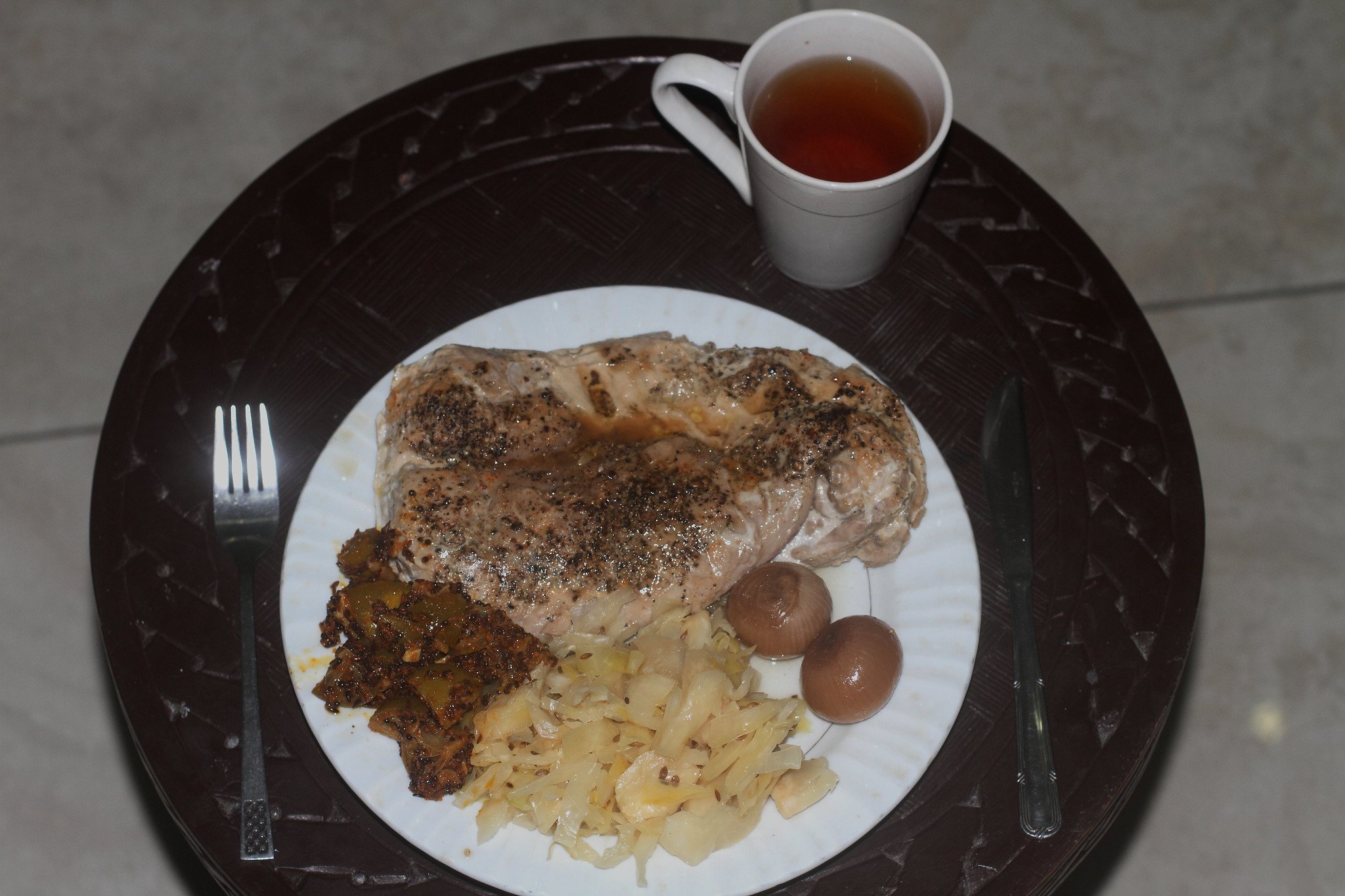
 Actually, I enjoy cooking for myself very much and aren't too bad at it. Here's one I did earlier: I'd caught the yellowfin that morning. The sauerkraut, lime pickle and pickled onions are all homemade from local produce, other than the spices. And the darjeeling of course. The big plus of preparing your own food is that you can make whatever you want regardless of anyone else's styles and tastes. This one's a real mish-mash of different traditions so you'd be hard pressed to find anything like it on a regular menu. But you do need to dip into other styles and traditions sometimes whether to extend your repertoire, or just for the simple enjoyment of it.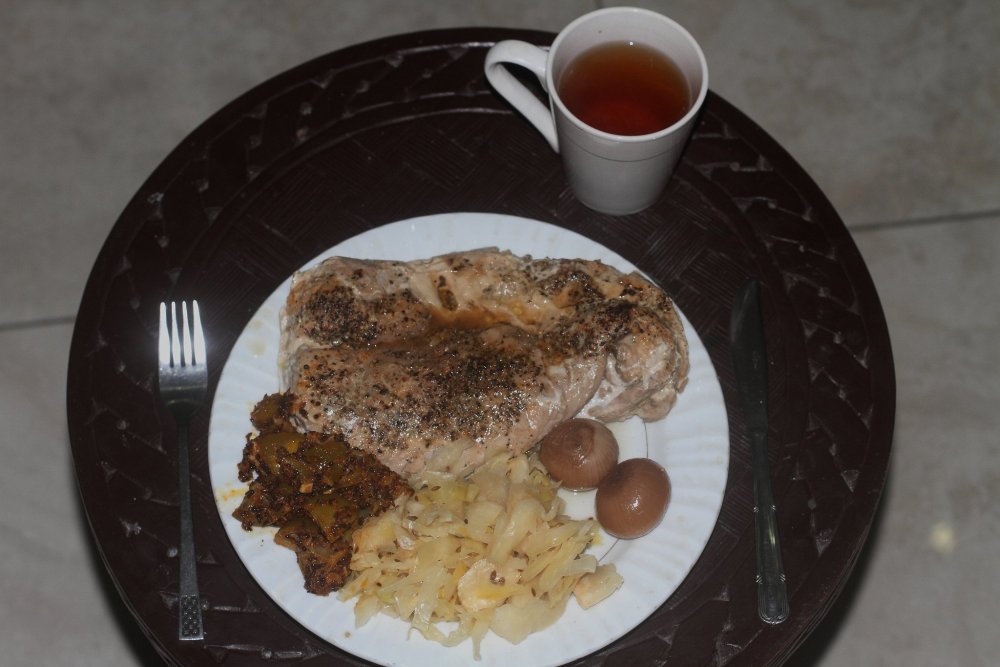
-
Check entropy of mixing. The slightest difference in particle properties produces a significant step change in entropy irrespective of the degree of difference. It's this aspect that got me thinking about these spin isomers in the first place. Again: Gibbs' Paradox.
-
Hey, I'm not knocking your domestic arrangements. But we are all born into cultures that have a relatively restricted diet. Here in Nigeria I have been able to expand that diet to include such delicacies as Ethiopian nightshade, pumpkin leaf and pan-fried locust. I'm not particularly recommending these to anyone else out there, but I do think it's important to understand for instance that insects can be a viable (and surprisingly tasty) food supplement. I'm not particularly keen on the various preparations of cassava, but yam is a perfect starchy component of stews. I'm just saying that we all have a certain tunnel-vision regarding food that is culturally ingrained. We can all benefit by expanding our cultural horizons to make us less dependent on the specific diets we grew up with and along the way maybe find some unexpected delights.
-
Too late chum. Your comment was entirely inappropriate so welcome to my blocked list. You've nothing to say worth hearing.
-
That wouldn't be directed at me, would it?
-
I beg to differ somewhat (though I do understand where you're coming from) One thing a good restaurant does offer is the opportunity to try something new and be educated in a relatively safe environment. Yes, they can be a bit of an expense, but one expensive treat a year isn't going to break the bank. I try to make a habit of giving myself at least one treat a year, just to make what I do seem somehow worthwhile. Anyway, my treat for 2006 (I think) was to take my mother and children for week's holiday in Montparnasse. The deal was they could go wherever they wanted during the day, but the evening meal was a proper sit down job somewhere decent (ie my choice!). The highlight came at La Coupole (I think). I just remember the expression on my mother's face looking first at her 'adventurous' choice of tartare de dourade and then at my plate of la grande choucroute. Fortunately for her, I quite like raw fish and was happy to share. It was a magical bonding moment, and not lost on my then teenage son and daughter. So while I'm quite happy with regular vegetable soup and bacon omelette sandwiches on a day-to-day basis, it's good to know that there are many, many options out there.
-
Now I can sleep with an untroubled mind!
-
I'll have to sleep on that one. When I wake up may be I'll have figured out how what you said was different to what I said. Thanks nevertheless!
-
I found the discussion of J state populations a bit hard to follow. Is the 75% ortho equilibrium limit simply due to equipartition amongst these extra rotational degrees of freedom, or is there more to it than that?
-
The mental picture I'm getting is that the electron fields recoil first from the collision due in part to their much lower inertia. The consequent relative shift of -Ve potential away from the point of impact then acts on the nuclei and as @swansont says, drags them along. In the extreme case, this mechanism fails and the protons and electron seperate leading to a plasma, which we know happens so that's consistent. It's a classical picture, but there's room for a buch of vitual photons to be showering the nuclei to create some sort of Feynman diagram out of it. As regards the isomeric transition perhaps there's some really narrow window in the collision spectrum where the colliding nuclei are sufficiently closely aligned for an exchange of spin states to occur? The energy transition is in the same ball park as the latent heat of vapourisation (1.445 kJ/mol vs 0.904 kJ/mol) so the kinetics seem credible even if the actual mechanism is opaque. In passing, I find it intriguing that such a quantum oriented phenomenon can have such a marked impact on bulk thermodynamic properties. The anomalous behaviour of the specific heat of hydrogen at low temperatures has been known for a long time of course. It's a classic case of Gibb's paradox: the tiniest imaginable difference between particle species is sufficient to cause a significant step change in macroscopic entropy.
-
How does this work? It seems to suggest that the electrons further away from the nucleus must exert more attractive force than those closer. Or is it a case of 'more electrons behind than in front'? If so, I'm struggling a little with the inverse square aspect of Coulomb's Law.
-
Let's be clear on this. From at least the mid-1930's the energy sector has been fully aware of the long term impact of burning fossil fuels due to the advice given by its chemists and chemical engineers who understood the principles first clearly articulated by Svante Arrhenius in the 1890's. Their position has been uniformly duplicitous ever since. They have not the slightest interest in rational debate. They see it simply as a war of words. We owe it to our children and grandchildren to respond accordingly.
-
Getting back to the OP, how are the momentum and energy transfers in a collision actually transferred to the nucleus? I can picture electrostatic repulsion and possibly even the Pauli exclusion principle acting on the electrons, but I struggle to picture the corresponding forces of repulsion acting on the positively charged nucleus. Okay, I admit it, I've not the faintest idea of what keeps a nucleus centralised within the atom.
-
That's neat! Thanks!
-
So you go with electrochemical. Makes sense. A smidgen more: Wikipedia tells me that the energy transition from para to ortho is 1.455 kJ/mol. Dividing by Avogadro's number and Planck's constant gives a frequency of 3.646 THz which just about crawls into far infra-red, I think (if I've done it right. Not a calculation I often get asked to do!). Also, I find it intriguing that it's impossible to obtain by heating an ortho/para ratio that's higher than 3:1. Is it purely coincidental that ortho is a triplet state and para a singlet? PS : Apologies - @studiot's attachment is beyond the capabilities of my prescription lenses!
-
It may be relevant that the transition rate can be sped up by a factor of twenty or so in the presence of an iron catalyst. The immediate assumption would be that some sort of electrochemical mechanism was in play, but perhaps it's more magnetic than chemical.
-
One more conspiracy theory to add to the list, then?
-
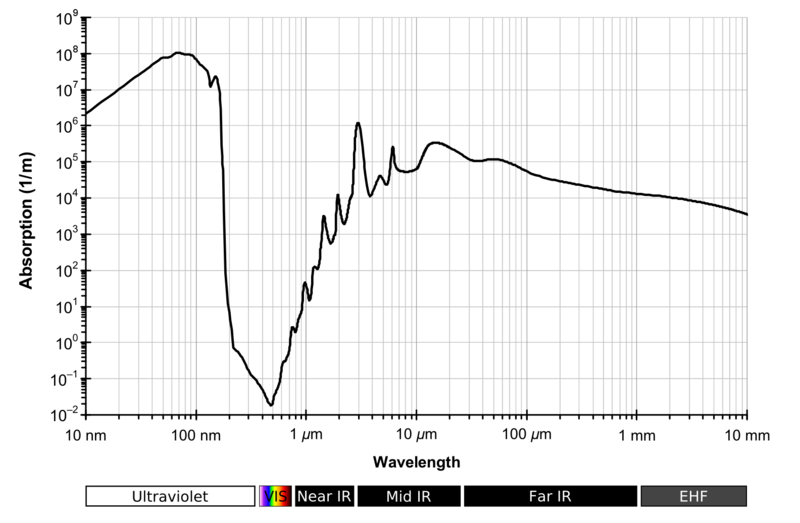
Looking at the absorption spectrum of liquid water ; Doesn't this make it essentially black to UV? Seems to defeat the object.
-
I was reading up on the equilibrium relationship of ortho and para (molecular) hydrogen (ortho having proton spins in parallel alignment, para ant-parallel). With para hydrogen being the lower energy state, relatively pure para hydrogen (~99.8%) can be obtained by chilling pure hydrogen down to around 20 K and keeping it there for a couple of days. If this is rapidly heated to a more moderate temperature and then kept fully insulated, the gas will slowly lose temperature as the the appropriate ortho/para equilibrium is established. Essentially an endothermic reaction. Though it can take several days to do this. It's sort of a remarkable behaviour in itself but it got me wondering exactly how the protons manage to extract energy from the bulk internal energy of the gas. I'm guessing the surrounding electron orbitals aren't the insulating cushions I'd pictured them to be.
-
If there's one word that sends chills down a chemical engineer's spine it is BLEVE (and it needs to!). Post script: LPG is often stored in elongated cylinders informally referred to as 'bullets'. A common 'good design practice' is to avoid aligning them with the long axis pointing towards any habitation within 3 kms.
-
How long have you got? Firstly, you need to know the water carrying capacity of air at your lowest temperature. This is calculated via the saturated vapour pressure (Ps1) of water at this temperature (T1) for which the August Roche Magnus equation is probably most convenient and simplest (it derives from the Clausius Clapeyron equation qv) Ps1 = 610.94e^(17.635(T-273.15)/(T - 30.11)) Where units are Pa and K. For T = 293.15 (20 oC) this gives Ps1 = 2,335 Pa The ideal gas equation (PV = nRT) then tells us that the maximum molar water vapour capacity per m3. ns1 / V = Ps1 / RT = 2,335 / (8.3145 x 293.15) = 0.9573 gmol / m3 Taking 18 as the mol wt of water that gives a mass density of 18 x 0.9573 = 17.23 g / m3 @ 20 oC. That's more than enough for one post. Tell me if you follow it so far and we can move on to an easy bit followed by a hard bit.
-
Which reminds me of the Keynesian multiplier: Acceptance of large scale homelessness is a political choice.
-
The Nightjar family are all pretty cryptic. Here's three from Nigeria. Long-tailed Nightjar - Caprimulgus climacurus sclateri Standard-winged Nightjar - Macrodypteryx longipennis Plain Nightjar (cinnamon form) - Caprimulgus inornatus



-
For many years, I leant strongly towards some form of non-analytic emergence principle to explain eg some of the wackier hypotheses of statistical mechanics that are simply not seen in classical mechanics, such as 'all the molecules of gas are in the corner of the box' type paradoxes. I'm tending to drift away from this as I see these paradoxes being due to a) crude over-simplification of statistical mechanics by some rather than a real fault in the method, and b) an increasing awareness that quantum phenomena significantly modify the assumptions of randomicity by the creation of 'forbidden zones' due to destructive interference. In particular, maximal quantum entanglement of the gas particles is often equated with the state of thermal equilibrium. This suggests that the system has shared memories of its recent particle collision history embedded within the affected fields, and if the Transactional Interpretation of QM has traction, then this memory extends at least a little into the future too. The upshot is that the molecules do not act independently of the bulk gas. And the bulk gas behaves accordingly. Quantum thermodynamics is a currently developing field that is attempting to address this. Perhaps the most appropriate methodology could be called 'holistic reductionism'? Is that an oxymoron?
-
The last ten years in particular has seen a major increase in concentration of global wealth into the hands of the 'haves' at the expense of the 'have nots'. (see https://www.worldbank.org/en/news/press-release/2021/10/27/global-wealth-has-grown-but-at-the-expense-of-future-prosperity-world-bank for a fairly tepid version of this) This has consequences. In particular, it causes an increase in the number of 'have nots' who have limited or no easy access to bathroom facilities, and seek some alleviation of their misery through intoxication. Who has created this sorry state of affairs? Do the miserable wretches enjoy their condition and willingly embrace their misfortune? Rather the OP seems to voice a total denial on behalf of the 'haves' for their greed being a major causative agent for the ills in society that are a natural consequence of their actions. One wonders whether the OP is one of the 'haves' or one of the 'has just slightly more than the have nots'. There are very clear historical precedents from which we appear to have learnt not enough.