
sethoflagos
Senior Members
-
Joined
-
Last visited
Everything posted by sethoflagos
-
 Thanks for (almost!) confirming that. Which points a finger towards... A thought occurs to me. While fermentation is active, the CO2 bubbles evolved are highly unsaturated with regard to all other volatiles and therefore should make an effective stripping gas removing dissolved O2 from both the aqueous and oil phases. This is a convective (ie orders of magnitude faster) process so even a modest diffusion barrier is going to act as pretty much a one way valve isn't it? Hope so. Otherwise @TheVat would have to drink the brine to get his vitamins. (I assume it was lipophilic there) Me too. The diet change was instrumental in bringing me back from a bad place early in the year. Freshly made fennel roti, egg and fermented tomato. A great start to every morning. For about 25c in ingredient cost. Guess that's a whole-wheat taco to you lot.
-
Makes sense. Do you know which of the vitamins may strongly prefer the oil phase? I imagine most stay locked within the plant cells? And there should be minimal contact between the oil and veggies. Yes, I usually add some sauerkraut juice to be sure, but I've yet to have a fermentation stall on me. Because... climate. Even my 'cool room' will rarely drop below 25oC. (I don't do aircon). Those local logistical issues I mentioned? I had to ask my wife to obtain and hand-carry champagne yeast when she flew here a couple of months ago. The stuff just isn't available. Trouble is with US sites on this topic, they all use Mason jars, and the accessories are designed for that. I have a very strong preference for Kilner jars. Chalk and cheese. Mainly plain lactic ferments. I do vinegar pickling as well (onion, beetroot, gherkins etc). In some concoctions, I suspect there's a bit of both going on. Not 100% clear on what a 'vinegar ferment' is exactly. 🤯
-
I've been fermenting all sorts of vegetables recently to reduce spoilage waste in our hot, humid climate with a highly erratic power grid. No issues with the rapid fermenters like cabbage and tomatoes, but the slower ones, like carrots, peppers, radishes etc are becoming susceptible to Kahm yeast. Putting together the full sterilisation/oxygen exclusion kit out here is logistically challenged. I've not come across anyone doing this, but it occurred to me that floating a 1 cm layer of vegetable oil on top of the brew might be a fair substitute for airlocks etc and keep it sufficiently anaerobic underneath while allowing the CO2 to escape. It appears to work a treat, but I'm unsure of how insoluble oxygen is in vegetable oil, and whether it might strip necessary components of the brew (eg lactic acid etc) out of the aqueous phase. I pretty sure it will scoff a fair bit of capsaicin for example. Any thoughts?
-
Exactly my understanding too. These are the normal English transcriptions of the Arabic, Hindi, and Urdu scripts respectively.
-
How does one determine the path of least action if one does not know the destination?
-
An interesting framing. On first impressions, I read his 'big C' Communism as maybe typified by Fourierism, a utopian viewpoint that greatly influenced Proudhon's libertarian socialism. Traditionally, the foundational split in communist ranks stems from the breakup of the previously close collaboration between Proudhon and Marx over a petty matter seemingly unconnected with their significant differences in realpolitik approach. Ultimately, this lead to the fracturing of the International Workingmen's Association into what I internally label 'French' and 'German' schools (albeit with slightly different terms best not divulged). However, Graeber lumps the F & Gs together and adds in the religious communists for good measure. So who are the 'small c' communists? Graeber begins with those happy to play for the team in the workplace, and extends this to a more general grouping of good Samaritans, generally decent sociable folk, and Roger Waters' 'bleeding hearts and artists'. Critique? What's the way forward? Off the top of my head, he ignores the social policy liberal-authoritarian axis. The 'German' school in its Leninist form offers armed insurrection leading to a monolithic, authoritarian single-party state that rather than 'withering away' slips inevitable into corruption and the surplus value that should be returned to the labourer in the form of services and infrastructure is trousered by the apparatchiks due to the lack of democratic controls and independent judiciary. The @MigL scenario. State capitalism. No better, often worse than what it replaced. Proudhon's version, progressing peacefully though democratic social evolution has had much better results, but only if the word 'communism' is avoided. Amongst Anglicans and other British Protestants, the word is indelibly connected with the Catholic rite of communion and therefore utterly non grata. Achieving the half-way house of a fully democratic, liberal, social democracy is not a utopian pipedream. It works. Albeit with a powerful, unexterminated opposition to contend with. So I'm sort of more comfortable working with the traditional taxonomy of the socialist movement, but Graeber's identification of potential recruits is, as I say, an interesting framing.
-
Aha! One of those subtle transatlantic differences in shades of meaning. Heartfelt apologies for the misunderstanding.
-
Me too. In particular, I've trying to get my head around the Planck Consortium's finding that the Equation of State for the observable universe is: w = 1.028 +/- 0.032 or w ~ -1 This seems to imply that for at least the more recent part of the last 13 billion years, the universe has been following quite a narrow trajectory between Big Rip and Big Crunch despite significant density and compositional changes. Moreover, recent work by Hooft, Susskind and others have indicated that the Bechenstein limit sets an upper bound on the entropy of any region of the OU in addition to the ever increasing lower bound set by the 2nd Law. Projecting these conditions backwards and forwards in time impose quite severe constraints on the rate of entropy production and in particular the number and different types of particles in play at any given stage in the evolution of the universe. I get a very strong sense that we're missing a major causal factor that is driving the universe asymptotically down a 'preordained' route. If anything in fundamental physics was initially 'plastic', it's as if the fledgling universe took a look into the far, far future boundaries of spacetime and worked out what it had to do to its inner workings to reach that destination. Far-fetched maybe. But I'm still holding a candle for absorber theory, or TI, or the advanced wave of the Schrodinger equation to supply the feedback from the Restaurant at the End of the Universe and collapse all those multiverse options down to one.
-
Perhaps, but his output remains highly relevant. Wikipedia's article is succinct enough for here: At one level (consisting the vast bulk of it), it is a dry, precise, apolitical, mathematical analysis of capitalist production. Afaik no significant elements of this have been definitively refuted, and it remains relevant pretty well in its entirity. (Which I have read, plus all the background in Grund One central question of moral judgment generates its political content: is it ethically justifiable to simply pocket the surplus value created by the labour of someone else? I suggest that this too remains as relevant a question today as it was 150 years ago. Personally, I believe that only fools and monsters would think this has a simple yes/no answer. Which makes it a particularly interesting question. So I'd urge a little thought before tarring him with the brush of 20th century history. Like it or not, he's up there with his contemporary, Darwin.
-
No quibbles with that analysis +1
-
Yes, Credit where credit's due. Agree, I think. The mixed economy model seems to be the best option, particularly when coupled with a fully democratic, liberal(ish) social policy. The increased diversity of this model appeals to me on thermodynamic grounds at least.
-
Certainly didn't help, though the Social Contract did stabilise Labour's position with the unions. Economic mismanagement by the preceding Heath government, lack of investment in aging industries, the 1973 oil crisis, consequent stagflation and onerous constraints on policy imposed in return for the 1976 IMF loan also played major roles in Thatcher winning the 1979 election I believe.
-
The British Labour Party that formed the government for most of my youth was essentially a Marxist-Leninist party in that Clause IV of its rule book read: Coming out of WWII, and its necessarily interventionist war economy, we gained a free National Health Service, free schooling and university education, nationalised utilities and transport infrastructure and a few nationalised industries such as coal and steel. Recovery from the war took time, but by the sixties, things had picked up and living in a largely socialised mixed economy under a nominally Leninist government was actually pretty good. Are you suggesting that living in Britain in the '60s and '70s was no better than living under Hitler or Mussolini? Or Trump? I know I'm not going to undo 60 years of brain-washing here (isn't there another thread about this ...?), and as previously stated, I'd not support a fully state owned economy myself, but it IS potentially a fair and feasible option if and when conditions permit, and good will prevails. Like the US then 😉
-
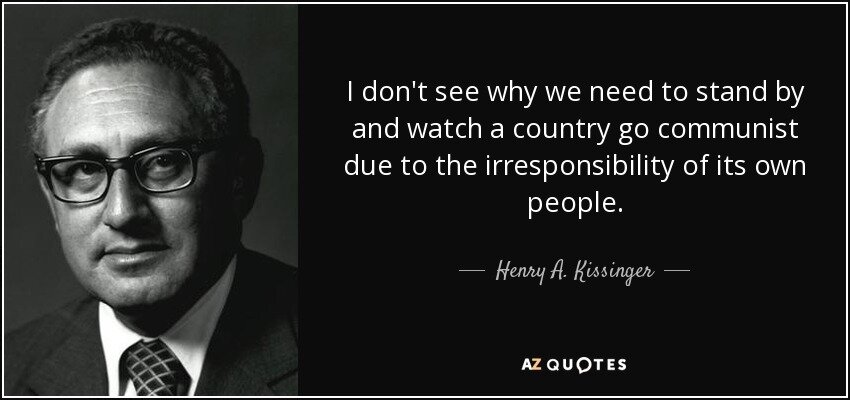
It is rather difficult to scale-up to nation-state level when the US military and/or their proxies suddenly arrive uninvited. Ask Vietnam, Laos, Cuba, Chile, Nicaragua etc Even if victorious, the necessary full focus on defence and counter-espionage tend to greatly influence the nature of the regime that emerges. Effectively installed by US destabilisation of the region, removed from office by communist Vietnam. Yes?
-
O my, yes! I'd forgotten about him, but your absolutely spot on there.
-
The Kibbutzim. Let us hope that his political incompetence leads to his disempowerment before his backers manage to fully dedemomocratise the electoral system. Perhaps Europeans of a certain age are more familiar with this imagery. but I can't see Trump speak without being immediately reminded of this: https://www.youtube.com/watch?v=UmnxcjRk37Q
-
Thesis could equally well characterise a feudal monarchy for example, while the antithesis sounds to me more like some flavour of anarchism. But it's witty and not too wide of the mark. Who's implementation? A reputable political analyst or Fox News? Okay, Wikipedia's synopsis. The scapegoating of vulnerable minorities comes a little further down the page, but it does come. Always. The same quote substituting 'Communism' for 'Fascism'? Really? Ditch the guff about natural social hierarchy and race and it might pass as a bar-room critique of Leninism but not much else. Communism in it's broader sense is simply the transfer of the means of production into common ownership. No dictator necessary, decentralised options (syndicalism etc), opposition subject only to the tyranny of a democratic vote. Not a communist as such myself but some of the ones I've met over the years seemed to be thoroughly decent people. Characterising them all as Stalin worshippers is a bit crass. Even if it is the 'usual implementation' in some benighted parts of the globe.
-
There is truth in that, but also I think some confusion between distinctions in economic policy (the left-right axis) and those of social policy (the liberal authoritarian axis). Fascism is not defined by its economic policy, but by a social policy that demonises minority outgroups based on eg perceived race/ethnicity, religion, sexuality, language etc. It is authoritarian by its very nature whatever freedoms it may bestow on its preferred ingroup(s) due to its implicit persecution of those who do not conform to its ideals. In a nutshell, this is the form of society that the OP claims to be superior to any other. On the other hand, Communism and Socialism are fundamentally economic policies to the left side of the spectrum. If coupled in mixed economy form with a liberal social policy you have the archtype European social democracy which consistently poll highest for overall quality of life for all citizens - the Scaniwegians, Switzerland, Canada etc. You know, those countries condemned by the OP as failures. Of course you're right about those examples of the authoritarian left. Right wing vested interests have persistently asserted that this is an inescapable outcome of left wing economic policy. But that's demonstrably untrue. The social democracies previously mentioned prove otherwise.
-
O, don't get me started! Oddly enough, I spent 1973 at a public boarding school that had an ambivalent attitude towards fascism that I was rather at odds with. 'World at War' wasn't on the approved viewing list so I used to skive off to my nearby Grandmother's house to watch it. Later in life, I was invited to be lead cornet in the West Yorkshire Fire Service Band which among other duties, due to their close ties with the Barmy meant I got to do the Last Post at the Remembrance Day service alternately at Leeds and Bradford. That meant a lot to me. I was very lucky not to be born into 'interesting times', but at least I had some opportunity to show my respect for those who were, and who made the ultimate sacrifice.
-
Roosevelt's support of the North Atlantic convoys to UK ports, and Barents Sea convoys to Arkangelsk and Murmansk prior to Pearl Harbor was a vital, if often overlooked contribution in the darkest days. My Dad lost a couple of cousins on the Hood and made sure I read The Cruel Sea by Nicholas Montserrat at a very tender age to make clear how brutal that episode was. Well over 50 years on, there are passages from that experience that still haunt my dreams. That and a visit to the site of Bergen-Belsen a few years later shaped a lifelong visceral reaction to Fascist ideology that the world needs now more than ever. I seem to have let a ramble take over that post. Hier legen funf tausand toten.
-
Thanks for that. Not seen that nugget in any of my field guides. Much about its pesticidal properties, aiding feather flexibility, and colouring hornbill's beaks for courtship purposes. But it seems it's an even greater panacea than generally realised.
-
If, as many believe, the European theatre was won and lost on the Eastern front, do we not owe a greater debt of gratitude to the former USSR? Just working through the logic of your argument 😉
-
... I guess typing "Shukria" is against site rules.
-
Isn't @HbWhi5F in the habit of acknowledging assistance freely given? Or is it a case of cost nowt ergo worth nowt.
-
By inference, P1 is also in mmHg. They're simply applying PV/T = constant with arbitrary units. Pressure units could equally well be in hundredweight force per acre providing they're consistent on both sides of the equality.