
joigus
Senior Members
-
Joined
Everything posted by joigus
-
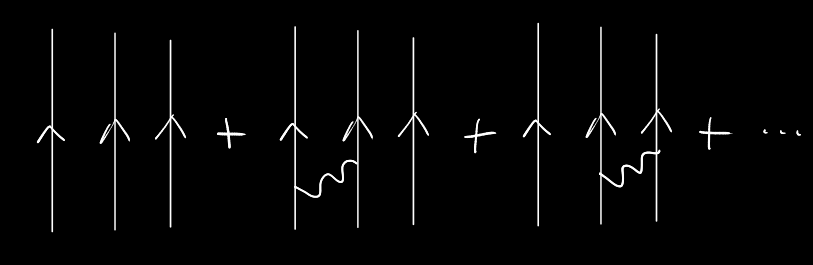
 @Albert2024, @JosephDavid, and the other guy, Let's hammer it home again. At some point somebody among you will understand (one can only hope). No vacuum in QFT has external legs. The vacuum in QFT is made up of things that look like, This means, in a manner of speaking, that the amplitudes (infinitely many of them) go from nothing to nothing. The vacuum state gives zero as expected value for the number operator of each and every particle. That, people, is what we call a vacuum. And thereby the name. A vacuum ultimately has nothing in it, except for amplitudes of something appearing there, and swiftly disappearing, according to quantum rules (HUP). Vacuum = nothing. Doh! OTOH, In the diagramatics of QFT, the "vacuum" this "paper" seems to be talking about would look something like this, That is, it has external legs (real particles that go from \(t=-\infty\) to \(t=+\infty\). In the picture I've represented a triplet of SU(3). It could be an octet, or whatever. Maybe not even an irreducible rep. of SU(3). What have you. It would have ramifications displaying vacuum polarisation, and so on. The point is: This is no vacuum. These "atoms" are there, and they keep there. Do you understand? Do you? Really? Do you, at long last, understand? Precision tests of the standard model would have detected this background (rather than vacuum) long ago, because other particles would scatter off these "atoms" copiously (among other things they would have to be 1043 times more abundant than nucleons and electrons, and 1033 times more abundant than photons. So, presumably, your beloved paper has been turned down experimentally ages ago. Remember this comment, which you also chose to ignore?: Maybe it's another completely different SU(3) gauge group, with its own coupling constant and all. You tell me. I don't have to read the article, as per SFN rules. If my arguments are wrong or misplaced, then answer them, instead of cajoling each other with idle pleasantries and even idler reputation points, plus meaningless punishing -rep points, as @Mordred pointed out. And that will be all, unless you finally come up with real counter-arguments from physics. Bye.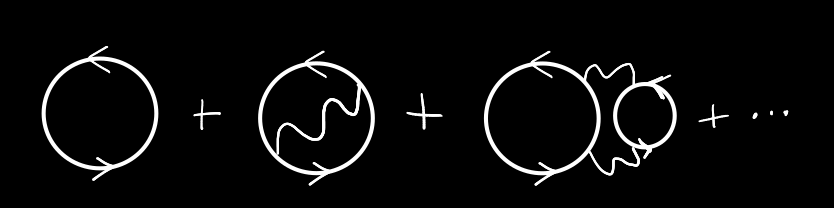
-
My recollections coincide with @studiot's. Rule. Trying to think about it afresh, if you accept that 1+(-1)=0, which seems far more intuitive, as well as (-1)*0=0 and (-1)*1=-1, the distributive property forces you to admit that, 0=(-1)*0=(-1)*(1+(-1))=(-1)*1+(-1)*(-1)=-1+(-1)*(-1) so (-1)*(-1) must be 1, which is the additive inverse of -1. I'm not sure that would be very persuasive to children though... I love this joke. It works in Spanish with "sí, sí" too. The intonation is essential.
-
ChatGPT, is that you?
-
It seems to be an either cookies, else subscribe wall. They never guess right what adds I'm interested in, so I always take them with the default settings.
-
Yes, thank you. I mixed up the energy (temperature) scales with the length scales, which are inverse to each other. 😊
-
I said this because there are about 1080 nucleons within the cosmological horizon. Nucleons are SU(3)-bound states. And 10123=1043*1080. I don't know about the holographic principle in this context. The reasoning is clearly non-holographic, as it refers to a volume content of gauge interactions giving rise to a volume content of vacuum energy density.
-
Agreed. A "vacuum" made up of SU(3) bound states wouldn't have the properties required to give rise to a cosmological constant, due to assymptotic freedom and confinement. Very clearly in particular due to confinement. How would these atoms push each other apart? At extremely low temperatures there's no interaction, and at high temperatures it's constantly producing more and more "lines of force" among every member of the triplet. So it's a no go for that reason too, IMO. I'd been thinking about that too, but generally I prefer to look for the quickest, simplest reason why an idea wouldn't work. This is not to be spiteful. It's for the sake of saving thinking time. You need to rule out bad ideas as quickly as possible. I also think that should be done before attempting any laborious calculation.
-
Yes, I remember having started to think about it when you mentioned Feynman diagrams. Sorry I didn't credit you. OTOH, now that I think of it, I don't even know what it means to say that there are 10123 particles of a given kind in the vacuum. Let alone SU(3) bound states!!! Why not virtual Vanadium atoms? No, really. Why not? The vacuum in QFT is made up of infinitely many Feynman diagrams with no external legs. They are all ultimately loops, and there are infinitely many of them, of course. The expectation value of the number operator is always zero for the vacuum though.
-
So do I. Not to mention the fact that these SU(3) "atoms" are in excess to ordinary protons in the universe by a whopping factor of 1043 and high-precission tests of the standard model have told us nothing about this bizarre vacuum. Things in the vacuum get scattered when the necessary energy is supplied, because they shift the Feynman diagrams in a way that cannot be ignored. But I could be wrong, of course. I also think the thread is going inordinately fast, with a noise-to-signal ratio that makes it prohibitive for the likes of me.
-
Yes, I've read about it. So maybe you don't have to quantise the gravitational field. People have thought of that before. It didn't work. What's new here is that the metric is stochastic, which removes the consistency problems. It's been drawing a lot of attention, let me tell you. The theory is kind of Frankensteinish in the sense that the Liouville formulation of classical mechanics coexists with quantum dynamics of fields. It's ugly IMO, it looks pretty user-unfriendly, very heavy on the technical side, but it could be a preamble to some simplifying idea that explains why space-time, and the 'field' accompanying it are fundamentally different. The author himself concedes as much: (from the paper) Btw, a simplifying idea is what physicists call 'beauty', a term sorrily misunderstood. Thanks for the posts. Very interesting. ++
-
ST geometry is usually said to take place in a 1+3 dimensional geometry. Meaning that one of the dimensions is singled out as time (by means of the so-called signature of the metric), and the other three constituting sections of the geometry at given times (so-called space-like surfaces). So what the OP is suggesting, it seems, is that a new dimension appears inside the BH when gravitational collapse occurs. Is that the case? Otherwise, GR's geometry already is 4D, as Mordred said. Or has this additional spatial dimension been there all along, like a dummy, that only acquires importance in the case of gravitational collapse?
-
True master of one-liners. The one about dating cracked me up!
-
And yes, fields is the relevant concept there. I forgot. Sorry, I didn't realise this was under the Teasers and Puzzles section. I added a spoiler.
-
This should easily be the most ignorant comment on these forums so far. 10120 (ten to the one hundred and twenty something) is not a precisely calculated number (like the fine structure constant, or the electron g factor). It is the gross overcount that QFT gets when applying cutoff on the harmonic oscillators to the Planck scale, to roughly estimate the energy density of the vacuum. So it's not that 10123 is the legit number for QFT vacuum energy density. This a grossly wrong number! And the thing to explain is not why Nature offers us this number. Rather, it is that the actual energy density of the vacuum is so low, instead of being this absurdly high number. Ditto.
Yes, thanks. That's right. I missed that possible interpretation. If I understood correctly most previous arguments, one cannot reach those distances in that sense either, and I agree. That kind of interstellar travel would require humongous energy. And the braking process too. The argument surfaced at the very beginning, although I'm not up to date on the follow-up Q&A.
In literature for example? I remember myself being quite OK with Tolkien's use of magic, as long as he didn't care to "explain" it. So we've got water, and fire, and earth, and wind, and the laws of Nature, and magic. Fine with me for the purposes of entertainment. When the Star Wars franchise started to appeal to midi-chlorians to try to "explain" how the force is particularly strong in some individuals, I remember having felt really disappointed: Do midichlorians act on ribosomes? Are they nucleotides, proteins...? I'm not sure those are absurdities though... I agree, btw, with most everybody else that science doesn't give you purpose. I love metaphors, so there goes mine: Science gives you a map of the territory, increasingly precise. What road to take is your choice.
Love every pixel of it! It reminds me of the Impressionists...
Oh! Such a good question! +1
And I applaud your applause. Truth be said, there are few members who are more willing to offer a helping hand.
GR, obviously. Newtonian gravity is perfectly linear. Real gravity is much more like GR... Or GR fits much better real gravity, NG being a suitable approximation for weak fields and slow velocities. A badger is similar to a skunk, and the probability of them being identical is 0%. I hope there's a point to this...
What is controversial, that gravity is non-linear, or that sources of gravitational waves do not have a unique signature? Doesn't seem to me like any of those things are controversial.
Oh, I see. I was thinking more of short distances rather than longer ones, as Lorentz contraction makes the accelerated body shorter and shorter. But the OP, as well as other members have been talking about cosmological distances too, now that you mention it. I must confess I haven't figured out how both are related. It seems like some combination of length contraction and time dilation (contraction relative to the traveller relative to the observers tied to the planets?). What I fail to see is how one is supposed to use these effects to achieve interstellar space travel. It could be that OP is trying to combine effects happening in different frames... This happens often.
I have. 🥹 It's so statistically significant that feels like troll farming. As soon as one is done, there's another one that seems to be saying, 'ok, I'll take over from here'.
That's a pattern of behaviour that you see in insects often, IMO.
Important Information
We have placed cookies on your device to help make this website better. You can adjust your cookie settings, otherwise we'll assume you're okay to continue.