
Genady
Senior Members
-
Joined
-
I remember getting a question on my US citizenship exam (many-many years ago), "What is Constitution?" with one line for an answer. I've answered, correctly, "Constitution is the supreme law of the land."
-
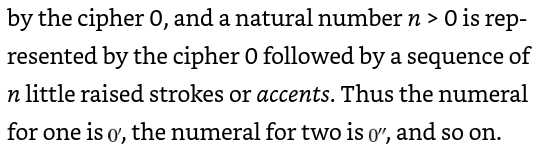
This notation, (rather than, e.g., S or s) is new to me. Only two days ago it was new to me, and it is already in my next book:

-
I've read it only last month and they've made a movie already 🙂

-
A good math joke, albeit 30 years old:

-
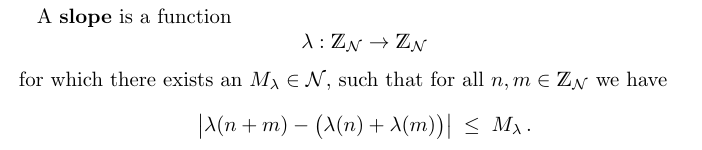
Right. And my book says, but still, since all the numbers here are integer, the definitions [math]|\lambda(m+n)-(\lambda(m)+\lambda(n))| < M_{\lambda}[/math] and [math]\left\{ \lambda(m+n)-(\lambda(m)+\lambda(n)) \right\} \,\text{is finite}[/math] are equivalent.
-
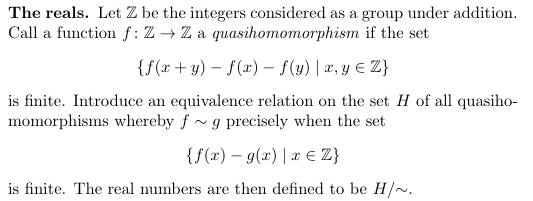
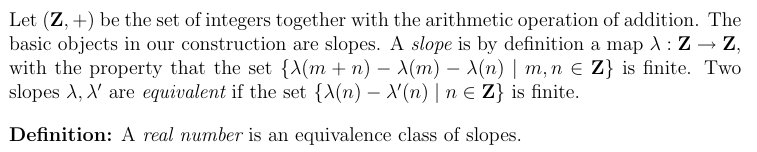
I still don't see a difference between the two constructions mentioned above. The first says, The second, Does anybody see how they are different?
-
Whoever it was that downvoted you, I've balanced it by an upvote, just as you've done for me earlier.
-
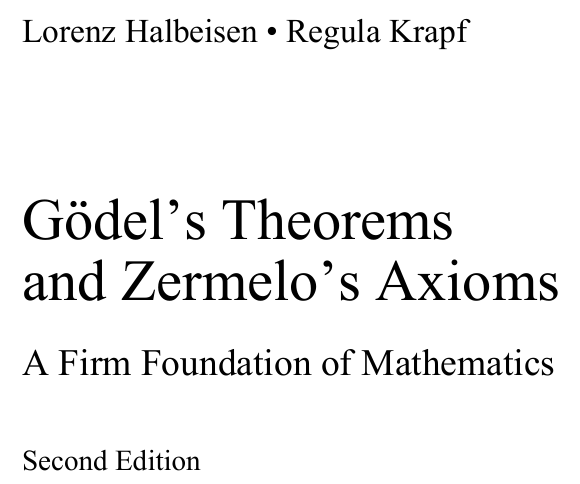
Yes, I'm studying this book: This notation, (rather than, e.g., S or s) is new to me.
-
This note of yours has a direct relevance to this "Quiz" of mine here: https://www.scienceforums.net/topic/140398-from-naturals-to-integers-quiz/ 🙂
-
The construction that I've learned recently follows closely the "2.12. Schanuel (et al.)’s construction using approximate endomorphisms of Z ([2, 11, 16, 29, 30, 1985])" in your first linked paper. Interestingly, my book cites rather "Norbert A’Campo, A natural construction for the real numbers, Elemente der Mathematik, vol. 76 (2021)." P.S. Ah, I see that A'Campo's is your second linked paper. Perhaps, there is some difference that I didn't see yet.
-
Thank you! I didn't know about 10 different ones, only about three, I think. And they all constructed rational numbers before constructing reals. So, a direct route from Z to R without Q was interesting.
-
Real numbers can be constructed directly from integers, without a construction of rationals.
-
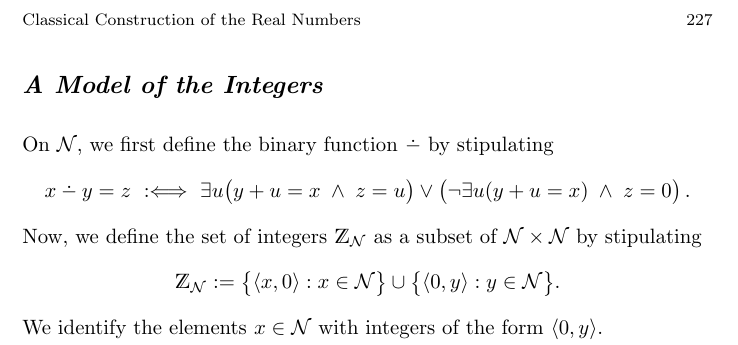
Given natural numbers [math]\mathcal{N}=\left\{0, 1, 2, ... \right\}[/math], Why do they identify [math]x \in \mathcal{N}[/math] with [math]\left\langle 0,y \right\rangle[/math] rather than [math]\left\langle x, 0 \right\rangle[/math]? Does it matter? If yes, how / when?
-
Right. As they say in the first part of the definition, xRy and x=y are mutually exclusive.
-