
Genady
Senior Members
-
Joined
Everything posted by Genady
-
Here it is: Mapping [math]f: A \to B[/math] is onto if for any X and any mappings [math]p: B \to X[/math] and [math]q: B \to X[/math], [math]p \circ f = q \circ f \Rightarrow p=q[/math].
-
TIL that "one-to-one" mapping between two sets can be defined as an external property of the mapping, i.e., without any reference to elements of the sets and to what happens to them under the mapping. Here we go: The mapping [math]f: A \to B[/math] is one-to-one if for any X and any mappings [math]p: X \to A[/math] and [math]q: X \to A[/math], [math]f \circ p = f \circ q \Rightarrow p=q[/math]. Can you come up with a similarly external definition of "onto" mapping?
-
It's from fb: https://www.facebook.com/permalink.php?story_fbid=pfbid028dPTEhRvxf6j3HMNy52Ymv742GMuQXekebvDo8DzjkAU9EuiENkDdM1Kt2TAUM8hl&id=100090706310719&__cft__[0]=AZZHIbs76gT7OBtsHj6mMXIx5moXtwff6b04aSxChSwB5lEXYpPMSGOGKRrOS9uci6M4uNynPdHRcXUqgAn7915tu-8VZC_TjOrw2r4iP4O92OMOlQ6FBa5PGInZyi69m869_BZmfljXXH2ce7DMOVWjbE4olX7ZzZg8C7glt3qkEg&__tn__=%2CO%2CP-R
-
These are not words in English.
-
Yes, it does. It is an effective manipulation technique.
-
Because it works.
-
I remember getting a question on my US citizenship exam (many-many years ago), "What is Constitution?" with one line for an answer. I've answered, correctly, "Constitution is the supreme law of the land."
-
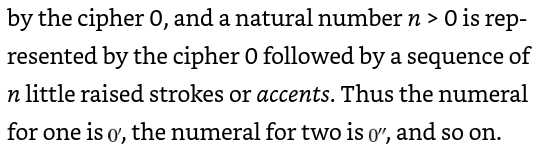
This notation, (rather than, e.g., S or s) is new to me. Only two days ago it was new to me, and it is already in my next book:

-
I've read it only last month and they've made a movie already 🙂

-
A good math joke, albeit 30 years old:

-
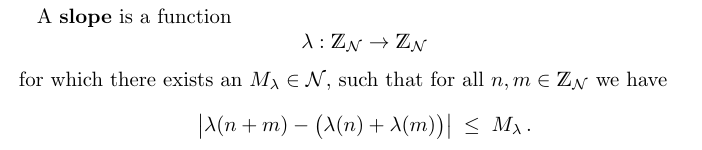
Right. And my book says, but still, since all the numbers here are integer, the definitions [math]|\lambda(m+n)-(\lambda(m)+\lambda(n))| < M_{\lambda}[/math] and [math]\left\{ \lambda(m+n)-(\lambda(m)+\lambda(n)) \right\} \,\text{is finite}[/math] are equivalent.
-
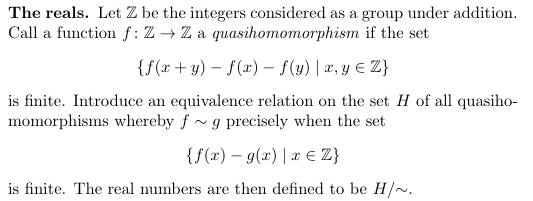
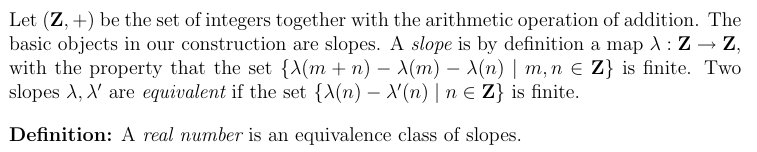
I still don't see a difference between the two constructions mentioned above. The first says, The second, Does anybody see how they are different?
-
Whoever it was that downvoted you, I've balanced it by an upvote, just as you've done for me earlier.
-
Yes, I'm studying this book: This notation, (rather than, e.g., S or s) is new to me.
-
This note of yours has a direct relevance to this "Quiz" of mine here: https://www.scienceforums.net/topic/140398-from-naturals-to-integers-quiz/ 🙂
-
The construction that I've learned recently follows closely the "2.12. Schanuel (et al.)’s construction using approximate endomorphisms of Z ([2, 11, 16, 29, 30, 1985])" in your first linked paper. Interestingly, my book cites rather "Norbert A’Campo, A natural construction for the real numbers, Elemente der Mathematik, vol. 76 (2021)." P.S. Ah, I see that A'Campo's is your second linked paper. Perhaps, there is some difference that I didn't see yet.
-
Thank you! I didn't know about 10 different ones, only about three, I think. And they all constructed rational numbers before constructing reals. So, a direct route from Z to R without Q was interesting.
-
Real numbers can be constructed directly from integers, without a construction of rationals.
-
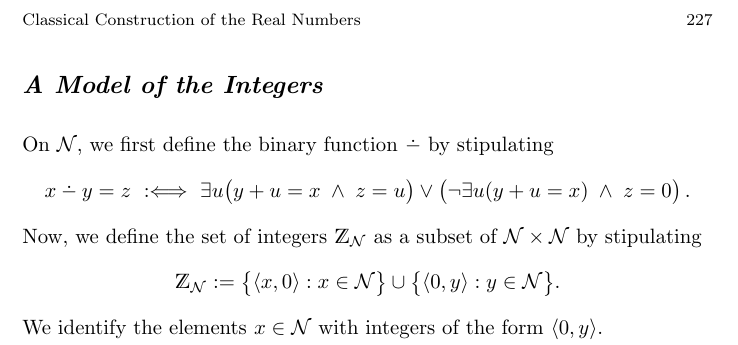
Given natural numbers [math]\mathcal{N}=\left\{0, 1, 2, ... \right\}[/math], Why do they identify [math]x \in \mathcal{N}[/math] with [math]\left\langle 0,y \right\rangle[/math] rather than [math]\left\langle x, 0 \right\rangle[/math]? Does it matter? If yes, how / when?
-
Right. As they say in the first part of the definition, xRy and x=y are mutually exclusive.
-
-
Ha, that's too. Still, there is another one, related.
-
Without going into any technical details, the short answer is,

-
No. (Check your notes or references about basics of algebra.) I've checked. Turned out that I am right. Can you find what is mistaken in the quoted definition? (Read it carefully in the OP.)
-
No topology here. This is pure set theory, more specifically, ZFC. There is no requirement that a set has to be well-ordered. It is only a definition, when it is. I claim that the definition as stated is meaningless, i.e., no set so well-ordered exists. (I don't remember which quiz/riddle on divisibility I posed months ago ☹️ ) P.S. I like your "Location." 🙂