
Genady
-
Joined
Posts posted by Genady
-
-
TIL that "one-to-one" mapping between two sets can be defined as an external property of the mapping, i.e., without any reference to elements of the sets and to what happens to them under the mapping. Here we go:
The mapping [math]f: A \to B[/math] is one-to-one if for any X and any mappings [math]p: X \to A[/math] and [math]q: X \to A[/math], [math]f \circ p = f \circ q \Rightarrow p=q[/math].
Can you come up with a similarly external definition of "onto" mapping?
-
16 minutes ago, swansont said: You need to provide a citation
-
-
-
-
-
-
-
-
1 hour ago, studiot said: Yes I agree they are the same construction with different notation.
This is exactky what I mean by a plethora of notation.
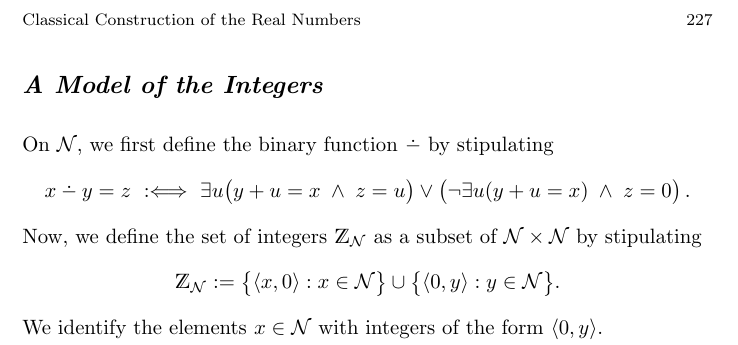
Right. And my book says,
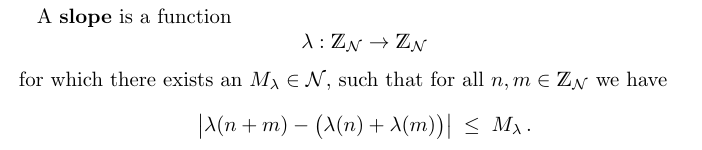
but still, since all the numbers here are integer, the definitions
[math]|\lambda(m+n)-(\lambda(m)+\lambda(n))| < M_{\lambda}[/math]
and
[math]\left\{ \lambda(m+n)-(\lambda(m)+\lambda(n)) \right\} \,\text{is finite}[/math]
are equivalent.
-
4 hours ago, Genady said: The construction that I've learned recently follows closely the "2.12. Schanuel (et al.)’s construction using approximate endomorphisms of Z ([2, 11, 16, 29, 30, 1985])" in your first linked paper.
Interestingly, my book cites rather "Norbert A’Campo, A natural construction for the real numbers, Elemente der Mathematik, vol. 76 (2021)."
P.S. Ah, I see that A'Campo's is your second linked paper. Perhaps, there is some difference that I didn't see yet.
I still don't see a difference between the two constructions mentioned above. The first says,
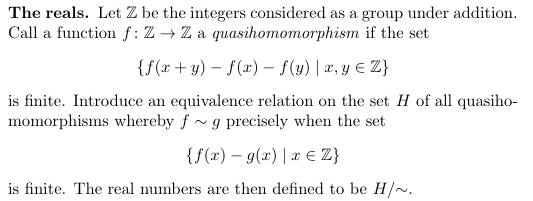
The second,
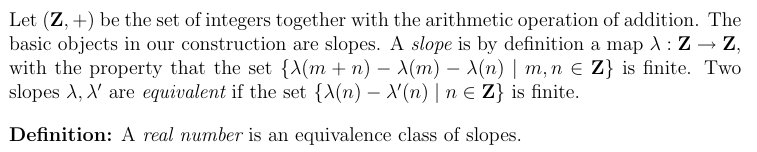
Does anybody see how they are different?
-
35 minutes ago, studiot said: You don't actually have to post in a thread to 'vote', which is why I originally responded as I did for I did not then know who it was.
The mods can see who voted what, of course.
Whoever it was that downvoted you, I've balanced it by an upvote, just as you've done for me earlier.
-
-
1 hour ago, studiot said: One note of interest is confirming that the 1 in the naturals is the same as the 1 in the reals or the integers
This note of yours has a direct relevance to this "Quiz" of mine here: https://www.scienceforums.net/topic/140398-from-naturals-to-integers-quiz/ 🙂
-
47 minutes ago, studiot said: There has been continued interest in this subject since the days of Cantor and Poincare.
Here are a couple of recent papers.
One note of interest is confirming that the 1 in the naturals is the same as the 1 in the reals or the integers for those who widh to be strictly pedantic.
The construction that I've learned recently follows closely the "2.12. Schanuel (et al.)’s construction using approximate endomorphisms of Z ([2, 11, 16, 29, 30, 1985])" in your first linked paper.
Interestingly, my book cites rather "Norbert A’Campo, A natural construction for the real numbers, Elemente der Mathematik, vol. 76 (2021)."
P.S. Ah, I see that A'Campo's is your second linked paper. Perhaps, there is some difference that I didn't see yet.
-
Edited by Genady
2 minutes ago, studiot said: Yes all constructions of R are isomorphic, I think at the current count there are more than 10 different ones.
The only real issue about this is do you include the number zero in the naturals ?
I don't see the downvote as justified, so I have added a balancing +1
Thank you!
I didn't know about 10 different ones, only about three, I think. And they all constructed rational numbers before constructing reals. So, a direct route from Z to R without Q was interesting.
-
-
-
-
-
4 minutes ago, KJW said: @Genady, is the mistake you see that subset S requires at least two elements and not merely be non-empty?
Ha, that's too. Still, there is another one, related.
-
-
-
24 minutes ago, joigus said: I'm more and more rusty on these things with every passing month, but doesn't the latter require S to be a closed set to be true?
At the very least it requires a topology, if I remember correctly. Open subsets don't necessarily have minimal elements.
I remember I still have a quiz/riddle on divisibility that you posed months ago pending. I'm sorry about that. Maybe you published the solution?
No topology here. This is pure set theory, more specifically, ZFC.
There is no requirement that a set has to be well-ordered. It is only a definition, when it is. I claim that the definition as stated is meaningless, i.e., no set so well-ordered exists.
(I don't remember which quiz/riddle on divisibility I posed months ago ☹️ )
P.S. I like your "Location." 🙂

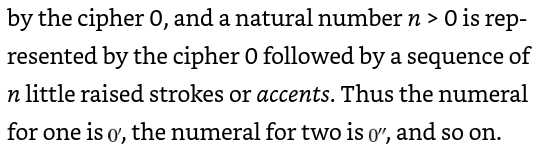



Today I Learned in Mathematics
in Mathematics
Here it is:
Mapping [math]f: A \to B[/math] is onto if for any X and any mappings [math]p: B \to X[/math] and [math]q: B \to X[/math], [math]p \circ f = q \circ f \Rightarrow p=q[/math].