
Genady
Senior Members
-
Joined
Everything posted by Genady
-

-
Do you have any discussion points pertaining to Astronomy and Cosmology?
-
Does time exist? Yes, it does.
-
The formula above is correct only for a flat spacetime in Minkowski coordinates. The general GR formula is, $$ds^2=g_{\mu \nu} dx^{\mu} dx^{\nu}$$ (the summation convention implied.) In GR, this "crucial parameter" does not appear in any important formulas. There is no such thing. It is either one event or separate events. Nowhere in GR time is treated as the 4th spatial dimension.
-
Absolutely!!! Please, moderators, do this right thing!
-
What does make you think about hyperbolic planes? What do you mean by "the field of physics"?
-
What physics do you know? And, as mathematics is the language of physics, what mathematics do you know? Relating to your post, what do you know about hyperbolic planes, fields in physics, forces, electromagnetic field, Euclidean plane?
-
Neither. It is just nonsense.
-
No, this is not so. Here it is:
-
Not answering is not enough. I use filters provided by the site's software to avoid seeing such bs on my screen. The site's organization provides clear separation of different forums. By violating this separation, you piss in my yard.
-
This is what defines if it belongs to this forum. So, your stuff can be "research" somewhere else, but it is spam here.
-
Science does not consider it a legitimate reference. Your "quest" is not a science, your "reference" is not a scientific reference. Take your thread and go elsewhere. Stop spamming the science forum.
-
Do you have a reference to this?
-
Sour grapes.
-
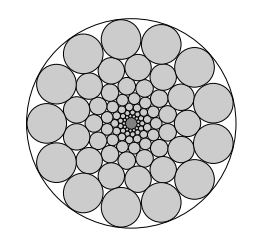
Look at the picture for case 2: You can count, \(n=13\). You can measure, \(R/r_n \approx 5\). If your formula, \(P_n = \displaystyle\frac{n \cdot r_n}{2\cdot R -r_n}\) were correct, then \(P_{13}=\displaystyle\frac{13 \cdot 1}{2\cdot 5 -1} \gt 1\), which cannot be correct because it has to be \(\lt 1\) for any \(n\). So, your result is wrong.
-
Please show it.
-
Surely your result, \(P_n=2.0944\) is wrong because \(P_n\) has to be \(\lt 1\) by its definition.
-
I'd need to see your step-by-step derivation.
-
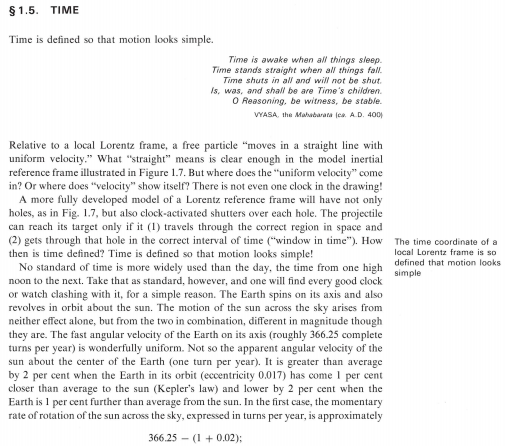
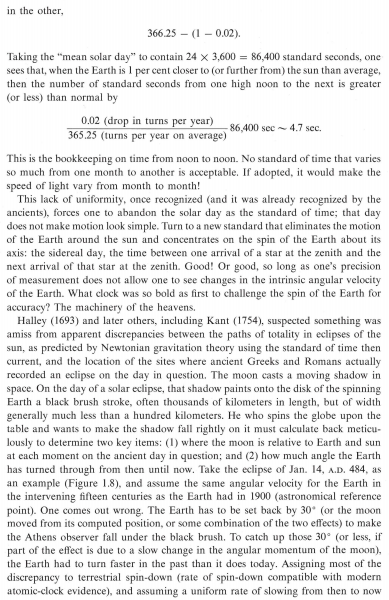
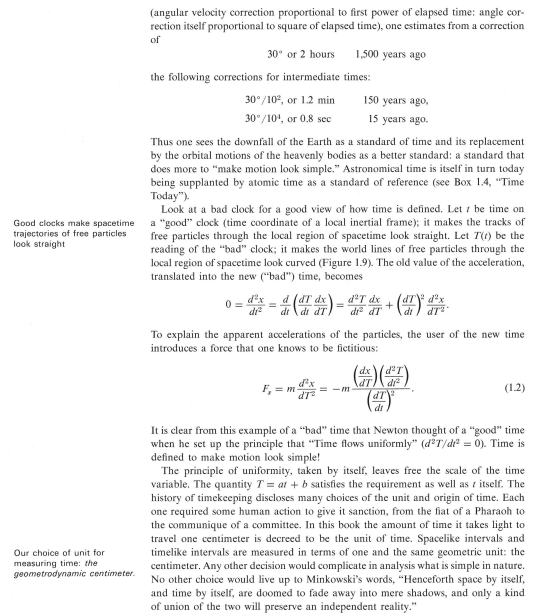
Here is the explanation of how time is defined, from the Gravitation by Misner, Thorne, and Wheeler:
-
There are many scientific formulas for time. For example, \(t= \frac d v\), \(t'=\gamma(t- \frac {vx}{c^2})\), \(d \tau^2=dt^2-ds^2\), etc.
-
You did not ask.
-
No, not necessarily. For example, if \(r_n= \frac c n\) then \[\lim_{n \to \infty} n \cdot r_n=c\]
-
"Why do we use kelvin to measure heat?" We do not.
-
Not necessarily. As \(n \rightarrow \infty\), \(r_n \rightarrow 0\).
-
The central postulate of general relativity is that local physics is physics of special relativity. And special relativity does not make any claims about matter.