
DavidWahl
-
Joined
-
Last visited
Posts posted by DavidWahl
-
-
4 hours ago, iNow said: I read it as core role. Important role. Key role. Critical role. Central role isn’t vastly different unless we’re actively looking hard for criticisms to levy… especially since the thread title uses the term drive.
“The mother played a central role in driving the family in their minivan.”
“Nuh uh! She sits up front, on the left side actually, not in the center!”
🙄
From what I’ve read so far, it seems like you guys are quite convinced that the thalamus is the primary source of consciousness, not just a contributing part. That’s what I meant by the phrase "centre of consciousness" (figuratively). It also seems like the terms "central role" and "centre of consciousness" are being used interchangeably here, even though they convey very different ideas.
-
Edited by DavidWahl
2 hours ago, DrmDoc said: Although I believe your perspective may have some merit, I think the insight the article speaks for itself by "offering new empirical support for theories that assign a central role to thalamic structures rather than cortical areas alone."
@TheVat is right. I see that the usage of the word in this case can be easily misleading if you misinterpret the context. I'm pretty sure the word "central" simply means critical or key here. This shouldn't be confused with it being the "centre of consciousness". The article doesn't explicitly state that the thalamus is the centre.
-
-
17 hours ago, exchemist said: No I have enough souvenirs already, including a framed photo of a N African guy sitting on a bench in some village, strumming a home-made guitar constructed out of a 5 litre can of Shell Rimula (an old brand of diesel engine oil) and a neck of wood. Sometimes I used to feel like that guy.
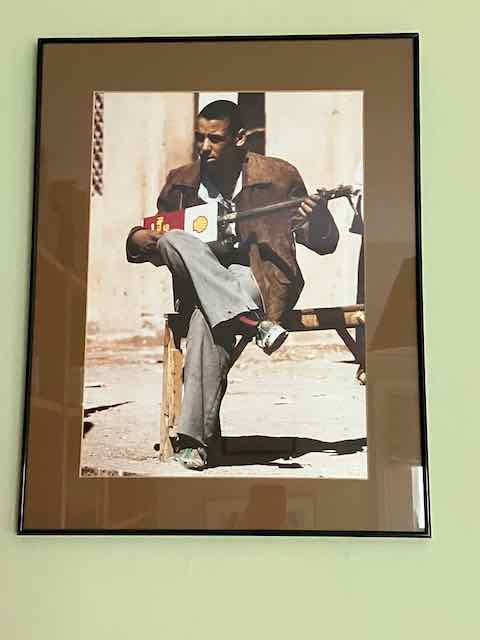
I see. Anyways, thank you for sharing this. This is soulful and achingly poetic, enough to make a grown man cry. Now I'm sad.
-
6 minutes ago, exchemist said: Yes, I remember flying over the refinery site on a trip back from Amsterdam and looking down to see...grass.... I think probably my most enduring contribution actually was the quality assurance manuals I arranged and largely wrote, based on my experience as a QA auditor, for lubricants production and distribution. That back-breaking work was so unglamorous that nobody was keen to do it again, once they were there! But I console myself they were important, even if not the sort of thing that launches brilliant careers.
That's like watching the child you raised grow up and die. Do think there's any chance that a chunk of those manuals are still lying somewhere? If I were you, I would've retrieved anything that was left of them and kept it to myself as souvenir...
-
5 hours ago, Dhillon1724X said: I had different interests since childhood,I developed websites,learnt to develop games(only basic as i left because of school),science and many more.
I kept gathering knowledge.
Currently i am training for powerlifting and working on QCF.Wow, you're an all rounder, I see. I can barely manage to keep up with one interest.
2 hours ago, exchemist said: As for "great work", well one thing one has to be resigned to as one gets older is seeing what one has done get overtaken by later events. For instance the then state of the art, robot-operated oil plant I where I was once production manager and chief chemist got knocked down, leaving the site covered with just grass. Now it is part of a container terminal!
Sic transit gloria mundi, as the popes used to be reminded, during their coronation ceremony.
That must've been painful to witness...
-
-
-
-
13 hours ago, TheVat said: That was not the legal dilemma my post was addressing. I was giving the example of someone actually doing a criminal act (killing pets) and that was simply one example. I wasn't proposing that people be arrested for Maybe Will Kill Teenagers, when they've committed the animal killing. My point was that ASPD, when it manifests in harm of some kind, would be responded to as any such behavior, with legal penalties. If, while incarcerated, a prison psychiatrist makes a finding of ASPD, then that would become a factor to consider at a parole hearing - especially if the perpetrator did not express remorse for their actions, or showed antisocial behavior with respect to other prisoners.
I agree that once actual harm has occurred, it makes sense for traits like ASPD to be considered in sentencing or parole. But I’m still troubled by the question: What do we do when someone shows deeply concerning signs before any actual harm is done? There was a recent case of a teenage boy who created horrifying, disturbing drawings fantasising about murder and later went on to actually murder someone. His father noticed the signs prior to the event but didn’t act likely out of fear of overreacting. Was it right for society to wait? As @studiot also suggested, this issue is far more complex and nuanced than it may first appear. It runs deeper into society. It's not as simple as saying, 'Act only after harm is done,' or 'Don't criminalize traits.' We're dealing with difficult questions now about how to respond to warning signs that don’t yet qualify as crimes but may indicate serious risk.
13 hours ago, TheVat said: So, no, not a fan of Phil Dickian "pre-crime" enforcement.
I'm not in favor of pre-crime punishment either but I believe we should at least have a preventive system that allows for early support or intervention when someone shows credible signs of dangerous intent. That way we could protect others without criminalizing mental illness. This is the grey area I believe we need to take seriously.
-
57 minutes ago, TheVat said: If they score high on the HC, and start slaughtering the neighbor's dogs who disturb their beauty sleep, and the teenagers are next on their list, then that's a different situation where criminal justice comes onto play.
But there's a serious ethical dilemma here. Do we wait for violence to occur before we act even when we strongly suspect it’s coming? If we always wait until someone is harmed, we risk failing the victims who could've been saved, the damage is irreversible. Let's say there weren't any clear and early warning signs like killing the neighbor's dog, then who gets to decide what counts as a threat? How do we go about resolving this without crossing into the line of punishing someone for having a mental illness?
-
Edited by DavidWahl
1 hour ago, studiot said: It can be done if you rearrange your dots.
The trick is to use polar coordinates not cartesian ones and arrange you dots (which in the limit have zero diameter) in radial lines and then consider the angle between each line, taking the limit as that angle tends to zero.
You might also find the six circles and seven circles theorems interesting, along with Steiner chains.
(they do not fill all the circle.)
This is a good way to show that the dots do cover up the entire circle but what I dislike about this method is that it doesn't say much about the arrangement, it simply ignores it. Depending on the 2D-arrangement we choose, the packing density can change. Besides, I'm not sure it's safe to assume that an array of infinitesimally small circles to be approximately equivalent to a line. What about those gaps?
-
Edited by DavidWahl
Does someone know this?
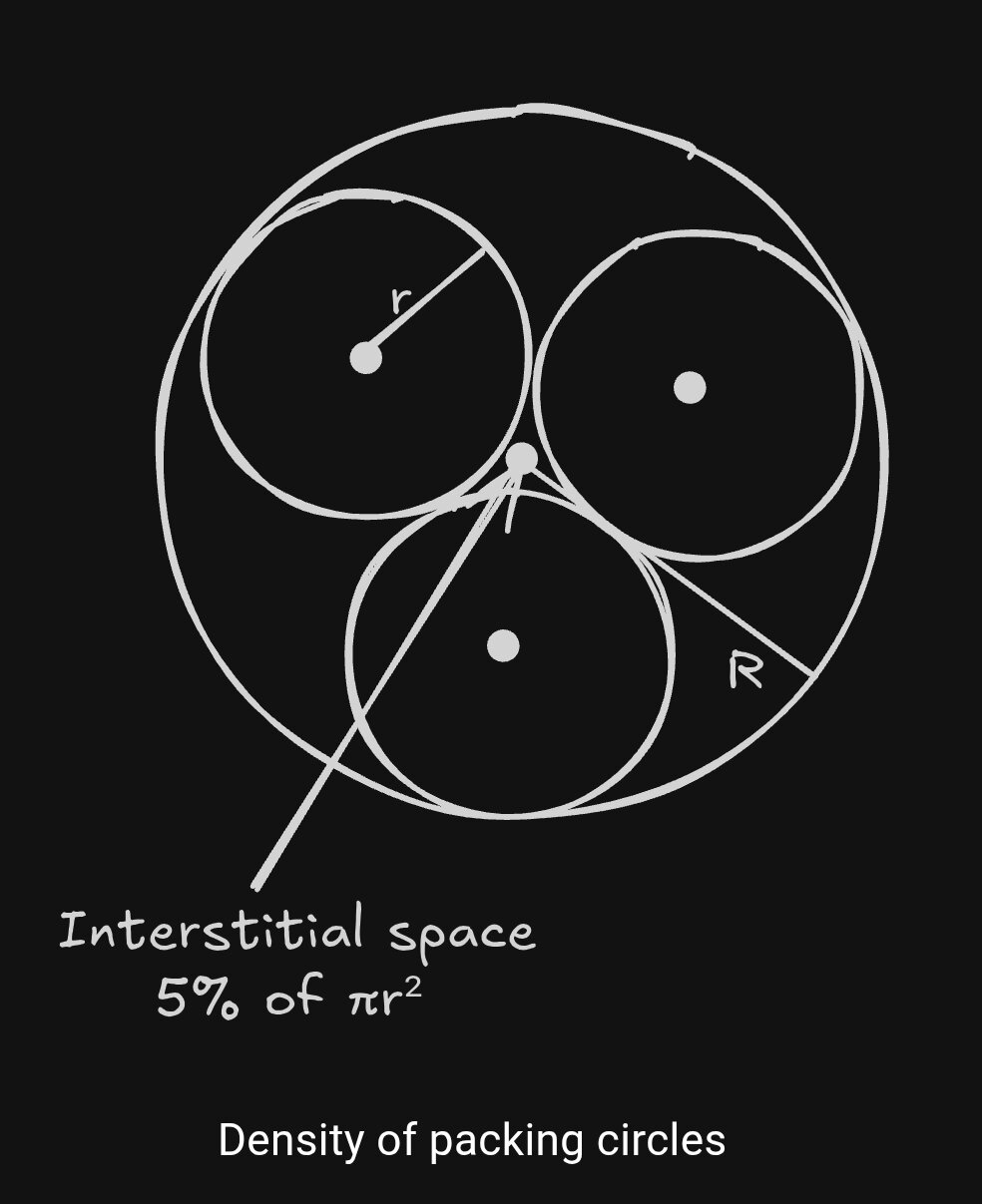
While I was making a small study on circle packing recently, I came across this problem that left me scratching my brains. I found this problem interesting and wanted to share. It goes something like this:

Q) We want to reduce the size of circles and as we do so, fill them up into a different and bigger circle as much as possible (maximum). As the radius of the small circles approaches to zero and fills up the mother circle,
1.Does the packing density approaches to 1 (filling up the entire mother circle)?
OR
2.Does the packing density approaches to that of the hexagonal lattice arrangement (i.e. 0.906...) and therefore not filling up the entire mother circle?
(For those who don't know, packing density is the ratio of the area covered by the circles to the total area of the space they are packed into. It's a measure of how much space is covered by the circles compared to the total space available.)
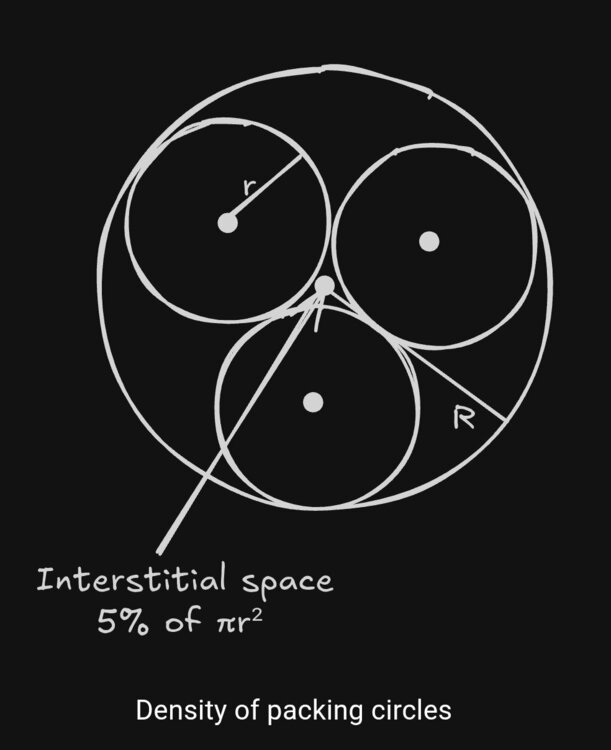
If you know calculus, in this case, the small circles will behave as infinitesimals and at first, it might seem obvious that the small circles must fill up the entire mother circle. But, if you observe carefully, circle as infinitesimals do not behave like traditional infinitesimals (rectangles) where as the breadth of the rectangle shortens, the gap between the infinitesimals and the curve decreases therefore covering up the entire area under the curve. Whereas in the case of circles, the size of the gaps (interstitial space) remains as significant as the circles themselves making up 5% of the area of the small circle. Therefore, as the size of the circles decreases, both the gaps and the circles equally compete for space. But I'm not really sure if this is still the case when the circles theoretically become point-like. It could be possible that the limiting packing density could be something else entirely.
-
14 minutes ago, dimreepr said: Well, no one has managed it so far, so how would you know what is required to succeed?
This is something I have come to understand from my own experience; although, specifically in this matter, we don’t have to witness success to know what it demands. I believe we already have all the important information we need. The most valuable benefactor of science will be the one who can fit all the pieces of the puzzle together harmoniously.
-
Edited by DavidWahl
16 minutes ago, exchemist said: Yes, I quite agree with both of you that it is a false argument to suggest that a low probability event is equivalent to an impossible one. I'm less sure I follow you in your comments about the evidence for life arising naturally. We have no theory of abiogenesis as yet.
We have plenty of evidence that modern life forms arose from earlier, simpler ones. One can reasonably that back to the idea of some original life form or life forms, which were the first to be "alive", but we don't have any actual evidence of the existence of these. All we have to go on is the commonality of much biochemical architecture across all modern life, which might suggest evolution from some common ancestor.
I think it is important in arguing with creationists (not "theists", please note, as plenty of theists accept life can have originated without special supernatural intervention) not to overstate the evidence. One thing I find creationists often don't understand is that science, being evidence-based, does not pretend to have all the answers already.
I agree with everything you said. We don't have a theory of abiogenesis yet but we aren't clueless either, recently there has been significant progress made in the field. I think finding the evidence for the first forms of life would be extremely challenging or maybe even impossible. Unlike creationists and something we are all acquainted with, the lack of a complete theory doesn’t imply a supernatural alternative by default. Naturalistic explanations continue to dominate with great success.
-
On 12/25/2024 at 11:15 AM, KJW said: I didn't put the two statements together to logically connect them. I put the two statements together because individually they are both begging the question.
No, they are not. And if they are, it's because you misunderstood my premise and have already formulated an opinion based on a false assumption.
On 12/25/2024 at 11:15 AM, KJW said: The first statement is an observation grounded in scientific evidence of what exactly?
That the conditions necessary for life's origin were met at least once and that evidence from history is, to a great degree, logically consistent with our origin. I’m just pointing out that the history of Earth shows a sequence of events that led to life. Whether those events were guided or not is a separate debate. My point is that a contingent natural history doesn’t necessitate a designer, even if it doesn’t exclude one either.
On 12/25/2024 at 11:15 AM, KJW said: "5) A pertinent question arises: is it merely coincidental that the most suitable environment for life to emerge and thrive happens to be the same environment we inhabit? This coincidence, though seemingly extraordinary, is a reflection of the conditions under which observers, such as ourselves, can arise to question it."
seems to me to be a statement of the anthropic principle.
Yes, I didn't know what the anthropic principle was when I made the statement at the time.
On 12/25/2024 at 11:15 AM, KJW said: "Our very existence serves as empirical evidence that such an event, however improbable, has occurred."
seems to me to be saying that our existence is evidence that the probability of forming life was not too low for it to occur without an intelligent designer, whereas this is the conclusion at which you are trying to arrive and thus begging the question. Your opponent could just as easily say that our very existence serves as empirical evidence that life occurred by an intelligent designer. Our existence may be empirical evidence, but of what exactly?
To show that life is possible. I think you're confusing probability with possibility; I should have been careful when using the word "statistical" to convey my topic. Life is possible but how much probable/improbable is another debate. I never stated anything about the likelihood of life. Since we exist, we know that some path (however improbable) led to life; that could be a natural one. Regardless of the likelihood of occurring, our existence is evidence that life happened. Whether it was completely natural or with at least some divine intervention is still an open question. So to settle your confusion:
In context, what I meant by "However improbable" is equivalent to "Irrespective of probability".
On 12/25/2024 at 11:15 AM, KJW said: With regards to the anthropic principle, I posted (on another forum) the view that the multiverse of all possible universes combined with the anthropic principle guarantees our existence regardless of how improbable life is (assuming that it is not actually impossible), making the point that our existence says nothing about its likelihood. At the time, I was suggesting that life was too improbable for it to exist elsewhere in the observable universe. Such a low probability wouldn't affect the likelihood of our existence but would affect the likelihood of the existence of alien life. The reason I mention this here is because the anthropic principle alone doesn't guarantee our existence in the absence of an intelligent designer, but combined with a multiverse, an intelligent designer is no longer necessary regardless of how improbable life is.
That's a strong argument, but I find the multiverse theory too speculative to rely on when making concrete, evidence-based claims.
On 12/25/2024 at 11:15 AM, KJW said: One additional remark I'd like to make is that I don't think the complexity of life can ever make it impossible, only improbable.
Well, yes that is exactly what I've been trying to say. My aim was merely to demonstrate that an intelligent designer is not necessary if you tried to argue from the premise i.e. even in the absence of an intelligent designer, it is not impossible for something as complex as life to have occurred. To show that naturalistic explanation suffices and naturalism is currently the better-supported framework because it builds on observable, testable mechanisms. I'm not trying to disregard intelligent design completely but to somewhat neutralise the position on life's origin in this particular case. Arguing on the grounds of the premise is useless because evidence we currently have leans toward naturalistic processes in the origin and evolution of life.
-
1 hour ago, dimreepr said: Imagine my pleasure at your condescension... 😉
I'm only returning the favour...😛
1 hour ago, dimreepr said: When did I say it did?
I never said it must.
1 hour ago, dimreepr said: Perhaps, but an emergent quality is awfully difficult to pin down...
Of course. Generally, it requires intensive labor and great skill to navigate amidst complexities without being lost. And for that, one has to be extremely disciplined and patient, and carry on the process with prudence.
-
5 hours ago, dimreepr said: There's always going to be a certain amount of anthropomorphism when dealing with an external entity, humans are just easier to approximate, in one's imagination.
That doesn't necessarily mean that one can't be more accurate, when applied to certain dog's over certain people... 😉
Poorly phrased. I didn't know one could deal with external entities inside one's mind. Good thing there's context, so I can still infer your intended meaning. You're right as long as you're talking only about qualia but there's more to consciousness than them; entities that can reside in the imagination but are not necessarily viewed through an anthropomorphic lens.
5 hours ago, dimreepr said: And you misundertsood my answer, so let me be clear, when the robots speak a language we didn't directly input into the system, we can no longer be sure, and we can no longer test, in accordance with an anthropomorphic vision...
Beyond a single word as common, I don't see how your previous statement has much, if not anything, to do with this one; but yes, you're almost there. If AI gains consciousness and continues to develop, that wouldn’t prevent us from studying the underlying structures of conscious systems (both artificial and biological). We can study those internal structures that gave rise to consciousness. In fact, I believe it could help us uncover more fundamental processes responsible for consciousness beyond the limits of biology and anthropomorphism. Of course, all of this under the assumption that those similarities or components do exist. But even if we fail to do so, I'm sure we can learn many things from this endeavour.
5 hours ago, dimreepr said: Simple never exposed nuance, it often seeks to mask it...
Not everything has to be nuanced to appeal to the intellect.
-
On 7/25/2024 at 4:36 PM, dimreepr said: Ask a dog, suppose you're Dr Doolittle and you can talk dog (without anthropomorphising), do you think you'll understand what it is to be a dog, without being able to lick your own genital's, or sniff the difference between a bitch and a dog etc.?
Yes, to a certain degree, I can. I don't need to be a dog to understand what it's like to feel hunger or to feel physical pain like dogs do in general because of our shared biological basis. Other than that, I'd actually have to be a dog in order to fully understand what it's like to be one. Forget about dogs and think about a similar case like this involving humans instead. Do you think you can truly understand what it's like to be a homosexual man assuming you're a heterosexual man? Is it possible, purely through the means of imagination and empathy, to understand the feeling of being sexually attracted to a man given that you're biologically/psychologically not androphilic in nature and you've never experienced it firsthand? This case can be applied vice versa.
On 7/25/2024 at 4:36 PM, dimreepr said: While we understand how AI work's, we can discern the output as a product of the process.
That's only partially true. Scientists still do not fully understand how ai systems work. We cannot always the discern the output of the process because, one of the reasons being, for the same input these systems can give out different outputs.
On 7/25/2024 at 4:36 PM, dimreepr said: The common/fundamental characteristics/components of all consciousness, is that we humans can communicate what it's like to be a conscious human, with other conscious human's.
You've misunderstood my question. Human beings are not the only conscious beings in existence. We can program two robots to communicate with each other about what it's like to be conscious and instill a sense of self in them but will that necessarily make them conscious?
On 7/25/2024 at 4:36 PM, dimreepr said: You need to refine your question, being careful not to conflate consciousness with intelligence...
I think my question is quite honest and clear. I'm still in search of answers. If you find it absurd or difficult to comprehend, I can always extend it's intended meaning through explanations or reframe it in more simpler terms; if you had asked for it.
-
On 10/6/2024 at 12:06 AM, Munim said:
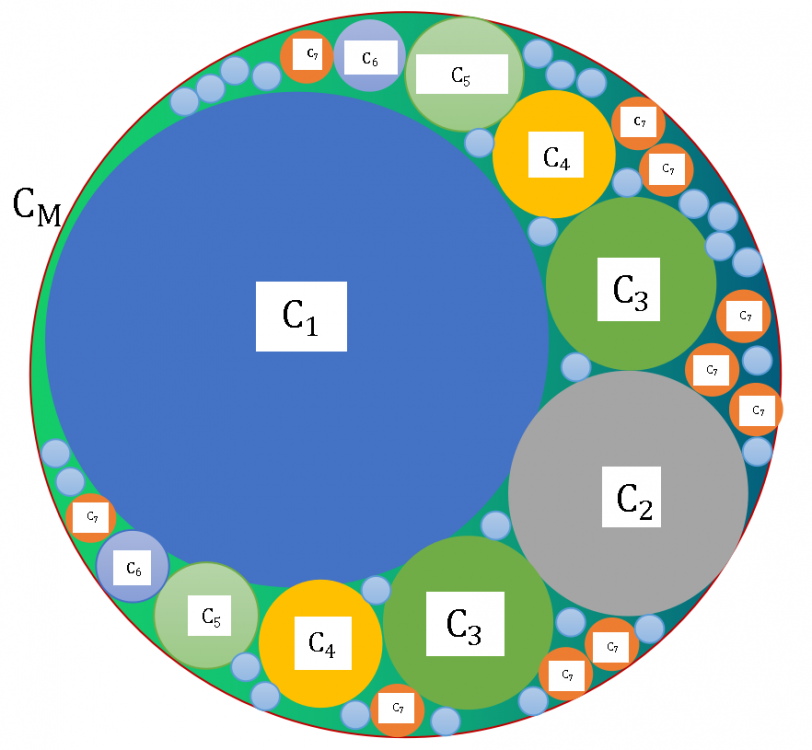
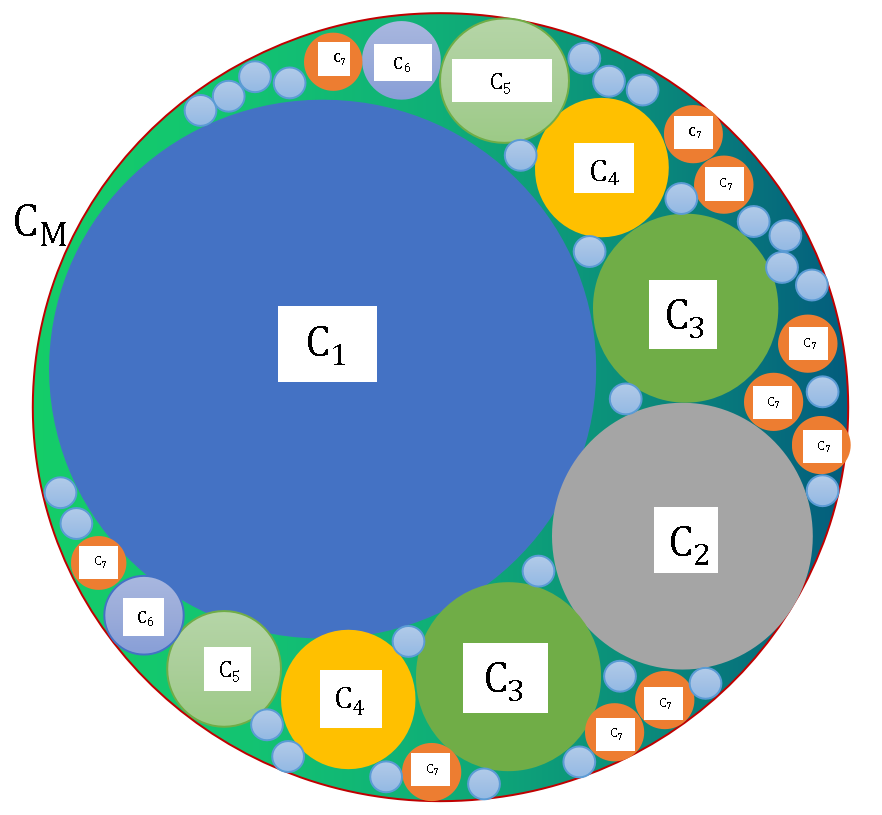
PROBLEM STATEMENT:
What is the least number of circles Ci that can be fitted inside a circle CM under the following conditions i.e. solve for the least value of n for a certain (L, i):
1. The circles Ci cannot share a common area.
2. The areas of the circles Ci must be Ai=Li*AM (where, L<1 & i=1,2,3,...n; AM=area of circle CM).
3. The system must contain the maximum number of circles Ci of the same area as possible.
A representation of the problem is attached to the post.
NB: It's an alternate statement to my previous post
To begin with, I would like to mention that I found this problem very interesting and subsequently, when I read further about it in the replies, I understood what you were trying to say even though you had poorly defined premises that definitely needed more improvement. I'm a highschool student, not a mathematician so I'm not equipped with advance tools or concepts to help you out but as of now with all my efforts, I would still like to make a small contribution to your problem. I must say this is a 'problem that consists even more problems within it' and may not be so appealing to mathematicians but I believe it has some potential in computer science as in someone can build an algorithm to solve this. I've stored my amateur work in the form of a pdf. English is not my first language so please don't mind. I hope you like it.
-
5 hours ago, Moontanman said:
I would like to suggest that the oxygenation of Earth's atmosphere wasn't exactly a benign occurrence that life then learned to use. The emergence of free oxygen due to photosynthesis was a devastating mass extinction event! Life didn't just "learn" to use it, the vast majority of life died or was forced into special ecological niches where oxygen didn't or couldn't exist while new organisms evolved to tolerate and then actually use oxygen as a energy source. This mass extinction lead to all complex life on earth.
Oxygen was a waste product, life didn't just not need oxygen, oxygen is a poison to anaerobic life! Oxygen caused a mass extinction event!
Yes I was aware of these facts beforehand. By the way, oxygen is not an energy source itself but is essential for the extraction of energy from organic molecules during aerobic respiration. And by implying that 'this mass extinction lead to all complex life on earth' is simply wrong because it alone was not the sole reason. More accurately it can be said that the rise in oxygen levels combined with mass extinction created the conditions necessary for the evolution of complex life on Earth.
5 hours ago, Moontanman said:Also, this is simply not what photosynthesis is, how it works, or how the use of it evolved "but eventually life found an ingenious way to utilize oxygen for metabolism through photosynthesis." this is just backwards and twisted and suggests oxygen was just a benign substance that appeared not to mention that metabolism doesn't always need or even use free oxygen! Also photosynthesis does not utilise oxygen it produces oxygen as a waste product, oxygen metabolism utilizes the oxygen photosynthesis produces.
I got mixed up and made a silly mistake that slipped out of my notice until you've pointed it out.
The correct that I wanted and should have written is:
"but eventually life found a way to utilize oxygen for metabolism through cellular respiration although not always exclusively"
But after a little reflection, I realised that the above statment would still be an incorrect one. As you mentioned, a lot of organisms died in the process because oxygen was poisonous to them but life didn't instantly evolved to be able to tolerate oxygen and perform aerobic respiration. Some microorganisms (likely ancestors of modern aerobic organisms) already had the biochemical machinery to use oxygen, but most likely this was initially just a minor adaptation. As natural selection goes, when oxygen levels rose dramatically, those organisms that could tolerate or even use oxygen for energy had a significant survival advantage. Since aerobic respiration is far more efficient at generating energy than anaerobic processes, this ability became more widespread and refined through evolutionary processes and is now a dominant metabolic pathway for many organisms. Even cyanobacteria, the main contributors of the oxygen uprise, was one of the earliest organisms that could perform aerobic respiration so that it could metabolize even in the absence sunlight and thrive in the oxygen-rich environment.
-
Edited by DavidWahl
6 hours ago, studiot said:In particular this one where I did not say that oxygen was eityher necessary or unneccessary. I said that going from no unbound oxygen to a biogenerated atmousphere of between 10% and 20 % was an enormous change, not to be dismissed lightly.
I understood what you meant. Some of the conditions were different back then. The environment that is suitable for current living organisms is not the same environment under which life originally emerged. Life adapted and evolved over billions of years, gradually modifying Earth's conditions to make them more hospitable for modern organisms. We are active participants in shaping our own environment, for example the emergence of cyanobacteria and other early life, as you have pointed out, caused an increased of oxygen levels in the atmosphere which contributed to the evolution of complex life. This doesn't violate my previous statement; it's an extension that is not so obvious at first sight but requires understanding to see how things play out with time and bring about those changes. Although I think I do need to make revisions and incorporate this as well if I need to strengthen my argument.
6 hours ago, studiot said:Is what I said not true then ?
Personally? Yes what you said is agreeable but, as I mentioned, it is unnecessary to what I'm trying to argue. The intention of writing these set of arguments is not to give the idea to the reader that I'm inconsiderate of other fields of knowledge and in no way do I want that. I chose physics particularly for simplicity and convention or else I would've mentioned everything on the list. Your attack is less on the formal and more on the personal side which I found meaningless with respect to the context.
6 hours ago, studiot said:You are the only one who mentioned thermodynamic equilibrium.
Yes I did, but still equilibrium is perfectly fine in this context as well. Unless, you feel like equilibrium should only be one thing. In that case, you can state your strong points why equilibrium should not be used the way I used it.
6 hours ago, studiot said:I posted an excerpt from Wiki which directly contradicted the statement you made.
I read it and everything is in alignment to my arguments as far as I'm concerned. I didn't find the contradiction that you said which is why I asked you to offer me more clarification and to be more specific. Unless by contradiction, you meant this:
"Evolution could be anything like the evolution of anime, technology, fashion and more"
Versus
"Evolution is not a random process"
To be honest, this is the only contradiction that my brain could point out.
6 hours ago, studiot said:You did not respond to my offering of the New Horizons data.
I didn't because I couldn't find the article after playing with all word combinations I could make from the sufficient information you gave me. So I now request you to kindly provide me a link but only if you want to be bothered.
6 hours ago, studiot said:Firstly I was not feeling very well the other night so I apoligise if you thought my posting over aggressive.
The red vote was not mine so I have added a + vote to cancel it.
However please read it properly as you have not responded to the points I made but points I did not say.
Not that I found it aggressive but a little careless. I apologize from my side too, I replied without giving much thought to what you said. If I haven't mentioned it yet, I'm relatively new to philosophy so I'm not properly acquainted with advanced concepts, argumentation, lexicon and condensed expressions. I try my best to do whatever I can and write what goes inside my head. Frankly I'm here to learn from others and have a bit of fun as well. So, please feel free to correct me when I'm wrong.
-
Edited by DavidWahl
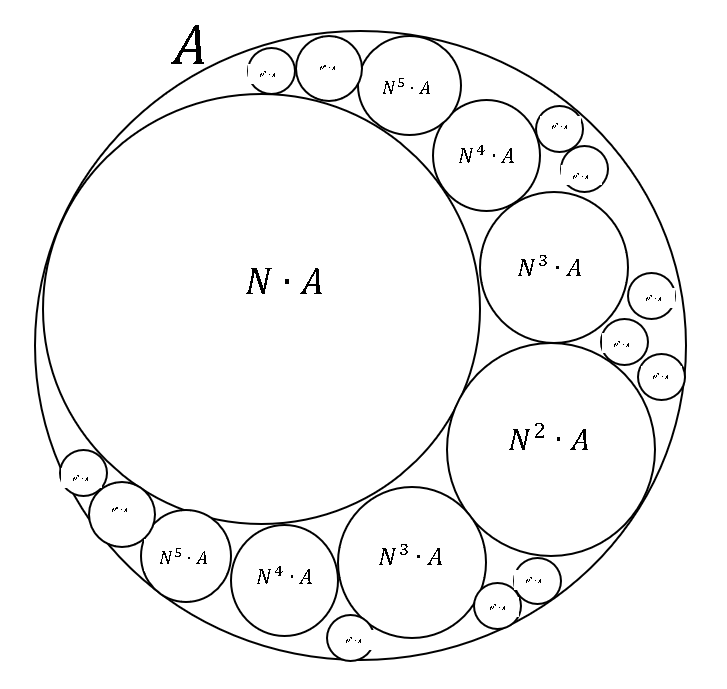
On 10/5/2024 at 11:55 AM, Munim said:PROBLEM STATEMENT:
What is the least number of smaller circles that can be fitted inside a mother circle under the following conditions:
1. The smaller circles cannot intersect or be contained inside any other circle besides the mother circle.
2. The areas of the smaller circles must be N (N<1) times any existing circle inside the mother circle.
3. The system must contain the maximum number of circles of the same area as possible.
I believe you are aware that problems like these are specially categorised under the area of Circle Packing in mathematics.
By intuition, the number of circles that can be fitted into the mother circle should be infinite because of your second premise, so I suppose there isn't any least number(?).
One of the ways to prove this is to show that for any given area (no matter how big or tiny it is and regardless of its shape), you can always try to fit some circle of area (N^k . A) where k is a natural number, A can take any arbitrary value and 0<N<1 as you have conditioned. And subsequently you can reasoned out that the number of such circles that can be fitted must approach to infinity.
Premise 3 doesn't have much an effect on this, in fact even if you slightly change it in certain ways, the result will still be the same because of the overpowering premise 2. This will hold true even if the mother shape (A) isn't a circle.
Until mathematically proven, I can't really be sure if all of this is true so there's room for speculation.
-
Edited by DavidWahl
11 hours ago, swansont said:The statistical argument is a shell game. It’s an argument used to justify a position that had already been reached. When it’s refuted, the proponent Gish-gallops to the next argument. Lack of/poor information isn’t the barrier.
It’s fine to put better information out there, but it’s unlikely to change minds.
I agree.
I've found that misrepresentation, misinterpretation, and manipulation of statistical data are among the methods they often resort to, to support their biased arguments and make weak justifications.
It is unlikely to convince them but by erecting a more solid set of arguments based on evidence, I'm expecting it would prevent them from developing complex, obscure and yet nonetheless wrong arguments in the future and reinforce them to take time to understand what is written before they could point out what is wrong but, of course, only if they don't want to embarrass themselves which is also very unlikely. When you don't make good, simple and complete arguments, they'd find ways to exploit them for which they haven't really understood and later they repeat their premises to argue with someone else because they haven't lost their faith in them since they don't think you have been able to completely refute them.

Thalamic Nuclei Oserved Driving Conscious Perception
in Science News
·
Edited by DavidWahl
That's very plausible, though the only thing that keeps me a bit skeptical is the olfactory part. Based on my limited understanding, one definite takeaway is that the thalamus seems deeply involved in maintaining the coherence of conscious experience. It's likely, what they would say, the conductor behind the illusion of unity and continuity of subjective experience.