
swansont
Moderators
-
Joined
-
Last visited
Everything posted by swansont
-
 Sunset being the operative word here. The sun would block the view - you need to be able to view Jupiter when it’s dark, and line-of-sight to Jupiter has to be far enough away from the sun to do the observing. Plus, Jupiter would have moved. I don’t see a way to achieve the geometry required. You could get close if you waited about 11.5 years, since oppositions/conjunctions are on a ~13 month cycle. “At closest approach, Jupiter will appear at a separation of only 0°55' from the Sun, making it totally unobservable for several weeks while it is lost in the Sun's glare.” https://in-the-sky.org/news.php?id=20270831_12_101 image from https://www.fas37.org/wp/planetary-opposition-and-conjunction/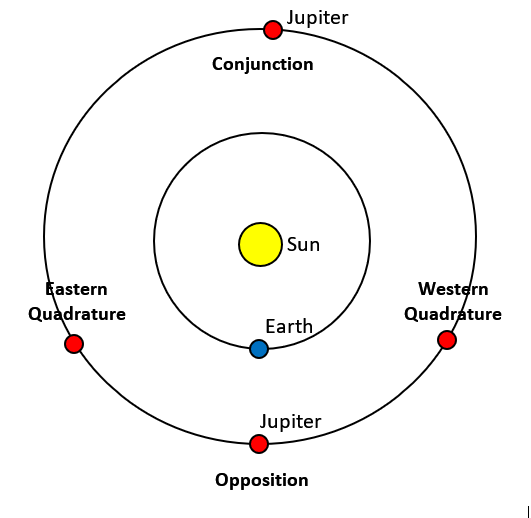
-
We have greater precision these days, because we have atomic clocks. How accurately can you divide a 24-hour day with the technology available back then? Pendulum clocks were a recent invention, and most didn’t have minute hands because of their limitations. Mechanical clocks have errors from temperature and humidity variations. Days have 24 hours, but that’s an average for solar time - that’s why GMT is mean solar time - it’s an average solar day. The location of the sun at noon varies, and determining noon is subject to the same kind of limitations as other astronomical observations. So maybe you are precise to around a minute or so, but that’s ~10% error on this experiment. How could that refer to light crossing the earth’s diameter? It probably means not visible for 11 minutes as compared to the expected time, but as discussed earlier, that can’t be for the earth on exact opposite sides of the sun.
-
There’s a list of historical determinations of the AU in this link. The ones in the 1600s tended to be low, by as much as 40%. The best ones from that era are still off by around 7.5% https://en.wikipedia.org/wiki/Astronomical_unit There would be errors in Jupiter’s position as well, so the distance to Jupiter would have errors, and there would be limits on the timing precision and accuracy.
-
SD? BD? I told you my idea. 22 minutes (not 11) to travel 2AU. Given the precision that they could achieve with the measurements, it’s not a bad estimate As has been pointed out, both in this thread and in the literature, it’s 22 for the diameter. One huge issue is that you are not doing a good job of understanding the information that you’re given. There is no reasonable expectation that an observation ~250 years ago would have the small errors we can achieve with recent measurements. If you want to claim this you’d need to show that all of the relevant parameters were already accurately determined. (you can’t)
-
Establish the timing of a cyclical process, which in this case is the eclipse of Io. You notice it happens regularly (either the disappearance or re-emergence) so you can predict when it will happen in the future, which you confirm over the course of several days or weeks. Predict when they will happen several months from now, and also the following year at opposition. Check when they actually do, and note the discrepancy in time, t, between predicted and actual eclipses. Confirm that the measurement at opposition is correct but measurements spaced by several months are off, which tells you it’s not an issue with Io’s orbit. Using orbital mechanics, estimate the difference in distance (d) between earth and Io for these events. Light speed is d/t
-
Moderator NoteIt’s enough to confirm that LLMs make stuff up, which is why this kind of discussion isn’t permitted. Stop posting it.
-
It’s a mirage from the hot air right above the track refracting the light because it’s at a lower density than the air away from the track. The air is also turbulent, so the refraction is varying in time, blurring the image https://en.wikipedia.org/wiki/Mirage Scroll down to “heat haze”
-
No, it’s not what he did. As KJW noted earlier, he looked at eclipses, and you only see one per orbit, either entering or leaving shadow. A link to the Wikipedia page was provided. from that article: “The key phenomenon that Rømer observed was that the time between eclipses was not constant, but varied slightly over the year.” (bold added) IOW, the time of day was not consistent with the occurrences on a regular cycle. He was looking at the time between the eclipses, not the duration of them. The time of day of observed vs time of day expected is what showed the discrepancy.
-
You’d need new physics to explain how you could. And there’s no need to shout
-
Where are you getting these numbers? From actual observation, or are you basing them on your own ideas? The idea behind Rømer’s observations is not that the duration that Io is visible changes. It’s when it becomes visible, or disappears. If the orbit is determined to sufficient precision, those times should be predictable, but observation didn’t match up - there was a discrepancy when the earth was farther away. Whatever event was being observed happened later than expected. That applied to its disappearance and its reappearance Note the time (on a clock) that the photons stop arriving. It happens when you take the time the light is blocked/unblocked and add the time it takes for the light to reach earth (Ttravel) Notice that this happens on a regular cycle, so you can predict the time you expect the photons to stop/start. When the earth moves farther away, the clock time when the photons stop/start later than expected because of the increase in Ttravel In the animation, the light is blocked at ~ 6 seconds and the photons stop arriving at 8 second so Ttravel is 2 seconds. If you double the distance, the light will be blocked at the same time, but the photons would not stop until 10 seconds, because Ttravel is now 4 seconds. The event happens later.
-
Thank you. Getting a response to a pretty straightforward question was like pulling teeth. This isn’t a physics forum, it’s a science forum, and a moderator enforces rules (my role as moderator is mostly irrelevant here, as there has been no need for moderator action). I never claimed expertise in cosmology. You might consider that misunderstanding can also be based on inadequacies in the presentation, and that asking for clarification is an effort to gain understanding. Also that berating people for asking for clarification is perhaps not the best approach. (this observation is why my role as moderator is not completely irrelevant) Thank you for the laugh.
-
I wasn’t asking about DM in your hypothesis. I will rephrase: You gave a result for “Newtonian Baryonic” with a RMSE of 43 km/s. I wanted to confirm that this did not include DM. Because the obvious followup is what do you get with DM? Comparing your result to DM-free data is meaningless. Who cares what the RMSE is for an incomplete, biased data set? Both suffer from the same issue of being the wrong tool, IMO. It’s not very informative. It’s AN answer, to be sure, but it doesn’t address the objection. For HSB/dense galaxies you invoke the internal observer effect to explain why there is a poor match, but for LSB galaxies you do not. But later you define internal observer as looking at a system in their own potential well. All galaxies (other than the Milky Way) should therefore be external observers, not internal. There was also an issue of physically justifying the sqrt(3) value, which I think KJW asked. Yes, you invoke this factor that doesn’t align with its definition, and even though you invoke a hand wave, it doesn’t change the fact that the equation is a poor match, which you admitted to.
-
I don’t think I made these points. There are your responses. Chi-squared, for example, is still a curve-fitting test, but I don’t see where you answered my question about whether dark matter was included. I don’t see where you addressed the issue of your internal observer effect only being applied to some observations. I tried to quote directly from your posts. “Yes, for some dense galaxies (like NGC0801), there is indeed an overshoot at the bulge.”
-
My coup was by the books.
-
No “we” don’t know this. If, by “disappears” you mean “we lose sight” then yes, it’s true. But if you mean its location is behind Jupiter, then it’s not. Io will be visible to our eyes when it’s behind Jupiter, or in its shadow, for an additional ~10 minutes after it’s physically there, because light from it takes time get to us. In the same way we notice a lag between thunder and lightning, because sound travels slower; we see the light almost immediately (of order a microsecond) but sound takes of order a second if we’re a few kilometers away. You need to be precise in your descriptions
-
The upshot of this is that you can’t tap into zero-point energy, so it can’t be an energy supply. This also points out the shortcoming of looking at descriptions of physics rather than doing actual physics.
-
You don’t need them to be mini-BHs, and the obvious next questions are what do you get when two electrons fuse in this way and where are these particles?
-
The Newtonian solution they both obey the same 1/r^2 trend, so the repulsion is always bigger than the attraction by the same factor. How do you get enough of an attraction? You would need to propose some new physics.
-
Why? These would seem to be pretty much orthogonal. One can be a gifted researcher and a bigot, and also a stealer of lab notes. And getting or taking credit for others’ work is not an uncommon occurrence. PIs, for example, routinely get credit for work done by their students, even when they are doing far more administrative work than research.
-
This suggests it’s based on your preposterous misunderstanding of the situation and not on actual observation. IOW, you’re just making it up. Interesting detail, but I think the gross misconceptions on display are unrelated to this. LLMs are not reliable sources of information One misconception on display is that somehow we’re seeing distant things as they are right now, which is contradicted by mounds of evidence. Distant stars might not be there anymore, as we see them, as they could have gone supernova in the years it takes for light to get to us. We routinely have to account for delays for various electromagnetic signals. You can detect where a break in a fiber-optic cable is using a time-delay reflectometer (important for telling you which manhole is closest to there you need to go to do repairs). GPS receivers work by justing the difference in the timing of signals from satellites so you can find your location by trilateration. All of this is being ignored with the fixation on this one set of observations.
-
Angle would be different, so the arc it has to travel will be different, but they might have the numbers backward. (or wrong) Not sure where 4:10 comes from, but when it’s occulted as viewed from the sun, the sunlight is blocked by Jupiter. When occulted as viewed from earth, the sunlight may or may not be hitting it; that depends on where the sun is. We can’t see it because Jupiter is opaque. It will absorb or reflect light and we can’t see things behind it, like with any planet. Light reflected by Io doesn’t pass through it. I’m not sure why you think this is relevant, since the salient issue is that the distance does change. Throw the balls, but vary the distance. You notice the first ball arrives at 12:00 and the next one at 12:05, then 12:10, so you confirm the 5-minute interval. Then he moves, but launches them on the same schedule. The ball you expect at 1:00 shows up at 1:01. If you know the change in distance you can determine the speed of the ball. The ball took a minute to travel the additional distance
-
The number was incorrect, but I don’t understand your fixation with it, considering the relatively crude techniques involved, and the associated uncertainty in all of the values used in the calculations. I don’t get why this is a mystery. Io emerges, and it takes 11 minutes for the light to get to earth. But we can do (and have done) other experiments/observations to confirm this, and you’re ignoring them. No we wouldn’t. You can’t make an assertion and also use it as established fact. We see pulsars pulse at regular intervals. We get radio signals from satellites that don’t have these distortions.
-
I’m unsure how you can decouple the two concepts. If it takes time to travel a distance, that ‘s associated with a speed. I don’t think there’s any question that it disappears. Jupiter is opaque. As for real time, the simple answer is no, it takes time for a signal to reach an observer, and there’s 350 years of science that happened after Rømer that can be used to confirm that. What he discovered was that it takes light time to travel. The earth’s diameter was only part of that, and not directly measured. This is an assertion on your part, backed up by no evidence whatsoever. Which you won’t find, since the evidence that exists contradicts it. When you synchronize atomic clocks, you account for the signal travel time. You can then compare that to a clock that is moved from source to target and back, which confirms that there is a delay and the synchronization was done properly.
-
You wouldn’t but this doesn’t reflect what Rømer did, so I don’t see the point. The observation about a finite speed of light rested on when the occultation happened vs when it was predicted to happen, not on how long it took.
-
2009 is not cutting-edge. What has happened since then? Did the LHC provide evidence to support the conjecture? Here’s the blurb and the paper, which makes several predictions regarding LHC experiments. They discovered the Higgs after this was written, and the LHC has achieved 6.5 TeV per beam. Seems like we would have heard about the idea panning out. https://www.technologyreview.com/2009/05/14/31114/could-all-particles-be-mini-black-holes/ https://arxiv.org/abs/0905.1667