
swansont
Moderators
-
Joined
-
Last visited
Everything posted by swansont
-
 So it’s not contemporary physics that thinks this, it’s a few physicists speculating about something to investigate, in articles that might very well follow Betteridge’s law.
 -
For us, sure. But it’s true for anyone else, wherever they happen to be.
-
Actually Rømer inferred 22 minutes for the diameter. His number for the speed of light would have been low, if he had calculated it. But his calculation was not accurate for a number of reasons, and concluding anything about the actual value of c from this is erroneous. The thing is, it’s an inferred value, not a direct measurement. You can’t measure the timing of an occultation at closest and farthest separation, 6 months apart. For the second measurement, Jupiter would on the wrong side of the earth to be viewed at night, and even if earth, Jupiter and the sun were lined up for the first measurement, Jupiter would have moved in 6 months, and you would not have the alignment. Unfortunately most of his notes were destroyed in a fire, but it seems obvious that he made a number if measurements and extrapolated from that data to get these values, but they would depend on how well you knew the positions of both the earth and Jupiter. Even if the earth were fixed the timing would change because Jupiter moves, changing the distance and thus the time of light travel. But you can’t observe Jupiter unless it’s visible at night, away from the sun as viewed by earth. i.e. not at or near solar conjunction. So it seems obvious that he and others made multiple observations, and because they had some idea of the orbit, you could use Kepler’s laws to predict times of occultations, but these had some variation in them, for reasons that Rømer exposed. So if these data were averaged, any given occultation would likely happen earlier or later than predicted. It’s possible the expected times were based on observations made during opposition, since you could make more measurements. Hence observations made at other times would be later than predicted. By reconstructing the positions of the planets, he determined his 22 minute number, but as I said, there would be errors stemming from how well he knew Earth and Jupiter’s orbit, as well as the period of Io, and how well time of day could be determined.
-
The fact that his synchronized clock reads 10 minutes later tells you that. This isn’t an issue. While it would be in an actual experiment, we’re assuming that everyone agrees on where Io is when it disappears and reappears to the earth observer. The misconceptions lie elsewhere
-
No, my argument is that the events all happen ten minutes later. If you somehow get 20, you’re double-counting. If we have an observer (J) with a clock near Jupiter, synchronized to one on earth (ignoring the small relativistic effects) and J observes IO going behind at 12:00, the earth observer (E) sees it happen at 12:10. IO emerges at 1:00, according to J. E sees it emerge at 1:10. Both see the event last an hour, but E sees everything happening ten minutes later than J does.
-
You appear to be confusing “how long it takes” with “what time it happens” which is the same problem as the last time you posted on this topic. There’s also an issue with assuming a measurement made in the late 1600s would be as precise and accurate as modern ones
-
It would be hidden for one hour. It would be visible for 10 minutes while it is actually behind Jupiter, because it takes ten minutes for the light to get to us. It won’t show up for another hour, because after it emerges from behind Jupiter, it will take another ten minutes for the light to get to us. IOW it is not where it appears in the sky, owing to the light travel time. All events are delayed by ten minutes. Which is what Rømer discovered.
-
Moderator NotePosting to promote your pet theory in someone else’s thread is hijacking, and posting to promote your book is advertising. Both are against the rules.
-
Citation needed. What contemporary physics “considers” this? Dark matter is non-baryonic, so how can in be inside baryons?
-
I don’t know, but nuclei do deform. There’s the liquid drop model. An excited nucleus will oscillate like a blob of fluid. For a large nucleus, the two lobes get far enough apart that they don’t attract (the strong force has a limited range) but still repel owing to the Coulomb force, and you get fission.
-
Depends on what constitutes a problem. I don’t know about “required” but nuclei in particle accelerators are “pancaked” when observed from the lab frame. As far as not being able to exist, it’s sort of an ill-formed proposition. There is always some frame where it’s true, i.e. some fast moving particle exists, somewhere, and that can’t affect what happens in the object’s rest frame. All of the laws of physics are the same regardless of your (inertial) frame. Put another way, there is no object that inherently spherical, because the shape is relative.
-
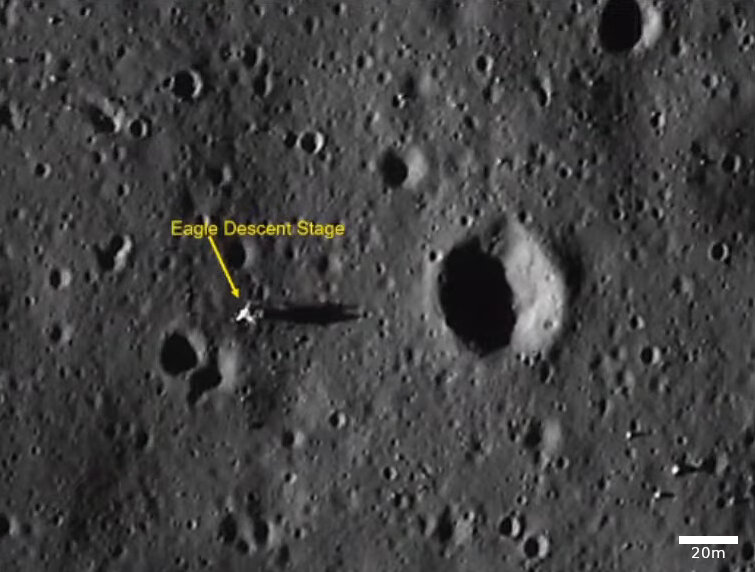
There are images from Chandrayaan-2, but I’m not sure this particular one is real. It’s higher in resolution, and the craters are different. Also, the shadow seems different (more triangular in this one) but that could be sun angle. https://en.wikipedia.org/wiki/Third-party_evidence_for_Apollo_Moon_landings#/media/File%3AChandrayaan-2_Apollo.jpg
-
I have not. I pointed out an instance of cherry-picking and then added discussion. You can’t legitimately count these as unique events. The fact that you admit your model doesn’t work well with a certain subset of the data should be enough to show that using RMSE is not a good measure of its quality. It’s why there’s a joke about the statistician with their feet in a tub of ice water and head in an oven says, “On average, I feel great!” Nobody is required to go to external links, per rule 2.7 The conclusion from this is that the model is flawed, but you haven’t admitted that. You’re also neglecting to respond to the other issues raised.
-
But this is a science discussion site.
-
But you did the former, and not the latter, when you posted “Look at galaxy IC2574 (and many LSB galaxies like it). Here, the baryonic contribution is low even at small radii. The "missing mass" problem appears immediately near the center.” which is what I was referring to. “many like it” ≠ all IOW, you basically said your model is a great fit for a subset of the data, which is cherry-picking. “Yes, for some dense galaxies (like NGC0801), there is indeed an overshoot at the bulge. This suggests that the transition from "Newtonian" (center) to "Relational/Dark" (outskirts) dynamics might depend on the local potential depth (the "internal observer" effect I mentioned in the paper that Ill link below” You don’t explain why this “internal observer effect” only happens for some observations. Aren’t all of our observations subject to this? Seems to me you are just substituting a fudge factor so you can say there’s no dark matter. “Thus, the factor –√ 3 is the signature of a holistic observation of a closed system from the outside (Galactic Scale), while Newtonian dynamics represents the differential observation from the inside (Local Scale).” How can a constant factor arise in galaxies that could vary widely in their gravitational potentials? If it’s because of our own potential, where does that come from? I don’t see where our orbital parameters show up in your model. Can you show a detailed calculation of this?
-
Ran across this on bluesky. Prevalence of allergies is a fairly recent phenomenon, following the pathogen load reduction of improved hygiene and modern medicine. It’s a discussion of how to mitigate the situation. “Evidence suggests a combination of strategies, including natural childbirth, breast feeding, increased social exposure through sport, other outdoor activities, less time spent indoors, diet and appropriate antibiotic use, may help restore the microbiome and perhaps reduce risks of allergic disease. Preventive efforts must focus on early life. The term ‘hygiene hypothesis’ must be abandoned.” https://pmc.ncbi.nlm.nih.gov/articles/PMC4966430/

-
That tends to happen when you cherry-pick data. But for galaxies who have little DM at small r, the orbits are just Newtonian, which suggests that your theory doesn’t predict such orbits properly. What happens when you calculate the orbit of the earth about the sun using the same method? And just a few days ago you said “I spent too much time addressing philosophical objections instead of focusing on the mathematical derivation. It won't happen again.” and here you are arguing philosophy. No matter. If the numbers disagree, and one argues that one is correct, the other must be wrong. You can’t claim otherwise.
-
This is just some sleight of hand, though. You used a measured value that depends on G and M.
-
“The frequency illusion (also known as the Baader–Meinhof phenomenon) is a cognitive bias in which a person notices a specific concept, word, or product more frequently after recently becoming aware of it” https://en.wikipedia.org/wiki/Frequency_illusion As for the rest, it’s why anecdotes are not evidence. Without a systematic study, you can’t say that these coincidences happen more than others. They’ve just been cherry-picked.
-
I’d like to see the derivation, and also the justification that RMSE is the appropriate standard to apply. Also, if this calculation is including dark matter. If no, and you’re just shifting the curve up, then the agreement is worse at small r. You get better agreement at large r, but the issue is that the shape is wrong, so you’re not solving the problem. There’s also an issue that the SMBH masses are inferred from theory, so if the theory is wrong, the masses are wrong and everything has to be recalculated.
-
Which would explain why their bill didn’t drop to zero.
-
Not with water, but a closed-loop system can use something with a lower boiling point. There are a number of possibilities.
-
Presumably the installation of a data center would include installing the power and data transfer infrastructure. The computers are Raspberry pi processors, which draw a few watts each. https://www.solarpowerportal.co.uk/colocation/could-modular-data-centres-heat-britain-s-homes-a-look-at-thermify-s-heathub “The HeatHub includes 450 Raspberry Pi processors, which collectively sit in a box the size of a combi boiler. The heat generated by undertaking cloud computing tasks contracted to the company will be used to heat a water tank over the course of about two hours.” I imagine part of the motivation is saving on real estate costs I have to wonder if any large-scale data centers could run turbines off of the waste heat and defray a portion of their electricity costs, or put these (or larger) setups where there is already heat distribution infrastructure.
-
Some radiation has rest mass. It’s electromagnetic radiation that doesn’t, so photons are not matter. Matter has mass and takes up space. It has fundamental fermions in it, which is why it takes up space.
-
Is there any evidence these came from the same direction? I have not seen any, nor is it obvious that we could precisely determine the origin direction, since they could have been deflected along the way. But from what I can find, Atlas came from a distinctly different direction than the first two, since it came in close to the plane of the ecliptic, and the other two did not.