swansont
Moderators
-
Joined
-
Last visited
Everything posted by swansont
-
 I guess not. I don’t see a connection. There is no “classical entanglement” (if there is such a thing) in your example. With spin or polarization, you know the two possible outcomes, and know how they must relate to each other. So this “further information” is available.
 -
! Moderator Note Split, as this has nothing to with the relativity question under consideration in the other thread
-
This is unclear to me. Are you asking about dress code rules? It seems like that where you’re going but there’s no actual question I can parse. Also you’re discussing laws but posted this in psychology. Please clarify. ”revealing clothing” rules are generally applied to women/girls, which is sexist. There’s an implied expectation that the men/boys can’t just refrain from bad behavior. (i.e. women are temptresses and men can’t help themselves) But this is both misguided and it doesn’t seem to be applied the other way around.
-
Pulling random gloves from a pile (or balls from a bag) is a straight probability calculation. The glove’s handedness is determined even if not known. My point was that there are limitations to saying the correlation is higher in quantum systems; it’s true in a Bell’s inequality experiment. It’s a case of classical physics not explaining the degree of correlation. But the underlying behavior is quantum - measuring a spin or polarization is not the same as determining the handedness of a glove. There’s no glove measurement analogue to putting the polarizers at 0 degrees and 45 degrees for photons.
-
I disagree. If I have a left glove and a right glove, they are correlated 100%, and you can’t get stronger than that. One special component of entanglement is that the states are undetermined until measured, not just hidden from observation.
-
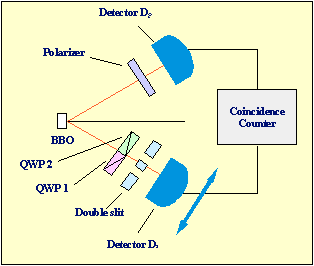
But it has been done that way. Walborn, Terra Cunha, Padua, and Monken PRA 65, 033818, 2002 https://laser.physics.sunysb.edu/_amarch/eraser/index.html But it doesn't. The entangled partner allows you to know which path, without doing anything to the photon going through the double slit. The proposal that "the two beams interfere so rapidly and in such a random manner that the light is no longer coherent."? Show that this is the case, then. Nothing has changed with the light, so why do the beams "interfere more rapidly"? Oh, well, that's just science, right? Oh, wait, no, that’s the fallacy of argument by personal incredulity If the photon only goes through one slit, how can you have interference? How are they showing which path? Where is the linear polarization in the double slit beams in the experiment I've linked to? Again, the experiment I've discussed uses circular polarization and shows interference. That's because there are multiple ways of doing the experiment, which is often the case for complex experiments, where each step might have multiple options. There are even multiple ways to do two-beam interference, without the additional parts for quantum erasure, and for delayed choice.
-
If you could entangle these properties it would apply, but you would have to formulate it in an appropriate fashion. Not all correlations imply entanglement. If a particle at rest alpha decays, for example, there us a correlation between the kinetic energy of daughter and alpha, But there is no entanglement, as these KE values are known.
-
! Moderator Note Threads merged
-
I didn’t, either In that experiment. But that’s not the only way to do it. You can polarize it before, and then not do anything to the positions of the polarizers while obtaining which-path information. As I have pointed out before. If you want to show that polarization is the culprit, you would need to explain how that is possible.
-
Nobody said anything like that. There’s nothing legitimate to be gained by making the problem more complex. There is nothing about relativity that says anything about the number of cars being relative.
-
Why would air move, without a pressure difference? PV = nRT is approximately correct. If the lungs expand, V goes up, P goes down.
-
No, there is one train. If you had two, one could crash and the other not, but every observer has to agree events, like whether it crashed. The observers will disagree on what time and how far away the event occurred.
-
I don’t see how. The train isn’t in two places at once.
-
I must say you’re doing a poor job of explaining this. Especially since, as I said, you can do the experiment in such a way that you don’t change the polarization in the double-slit. You need to explain how that happens.
-
There are measurements you can do that show that the correlation is not because the particles were secretly in that state all along, which means they are entangled https://en.wikipedia.org/wiki/Bell's_theorem
-
Our current understanding of physics is that this is not possible. It’s not an engineering barrier to be overcome.
-
Yes. The length is relative (hence “relativity”). It depends on the observer.
-
If you have entangled spins the spins are correlated, but undetermined before measurement. e.g. if you measure an electron spin up, you know its entangled partner is spin down, but they did not have those spins prior to the measurement, unlike in a classical correlated system.
-
Yes, that’s the interpretation. Why do you keep harping on about polarization?
-
But when you say double-slit experiment, it implies the basic experiment - it does not imply quantum eraser. Similarly, a quantum eraser experiment does not imply delayed choice. These are all distinct experiments and should be properly identified. The use of polarization is used to identify the path, but not in a way that compromises the interference, as shown by the fact that you get interference when you don’t know the path. You can do which-path experiments where the path is identified by looking at an entangled photon created before the interference. So the which-path information has nothing to do with altering polarizations in the double-slit path.
-
It's not one length. Go back to the example of kinetic energy you have ignored. In my frame, the train is at rest, and thus no kinetic energy. In your frame it is moving, and has a KE of, say 10^7 Joules. How can it have two values of kinetic energy? (answer: because KE is a frame-dependent quantity)
-
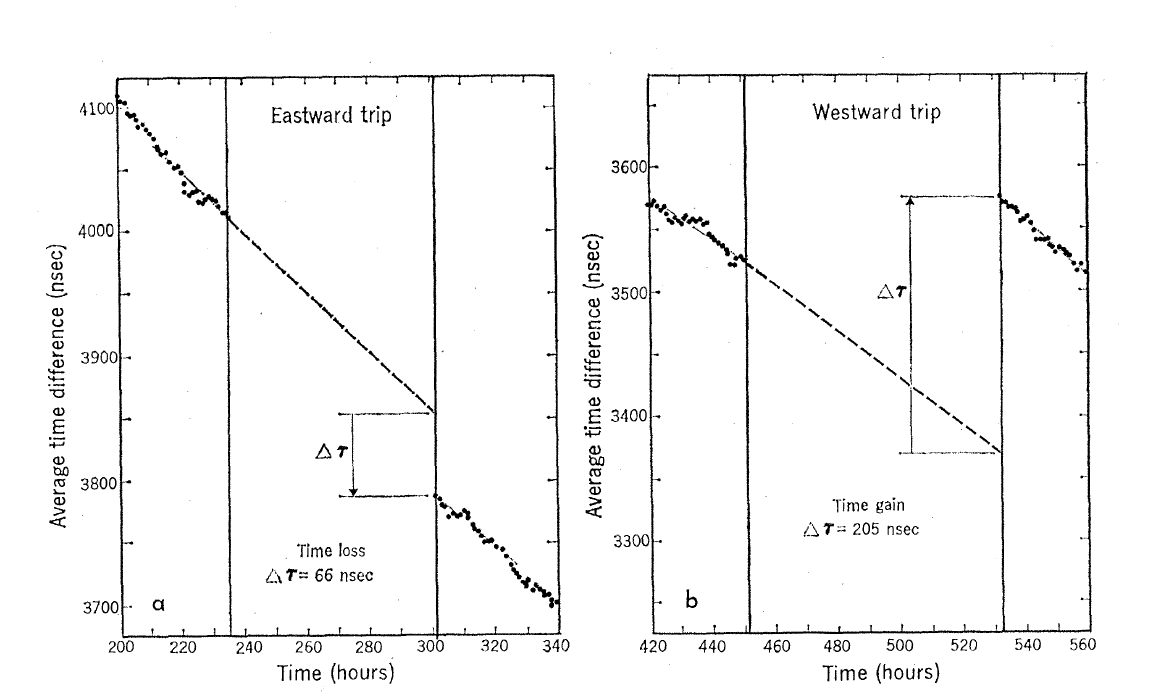
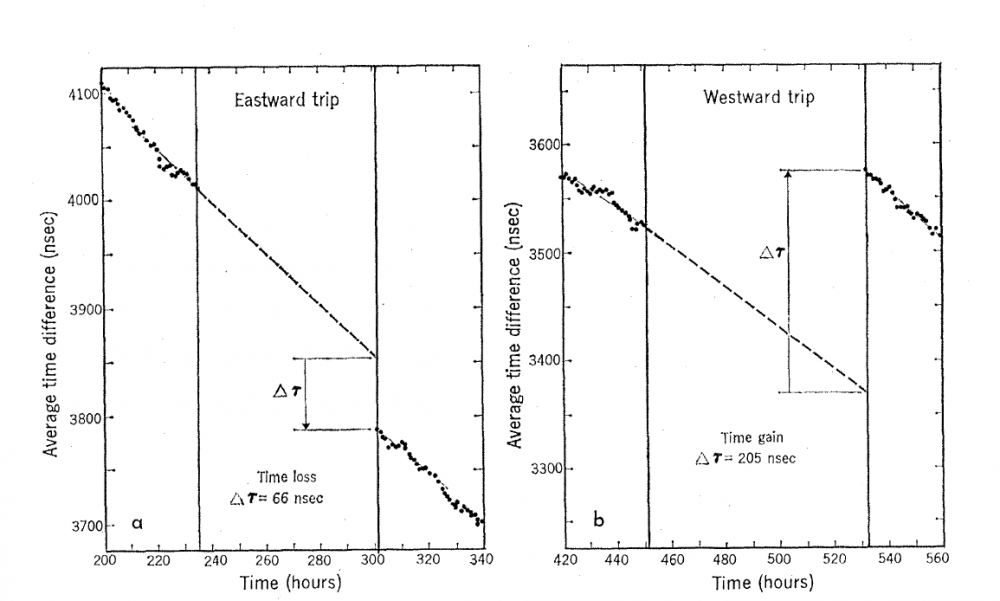
AFAIK they were strapped into the seats, so the beam would be going perpendicular to the plane's motion. But that would have no measurable effect on the outcome according to SR. No radioactive decay is involved. It would be transverse in this case. But if you're thinking about some preferred frame, then you have to account for the fact that trips at one time of day would be in one direction, and trips 12 hours later would be in the opposite. The time dilation was far larger than the measurement error from those clocks. If you think that the accelerations played a large part, that's one more thing that's up to you to demonstrate. From an relativistic point of view, the effect is minimal. The gravitational drop in the several millisecond travel of a thermal cesium beam is quite small. External electric and magnetic fields are shielded; these would have a large effect on the clock's performance if they were not. Yes; the earth's rotation is taken into account in the analysis. The motion about the sun is not as the effect is (or was, for those clocks and such a short experiment) too small to measure Can you calculate the angular speed of this to show that it's "rapid"? The gravity to show its hugeness? (hint: how long does it take for us to compete 2*pi of a revolution?) Feel free to show this. This is a graph from the Hafele-Keating results (Science, New Series, Vol. 177, No. 4044. (Jul. 14, 1972), pp. 168-170) Fig 2 from p169. Seems to me the scatter in the timing signal is smaller than ∆t. (edit: and they cite the experimental error in their results) It's likely you would need to show some model demonstrating that you would expect a result before anyone does this experiment. Not if relativity is correct
-
Who was doing the measuring? The answer is frame-dependent
-
Um, about that... https://physicsworld.com/a/the-double-slit-experiment/
-
! Moderator Note 1. You didn't quote or otherwise indicate that your question was directed at the OP, and 2. Spin polarization is not a wave-particle issue, so it's off-topic for that discussion. There's no point in inviting more, possibly confused discussion on top of what already exists.