
geordief
-
Joined
-
Last visited
Posts posted by geordief
-
-
Edited by geordief
37 minutes ago, studiot said: Not sure what you mean by brainwashing.
Not even sure that other animals engage in Otto's 'reasoning'.
That is what I meant by the difference between intuition and instinct.
Some animals have been known to chew their own foot off to escape a trap.
Less gory examples might be that different birds build different types of nests and beavers build all sorts of structures that benefit the environment.
But do any of these examples involve reasoning - or are they just instinct ?
Intuition, to me, seems to involve a form of reasoning where what happened in one instance is remembered and compared with and applied in a similar circustance on another occasion.
By "brainwashing" I mean (as per the OP,I think) that one deliberately or unconsciously "skips over" inconvenient evidence in favour of more reassuring evidence that fits in with preconceived ideas.
It reminds me a bit of the skit (was it Frank Muir?) taking off an Indian man getting fitted out in Saville Row as an English Gent in full regalia ,with a witty punch line that escapes me.-ah yes it was "but sir,why are you are weeping" "because we lost the empire"
It would be great if there was an animal behaviour that bore an relationship to that kind of behaviour where details are overlooked in favour of a more comfortable outcome.
I think we have the "deaf ear" when we pretend not to hear something and this can become physically true with practice.
Maybe I anthropomorphise my pet but I often remark to myself that it is purposefully ignoring me(if the weather is bad it will not respond although it will be all over me otherwise as it lives for its daily walks -and seems to be on tenterhooks waiting to be asked out)
Do you think the dog could be displaying intuition by comparing fair weather offerings against "head down" rainy day preferences?
-
Are there any non human examples where an animal "brainwashes" itself for material gain?
That could be a precursor to a human "brainwashing" themselves for a perceived psychological gain (which is what I understand the OP to be about)
Any examples of an animal deliberately disregarding evidence in any circumstance?
Could it be that there is animal behaviour where more than 1 piece of evidence is used for any particular goal and that those pieces of evidence are "weighted internally?
(I think some animals do practice deceit and trickery but do they ever turn that tool on themselves?)
-
Edited by geordief
I haven't actually listened to this in half a century (I am going to).Apparently the subject matter is in the news as a genre of writing is showing up (unbeknownst to me ) over the past while.
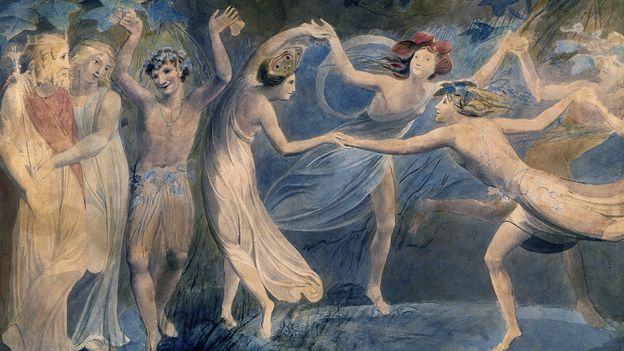
'Complex, dangerous, sexual beings': The erotic, so-calle...
The fairies in erotic "fae" romantasy are not cute or benevolent. They are dangerous, sexual beings, which is exactly what they were in historic folklore, according to a new book.I remember this as a really great song on a really great album(Liege and Lief) with a fantastic singer in Sandy Denny ,who very sadly departed this world via the staircase ,as I remember.
-
Edited by geordief
8 hours ago, Mordred said: If the path is not possible its not included this includes faster than c. Quantum tunneling is a possible path so is inclusive as it describes how a particles can cross a potential barrier higher than their total kinetic energy so it also has a non zero probability.
Thanks.
Would there be any actual practicality to that?
I mean ,are there any physical scenarios where the probability of an interaction can be predicted by summing all the possible paths from a point of emission?
Or are we just in interpretation territory ?
(Out if the top of my hat ,might quantum computing involve that kind of a scenario?-I don't have any understanding of that subject apart from superposition and ,presumably decoherence being involved)
-
-
Edited by geordief
If I can just continue this thread without opening a new one,I think this would be a related question.....
I think the "all possible paths traveled" may have been Feynman's favourite interpretation of the model.
Can I ask ,when these paths are (if they are) drawn and calculated are physical impossibilities and constraints built into the calculation?
ie some paths might require faster than c transfers and some paths might encounter strong spacetime curvature.
In the "theory" (if this can be called a theory) ,but not perhaps in practicality are the probabilities (zero ,perhaps in many cases) weighted accordingly?
Also is "tunneling" a class of travel that is included?
-
2 minutes ago, StringJunky said: You probably heard bodybuilders talking about turning fat to muscle. It's not the case.
And vice versa?
Does muscle not actually turn to fat (as I think I have heard said) but does it simply waste away - with fat increasing or decreasing regardless?
Ps I wonder if there have been studies as to whether body building is a physically unhealthy recreation in the long term (I am sure practioners may feel the opposite)
-
When 2 quantum objects interact does the outcome depend in some way on how each of the two objects "know" each other ?
Is that where the Uncertainty principle comes into play?
Does each object need to know both positions and momenta of the system in order to "decide" how the system evolves subsequently?
It is not just an observer who cannot measure this but the physical objects themselves have to know this for the outcome to be considered exaxtly "predetermined"..
Just as Feynman strongly emphasized at the end of the lecture ,paraphrasing "it is as if Nature herself doesn't know her next move"
-
-
5 minutes ago, swansont said: No; they’re in the ground state, so energy has to be added to do that, which doesn’t happen spontaneously.
No, the limit is practical, not theoretical. Since you know what state they’re in, entanglement isn’t involved between the atoms.
I was thinking of an outside atom which might have been entangled with one of the atoms before it entered the BEC..
Is that possible ,or of any possible consequence?
(Would the creation of the BEC break any prior entanglement?)
-
Edited by geordief
6 minutes ago, swansont said: hey’re all in the same state in a BEC (ground state of the atom, typically, and ground state of the potential well). That sounds like a minimum information condition - the entire BEC would be a single qubit.
The atoms don’t have a memory of their prior state. They would end up in a state that depended on the interaction that caused the BEC to decohere and be disrupted.
Can a BEC decohere spontaneously and without interaction with an outside system?
Is there any theoretic limit to the number of atoms that can be "assembled" and has there been any question as to whether an entangled atom (I think you can entangle atoms but I could be wrong ) can be involved in any of this?
Edit :a very quick search indicates that atoms can indeed be entangled,
eg https://www.sciencedaily.com/releases/2026/01/260126075842.htm
-
Edited by geordief
6 hours ago, swansont said: I think so; as long as it’s a BEC you can’t distinguish individual constituents
Do you know what happens to the information each atom has vis a vis each other as they are seemingly subsumed into some kind of a communal identity?
When they re-emerge has that information evolved to a new configuration or does it return to the same configuration it had prior to the change of status?
-
45 minutes ago, swansont said: hey can be, because we can create Bose-Einstein condensates and Fermi gases, which rely on the particles being identical, and do not behave like a mixture of gases under similar conditions. Whether they incorporate the embedding system would likely depend on how strong of an interaction there was between them; making these isolated systems is not easy to do, and they can be disrupted fairly easily
Does that mean that no constituent part of a BE condensate can have any interaction with a neighbouring system but can only interact with it as a group?
Would that in anyway involve faster than light(or instantaneous) transmission of information ?
Or does the BE condensate unravel like a ball of wool when disrupted?
-
44 minutes ago, studiot said: The for all is a problem, the for all physical even more so.
Can two physical things occupy exactly the same space ?
Is orientation important important ?
Say I have two allegedly identical mirrors and I stand them side by side, one with the mirror face towards me the other with its back to me.
If I shine a torch on them I will observe two totally different responses to my light.Everything ,including orientation would be important but I was interested as to whether quantum objects/systems in particular could be identical in every regard or whether this could be ruled out in all circumstances.
-
1 hour ago, studiot said: This must surely depend upon your definition of identical ?
I suggest the best way to approach this situation is a pragmatic one, like the definition of a point particle.
"Identical for my specified puirposes"
I think I mean for all(physical) purposes.
We know that no matter to what degree of identity we prepare any two systems they will evolve differently.
I wonder if this is due to the "embedding system" ,a property of any two "identical" pairs or a(non-linear?)combination of both.
2 hours ago, MigL said: I believe R Feynman may have been referring to the demise of Determinism in modern Physics.
"Determinism is the philosophical view that all events, including human actions and decisions, are inevitable consequences of preceding causes and natural laws. It suggests that the past and present dictate a single, unavoidable future"
Yes ,that is how I took it.
3 hours ago, sethoflagos said: This would imply that it was possible to create multiple exact copies of the system - if you can do it once, then why not do it again and again?
It works in the classical world - we can design an operation that takes in arbitrary states of raw materials and converts them to multiple 'copies' of a predetermined state (Model T Ford, von Neumann probe etc).
But if we try shrinking this principle down to the quantum level, we start running into some issues with the mechanics. The erasure of arbitrary information in the input states implies eg a loss of entropy from the universe (see No-deleting theorem) and teleporting the output states to some storage destination has the potential to break causality (see No-cloning theorem).
And that's just the stuff that I think I can almost get my head around.
Will have to look at those theorems.They seem relevant
-
Edited by geordief
1 hour ago, swansont said: Atoms of the same isotope are. They obey Bose-Einstein or Fermi-Dirac statistics depending on their spin, which assumes identical particles; the formulation of e.g. the Pauli exclusion principle assumes identical particles.
(Identical here refers to quantum states; you can’t apply a classical-physics-based notion of identical to the situation)
Experimental replication carries with it the notion of statistics and uncertainty. You can’t ignore that, because any physical process has noise
If we call those 2 atoms "systems" ,is there any sense in which they can be considered as "isolated systems" or does /can their quantum state incorporate the system in which they are "embedded"?
-
I was listening to a Feynman lecture on the 2 slits experiment and he finished his talk by saying that it used to be thought that if a system was set up accurately enough then it was possible ,in theory to predict its subsequent evolution.
He then said that this could no longer be considered to be the case and that ,in another's words "nature does not herself know what comes next"(to paraphrase)
Might a reason for this be that no physical systems are identical even in theory?
(each system has its own unique place in the overall system)
So ,in practice no experimental setup can ever be precisely replicated -and no subsequent evolution of one system can ever be replicated by setting up another identical system and "prodding" it identically to the other.
A corollary might be that the mathematics used to describe any physical system is always going to be an approximation to what actually happens (which would be unwelcome "news" to anyone who believed mathematics to be fundamental to physical existence-rather than a very,very useful tool)
-
-
-
Edited by geordief
2 minutes ago, Mordred said: Thats an accurate description
Thanks. One less misunderstanding is always good (as if a little bit of "decoherence" occurred in my brain,ironically -leading no doubt to further bouts of more informed incoherence* down the road 😉
*for clarity ,I meant "incoherence" in a personal,psychological sense in this particular case 😉
-
26 minutes ago, Genady said: If it makes it almost certain, there is almost no interference
Ah yes,I see it now (your addendum)
It is interesting (and something that I think I did pick up on in the Feynman lecture) that you can apparently get a blend of bullet like detections and an overlay of interference pattern on the detection screen.
I hope I have that right. It seems like an important clarification (to my previous understanding - which was it was 100% one or the other)
-
11 minutes ago, Genady said: You know that only one photon passed through because you get only one mark at a time on the second screen, say one mark a minute on average.
Yes ,I think I had thought of that.
Is there any point (I expect this has been done) in having detectors on the barrier with the slits in as well?
That way ,if you had one detection at the main detection screen you might also have some multiple at the first barrier alongside the slits?
I am not sure what that would add to the scenario but it might show a little more detail possibly.
-
Edited by geordief
12 minutes ago, Genady said: It does not matter how many photons are sent out at a time: by moving your source farther away from the screen you can get the intensity at the screen as low as you wish.
Down to one photon?
And you can't achieve that while maintaining a greater proximity to the slit(s)?
I mean ,for simplicity it would be nice to be able to "drop off" a single photon directly in front of slit A so that there would be only the very faintest possibility of it being able to reach slit B (the angle being so tight)
-
8 hours ago, Mordred said: given the above a higher intensity beam will generate more photons giving a higher probability of photons that will make it through the slit without interference
Is that with the 2 slits open?
By the way I seem to be being disabused of the idea that it is possible to send one photon at a time.Or is it possible but not relevant at this point or based on the question I asked?(considering one photon at a time might seem simpler if that was possible)
Today I Learned
in The Lounge
I expect you don't have the same history in Canada where beer was (as I think I heard) a healthier option for drinking in the (pre-?)industrial age than the water which was apparently anything but.
I think i heard thst that may have applied to spirits like gin too-incredibly.
Have you tried Newcastle Brown -what I used to drink ?