studiot
Senior Members
-
Joined
-
Last visited
Everything posted by studiot
-
Did you actually read the article you linked to ? Charles Babbage died in 1871. No one has suggested that Babbage's engine was the first - How about the Jacquard Loom controller from 1801 ? Or the abacus that certainly predated the Greek device
-
Yes, my mistake. Chad Orzel.
-
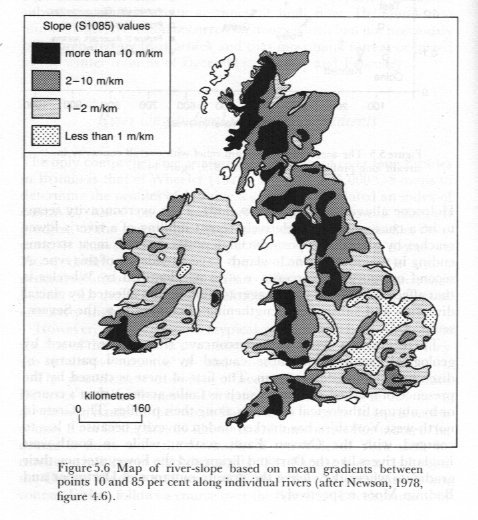
Thanks for your continued interest and more considered responses than the previous responder's wild posting. You mentioned rive gradients, I don't know if there are equivalent maps for Australia but here are some figures for the British Isles. There are some key comments in your post notably That is so true almost everywhere. +1
-
Thank you, so there is scope for this type of thinking. though problems to be overcome. +1
-
Update Interesting thing about beavers, doing exactly the Harappan thing and the Yeomans thing, in the continued drought. Beaver dams in east Devon create area of wetland amid drought https://w ww.bbc.co.uk/news/uk-england-devon-62662909
-
Thank you for this elaboration. How are these of equal shape ? It would be a very good idea if you could label your points (as in geometric points) so that issues can be discussed.
-
Thank you for posting your solution to the question, I am still thinking about it but +1. Four line segments, yes not four lines. Did you read the extract from Durrel ? You also mentioned area, do you include the diagonals as part of a tetragon ? Thank you for your contribution. Can you explain what bearing it has on my comments ?
-
Do you understand what this is all about and can you relate it to the thread topic of prime numbers and Fields ?
-
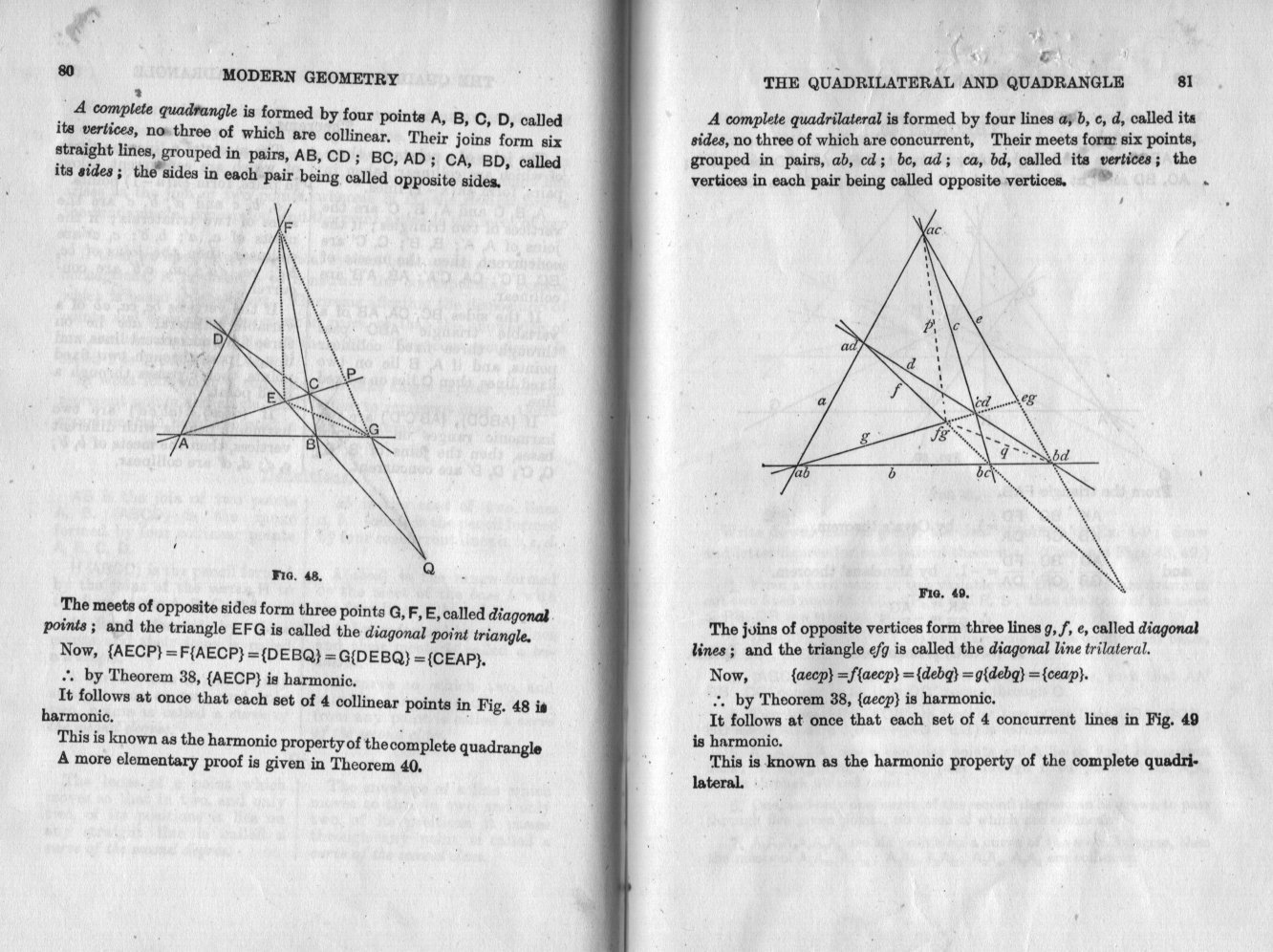
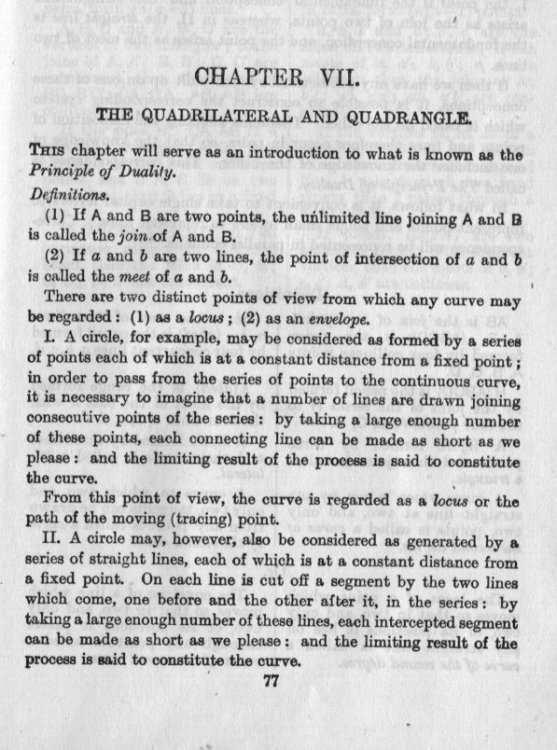
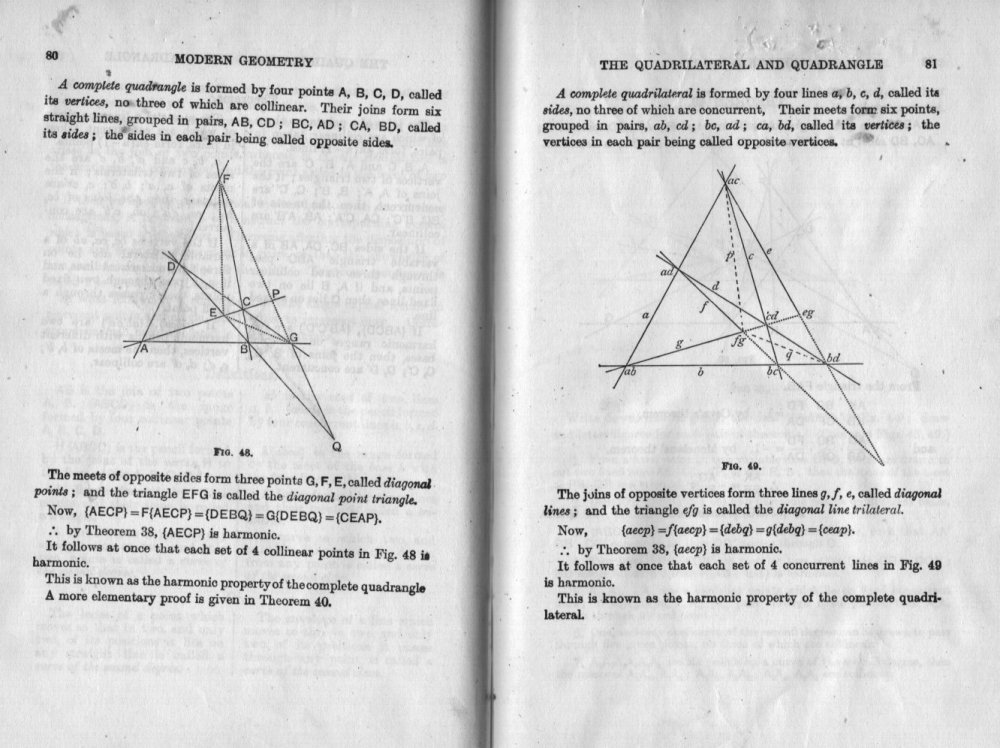
Members might find this distinction between a quadrangle and a quadrilateral enlightening. It is from one of the many textbooks from that master of Euclidian geometry, C V Durrell, entitled Modern Geometry (from 100 years ago). You might find the definitions in the first page useful.
-
That's not what I said. There are seven variables involved. Four of these are the independent driving and controlling factors and three are the dependent variables describing the results. The three resultant or dependent variables are 1) The max and min heights of the tides at any particular location and day. 2) The shape of the wave peaks and troughs, plotted as tide height against time at any particular location. 3) The timing of these peaks and troughs at any one location. (That is the relationahip of the timing from one peak to the next and its variation, which is what you are asking about.) The independent driving variables are A) The gravitational pull of the Moon. B) The gravitational pull of the Sun. The independent modifying and controlling variables are C) The local topography. D) Meteorological modifications. That is changes to any or all of the above dependent variables due to the local weather. These vary from day to day and are not cyclic. The Moon's gravitational pull causes a bulge in the water surface that is dragged round the Earth as the Moon orbits. As MIgL has already said if the Earth was a perfect smooth spherical water world this would result in a 'clockwork tide'. The height of this bulge above the mean level would be high water and travel round the earth at a regular daily rate. However this height is modified by the interaction of the Sun's gravity which results in a periodic monthly variation of this height called 'spring and neap' tides. But the story does not quite end there because the lunar orbital month is just a little bit shorter than the solar month, which means that the timing of the the interaction varies as the Earth-Moon system travels around the Sun. In other words the the Moon does not make a whole number of orbits of the Earth in the time it takes for the Earht to orbit the Sun. This basic pattern is called 'the equilibrium tide' and is nearly sinusoidal in shape. But the equilibrium tides faces two additional 'controllong' factors. The local topography is neither smooth nor part of a perfect sphere and varies in depth. This changes the general nearly sinusoidal shape to a more irregular pattern. But any modification to the timing is repeated daily as the topography does not change from day to day. It does not induce the cyclic day by day slippage of the high tide around the clock over about a fortnight, that is generated by the phasing difference between the Moon's orbit and that of the Earth. Finally, the weather (mostly wind) can hold back or push forward the timing of high tide by quite a few minutes and also hold its height down or pile it up. This is a random day to day affair that has no cyclicity.
-
Yes I think there is a small solar component but I haven't done any harmonic analysis of tides since the 1970s. But the result of the elliptical orbits of both the Earth rond the Sun and the Moon around the Earth is that the 'passing velocity' varies as the bodies go round. Kepler's laws say equal areas swept out in equal times. Not constant cvelocity around the ellipse. The 'equilibrium tide' therefore is not driven by a constant passing velocity gravitational pull. However you are quite right to observe that local topography has a great influence on the actual wave that is observed at any tidal station. Waters partly enclosed by land are subject to resonance and standing wave effects, just as the water surface in a bathtub laps back and fore. Southampton (the Solent) for instance has a 'double maximum' and the North Sea slops around just like the bathwater.
-
The shape of the Moon's orbit is an ellipse with the Earth at one focus. So the actual Earth - Moon distance varies over that orbit by about 13%. https://oceanservice.noaa.gov/education/tutorial_tides/tides06_variations.html
-
A small point; Technically, the figure offered by OldChemE is a re-entrant quadrangle and the one you offered is a crossed quadrangle. Neither is a quadrilateral. A quadrangle is not a quadrilateral unless it is also a polygon. Your figure might actually be a pair of triangles with a common vertex. I can't tell from the sketch.
-
How many sides does this figure have ? As to the original question for a quadrilateral, any figure, even a disconnected one of several parts and/or curved lines, a line can be drawn the make the area on one side equal to the area on the other. For some figures the two sides may be congruent figures or they may not depending upon the symmetries. I do not know enough about the topology of quadrilaterals to answer this - it is certainly the sort of question Martin Gardner likes to ask and there is a five sided version in his book on this subject, but observe that if a dividing line can be srawn to from two congruent halves, also quads, then the process can be repeated to yield an answer.
-
Oh Wow. Please Mr Swansont Sir, permission to use the argument of incredulity !
-
In my opinion you have packed far too much into this thread. So I will pretend you haven't tried to link reincarnation to Physics, or introduced discussion of And for one moment at least take your offering seriously. That means starting at number 1 only and deriving the equation you claim at the start as it seems to be your only attempt at Mathematics in the entire thread. What exactly do you mean by And where does it come from ? Worked examples and supporting mathematics required please.
-
All I see so far is a catalogue of completely off the wall and right out of the park claims, every one of them unsubstantiated. Do you actually have anything to discuss ?
-
Can't seek how you make that out when exchemist is trying very very hard to help you with some great explanations. +1 How is this a response to being told
-
So it tells you the standard surface pressure in millibars and the rate of fall with altitude (in feet). Clearly if you were able to ascertain that actual pressure at any particular time either at the surface or at a known altitude you could use that to recalibrate the surface pressure and continue to calculate the pressure at other altitudes using the same standard pressure lapse rate. Does this help ?
-
Winning jokes from the Edinburgh Fringe Festival. https://www.bbc.co.uk/news/uk-scotland-edinburgh-east-fife-62626292
-
I'm guessing, from your questions, that you are a student just starting to learn this stuff. Sensible questions, like the ones you have been asking, are very good so keep asking. But you will get so much more out of the discussion the you put more into it. Short answers like that to folks who have put in quite a bit of effort to help you will lead to them rapidly loosing interest.
-
Yes this is true. Stronger than what ? The signal near microwave and mobile phone masts, radar installations and in some factories is much higher. Negligible to most people, yes, but not to everyone. Some people are unusually sensitive. Such people will also suffer in an area of higher raduation from other sources. I do know of medically proven cases where moving the router out of someone's bedroom has resulted in beneficial effects. But some are also hypochondriacs and I am not prepared to discuss individual cases. Any electrical device that is not functioning properly either though poor manufacture, maintenance or misuse can emit unwanted, potentially harmful radiation.
-
Read the article again properly. It also gives you a direct standard conversion factor in the absence of calibration.
-
You might find this about a 'desert still' interesting. https://www.desertusa.com/desert-people/water-solar-still.html
-
Our version goes like this As I was walking home from work last evening I met a council worker (you can tell because of the HiVis gear). He was stomping a snail. "What are you doing that for ?" I asked, " what has that poor defenceless snail done to you ?" "Blooming thing's been following me around all day." He said.