studiot
Senior Members
-
Joined
-
Last visited
Everything posted by studiot
-
You have posted this in homework help. Are you working on some kind of project ? If so here are some more pointers. Babbage's wife, Ada Lovelace probably added more to computer theory than Babbage himself. But the great thing would be to separate the those who added practicality and those who developed theory. Both of these were needed in roughly equal parts. It is not known who invented the abacus, various civilisations in ancient history had some form or other. Later calculating machines were developed to, well to help calculate values for tables. Napier was the theorist and Outred the practical implementer (he invented the slide rule) Digital Theory probably started with DeMorgan. This is where Babbage came in with his analytical engine (the practical man) and Ada was the theorist. The next big development came before Turing's time and was still purely mechanical. Industry threw up the need for control of machines that required a series of steps. Hollerith invented the punch card system, which also started 'data processing'. Electricity was also beginning to make an impact and devices using electric switches (relays) followed by vlaves (american tubes) and then semiconductor devices were made. Von Neuman formalised the idea of 'the stored program architecture' originally using Hollerith cards and the modern computer was born. Turing did much theoretical work on the capabilities and limitations of such machines and invented the 'turing machine' as an idealised model. Now I have started your rehabilitation from the red marks with a +1 since you are showing some sense now. Keep it up and I hope you project, if you have one, goes well.
-
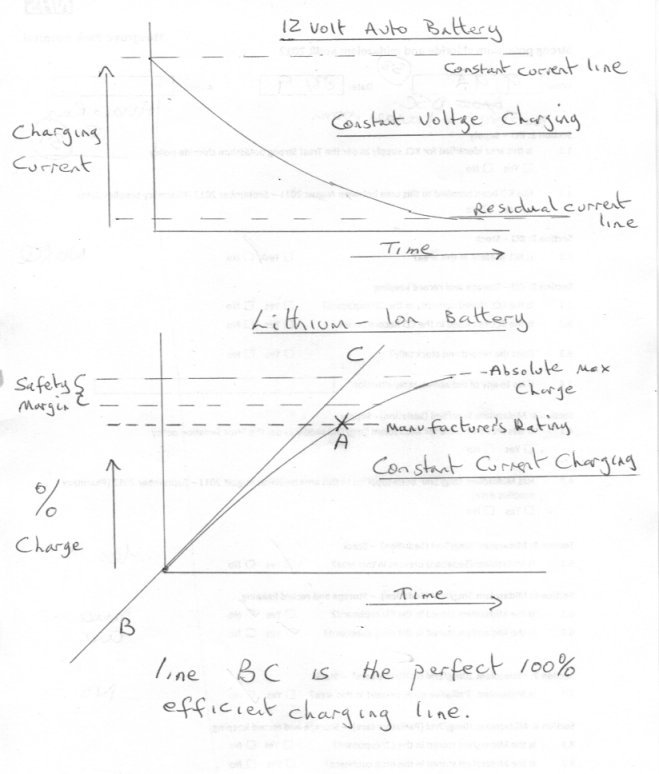
This should help. Exactly. That is what Erina quoted from Tesla So charging efficiency. I have attached two diagrams firstly the charging diagram of an ordinary common or garden 12 volt car battery. As can be seen the charger or alternator produces a (laughingly) constant voltage and the current is initially high for a discharged battery but gradually drops off as the battery voltage rises so the difference between the charging voltage and the battery voltage falls until the charger is just receiving a 'trickle charge'. This trickle charge can safely go on indefinitely. Processes within the battery dissipate the very small amount of energy safely as heat. Also since the charger voltage is only just higher than the battery voltage it cannot add further charge to the battery. Also shown is the dashed constant current line that sophisticated battery 'fast' chargers operate. It is not safe to try to pump the high initial charging current into the battery so when the finish point is reached this type of charger switches itself of and perhaps disconnects the battery. Lithium ion batteries can also be charged in this manner but constant voltage charging is slow especially when the amount of charge to be added is considered. So they use constant current charging and sophisticated controls which stop the process at the point A on the curve. Now an EV battery is much higher voltage than the old type - the Kia is over 300 volts - so the safety implications of overcharging are much more serious. Also there will be statistical variation in the absolute capacity from battery to battery. So the manufacturer rates the battery below this point and I have shown the statistical safety margin above this on the curve. But note the curve also turns over compared to a straight line 100% efficient charging, just as the 12 volt battery did. I have also drawn line BC to show this 100% efficient charging line. Now the further up the curve you go the further below 100% is the charging efficiency. So where the manufacturer places their battery rating on the curve determines the charging efficiency. The Kia is a cheaper car than the Tesla so I expect that they can less afford to offer a generous rating and are pushing their batteries harder. This would imply that their charging efficiency suffers comapred to the Tesla.
-
You have a PM. Carbon dioxide concentration is fourth on the Cambridge list of 24 atmospheric gases and particulates and stood at 384 ppm in 2007 with an annual increase over the previous decade of 1.65 ppm. Ther primar source (referenced) was NOAA. So something over 400 is hardly suprising today.
-
I'm sorry I still don't understand this. A formula is not a number. Perhaps there is some translation problem ?
-
What a silly question and what a good reply from @Peterkin +1 The question is like asking which goes faster a Fiat 500 or a Trabant , whilst ignoring the likes of Porsche, Ferrari, TransAm etc. What do you mean by computer anyway ? The object that most people identify with as a 'computer' was due to Von Neumann.
-
I didn't say it was all clouds and I didn't say that water vapour did not act as a greenhouse gas. In fact if your read carefully I said the opposite. Which is why I said
-
I can see I'm wasting my time here. What are clouds, if not water in the atmousphere ? Perhaps you get clouds inside the coal in a coal mine ?
-
I don't want to be nit picky. Especially as I sometimes use the analogy of eddies in a stream to discuss the idea of a semi permanent structural feature in a stream to represent what is meant by the quantum idea of particles being just such structures in quantum fields. But here we are discussing classicla EM fields as far as I know. So a few comments on the text. The electric field E has zero curl, it is the magnetic field that has non zero curl. epsilon and mu are not scalar constants , except in special circumstances, actually they are second order tensors that interact with the E and D and B and H fields which may result in these not pointing in common directions. The energy density is one half E cross D and one half B cross H for the electric and magnetic fields respectively.
-
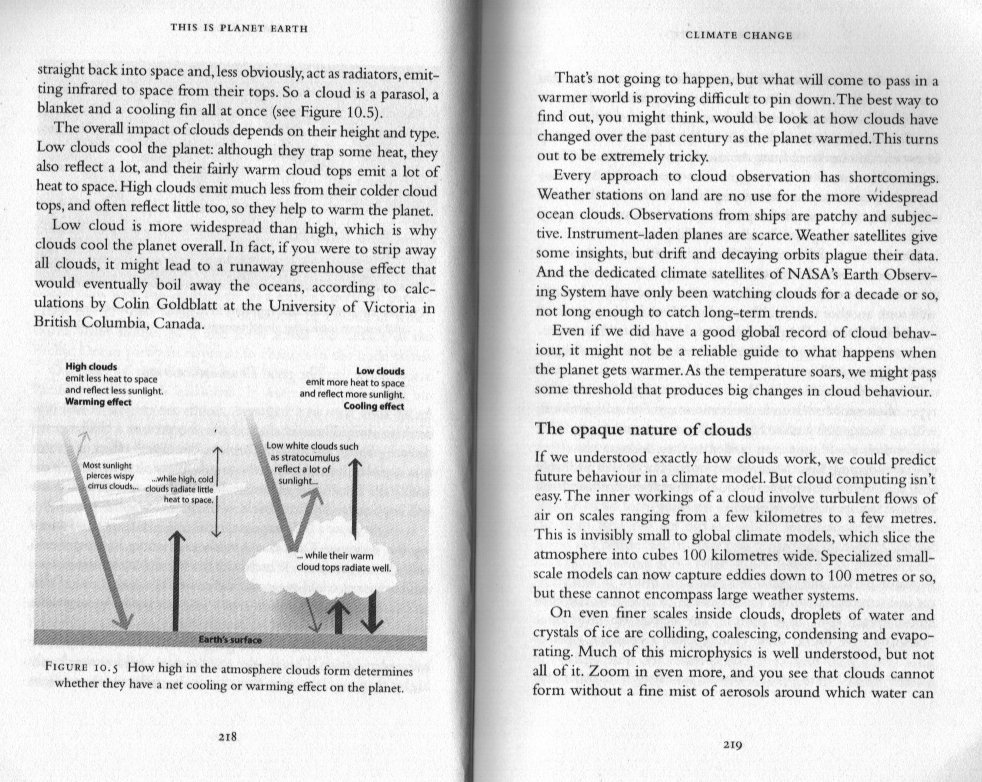
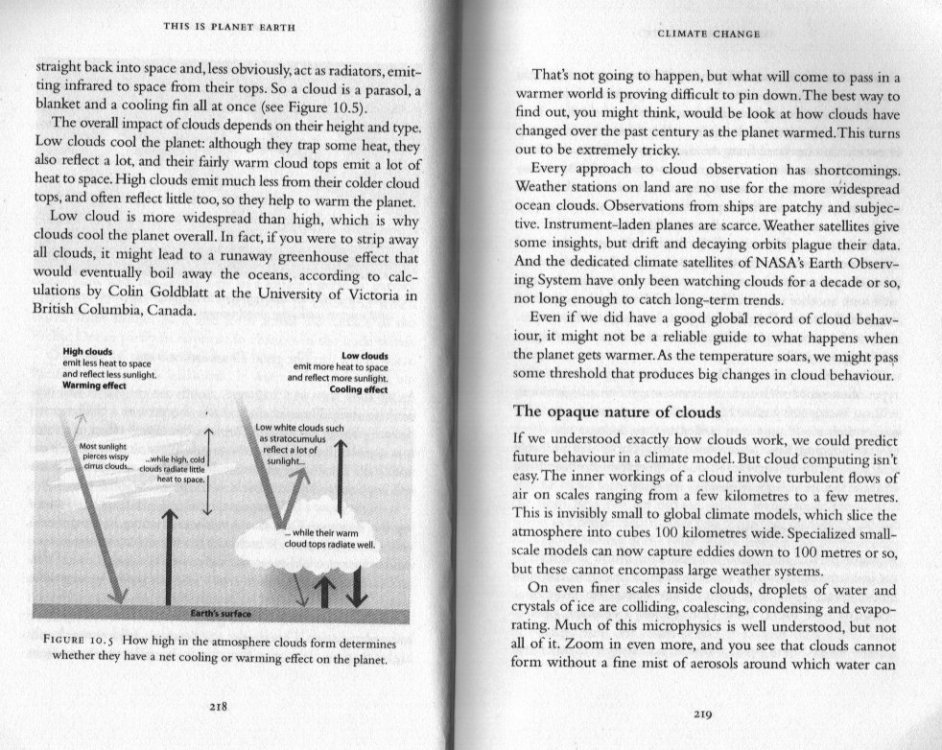
I am not minded to say much about atmospheric water since nobody is very interested but the offered analyses do not hold water (pun noted). The wavelengths that different gasses operate on for radiative absorbtion and emission effects differ from gas to gas. But atmospheric water has a net cooling effect on the Earth. Not only that but the effects depend upon the position (altitude) of that water. Here is a short extract from a 2018 New Scientist article about the subject ans what different experts around the globe from Canada to the US to New Zealand to the UK are trying to do about it. +1 to phi for his note on the polluting effects of nitrogen oxides.
-
Consider this oh monger of doom and gloom: The polio vaccine took 20 - 25 years to develop. The covid vaccine took substantially less than a year. Edit On the lighter note of "what do aliens do ?" Read "How to be an Alien" by Georges Mikes.
-
Thanks to swansont, +1, for pointing out the long term and statistical nature of the rotation. Statistical fluctuations are, by definition, 'unexpected' in any specific fluctuation timing or quantity.
-
I have a lot of data, too much to scan and post as such. But if you can indicate where you want to go with this I can certainly condense it for you.
-
I'm sorry I don't understand this comment. Heat is not necessarily a bad thing. The capacity of an electric vehicle battery decreases markedly with lowering of temperature, (or raising it above optimum which is in the 20oC to 23oC range) The car manufacturer will specify the capacity at this temperature. At 5oC the capacity will be 25% - 30 % lower and it can be as little as 50% lower in freezing conditions. Also the capacity depends upon the equipment used to charge the battery. The Kia Nero has a 64kW-hr rated battery. But it needs a 3 phase supply to achieve this capacity. Ordinary UK mains can only reach 80% of this value ie 51 kW-hrs, I recently charged a Kia from completely flat to this level - It took 28 hours charging at 10 amps on the UK 240 volt mains. This equates to 67 kW-hrs. So the charging efficiency was 51/67 x 100 = 76% Other types of lithium-ion (there are several types) batteries have different characteristics.
-
OK so the Telegraph has done its job as a respectable paper pretty well. These figures concur with other sources I have. In particular my Cambridge Handbook of Earth Science Data (mine is the first ed 2009), which gives all sorts of tables of useful data on - well Earth Science In the chapter on the atmousphere it lists much more comprehensive composition data, including non gaseous components such as dust and volcanic input. It also references other reputable sources such as NOAA, The UK Met Ofice, standard texbooks on Geochemistry, Chemistry and Physics. Amongst many other data tables, it offers a table of of the energy fluxes between the Earth and its atmousphere that may be a useful addition to your Telegraph data. Just a small point about you Telegraph data. The difficulty with the halocarbons is not the greenhouse effect, but their chemical action high in the atmousphere to deplete the ozone layer which proctects us from harmful high energy solar radiation.
-
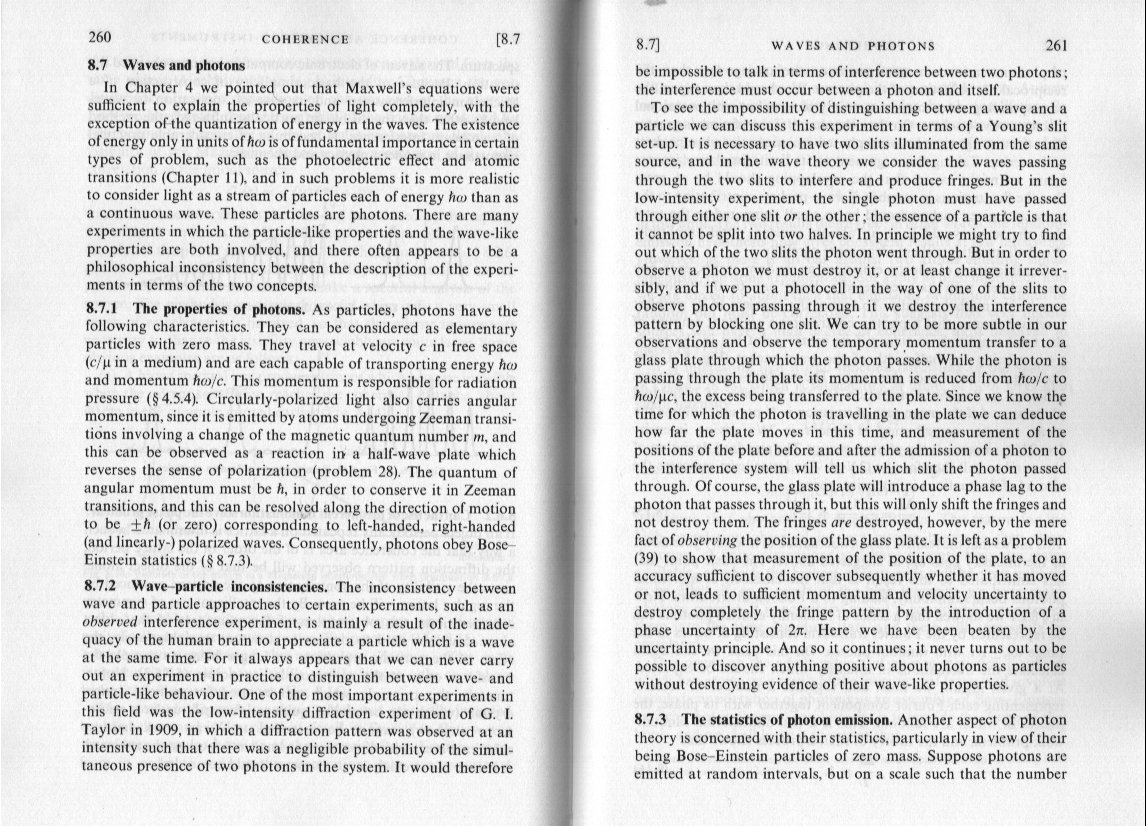
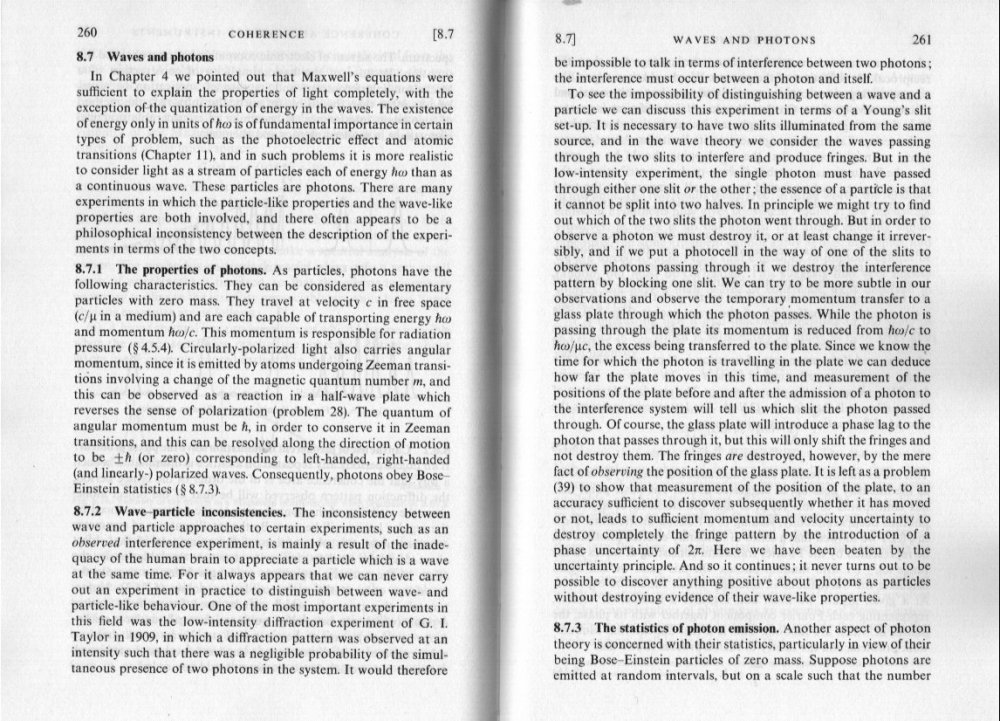
No I don't mean particles of any description or size by a source or a sink. Sources and sinks are an inseparable part of Field Theory in general and Maxwell's field theory in particular. If you are developing a Field theory, you should understand this and provide for them. You magnetic pole example is such a source, the other pole is then a sink. Again you missed my point. Maxwell's equations lead directly to a (continuous) wave theory, which is incompatible with photons. See in particular 8.7 here
-
Yes chenbier is correct but perhaps you would like a bit more since your battery 'efficiency' is not the same as mechanical or thermodynamic 'efficiency'. Traditionally efficiency is defined as [math]{\rm{efficiency = }}\frac{{{\rm{output}}\;{\rm{energy}}}}{{{\rm{input}}\;{\rm{energy}}}}{\rm{ \times 100}}[/math] You have an input and a theoretically empty battery. This battery has a 'capacity' which is the quantity of electricity required to fully charge it or charge it to 100%. But here your 'output' is the actual amount of energy you need to put into the battery to bring it to 100% charge ie its capacity. Your 'input' is the amount of energy, an energy meter would read as input to your combined battery and charger. Some of this input energy is lost in the charger itself as heat and some is lost in the battery as heat. Both of these losses count as inefficiencies. So say the capacity of your battery is 1000mA/hrs, your energy meter would read 1500mA/hrs. so the efficiency is 1000/1500 x 100 = 67% as chenbier says. You must have noticed that chargers and batteries get warm during charging ?
-
What a short memory you have. You were told, right at the beginning to post the main material here, not as a link. But here you go again.
-
Please separate out your various points so that others can identify what particular piece they are responding, without having to point to the whole lot ! I only wish to comment on the last line of your post image and the title of the thread. I don't regard addition and subtraction as 'Fundamental Mathematical Operations'. Most certainly not in a Philosophy forum where the history of Mathematics can be taken into account in a thread entitled "Birth of Mathematics from Logics" Incidentally, in case you first language is not English, these last two nouns are singular collective nouns without an 's' on their ends.
-
I did not take much notice of your earlier threads as you started with too much and too complicated material. So I welcome this fresh start +1 for a nice compact introduction to your question. In Mathematics you can define (choose) all sorts of variables. Many of these are not (very) useful. Science uses maths a great deal and gives the name 'time' to a particular variable it finds exceedingly useful. Useful in formulae, expressions and equations. Measurement of time is a separate subject and I would recommend a 2022 book by New York Physicist, Chad Orzel "A Brief History of Timekeeping" Chad opens the book by discussing the question "what is time ?" and may be to your liking - It contains much fascinating material. By all means carry on this discussion here if you like the start we have now made.
-
-
Thank you all replying. To me 'the obvious engineering solution' to the fact that there is too much water (over time) in one area and too little in another (again over time) is to move some water about from the excess to the deficit. I have put this in climate change because it is predicted that this imbalance will grow as climate change bites more and more. I was not my intention to limit examples and discussions to the US experience. It's just that their recent news renewed my long held conviction that worn out 'politix' has made / is making matters worse rather than better. There is not much known about the Harappan civilisation and there are several overblown stories or myths. But we do know this bronze age culture was able to control the Indus river basin and the monsson by exactly the engineering means I have described "Collection storage and distribution" Meanwhile in the UK we are also suffering this water imbalance, though to a lesser extent than the US. But late 20th century politix has removed our golden opportunity to do something about it, by breaking up a water industry that was brought together into a coherent whole during the early 20th century, and selling it off in disparate chunks to foreigners with no interest in our plight.
-
OK you are serious. We are all very glad to learn this. Welcome, my apologies for doubting, but unfortunately there are too many nasty people about and this site encounters its fair share of them. Looking quickly at the development of your discussion, a couple of things stand out. 1) I see no sinks or sources in your treatment. These are very important in the real world. Are you assuming that these three fields were and are always present everywhere and everywhen ? 2) I see no discussion of the clash between the continuous Maxwell field theory (which is compatible with both special and general relativity) and the Plank relationship E =hv which defines Quantum theory. I look forward to your answers
-
No you are not wrong Your 'thinking' is so far out of line with any section of this forum that the old scientific statement You are not even wrong applies.
-
Yes perhaps it was an oversimplified picture. +1
-
No collapse is really a poor term. What happens is that the interaction selects a particular solution from all the possible ones in the superposition. This is just like you choosing which square root you want when you select -2 (or +2) and use it as the square root of 4. MigL also make a good point +1 That there with a complicated macro system there may be (probably will be) many small self interactions between parts of the 'collapsing' system. Rather as some parts of a large structure fail before others when it collapses structurally. I don't know if there is any quantum situation similar to the transition from elastic failure to plastic failure which works like this. That would be an intersting speculation to pursue.