studiot
Senior Members
-
Joined
-
Last visited
Everything posted by studiot
-
A wise comment. +1 Leaves, whether whole or chopped up, contain a high proportion of beneficial organic material. As such gardeners add the material as a soil conditioner rather than a source of nutrients per se. I am not sure at what fineness this effect is nullified by 'grinding to dust'. Certainly simply adding carbon particles does not improve the soil.
-
From the beginning of the text in your link which brings us straight back to my comment about static v dynamic. This needs clearing up before looking at the question of how to increase the stored energy , without motion of something. And of course there are no relativistic effects when there is no motion.
-
I think first you would have to explain what a static EM field looks like. I have heard of static E fields and static H fields separately. But aren't all EM fields dynamic ?
-
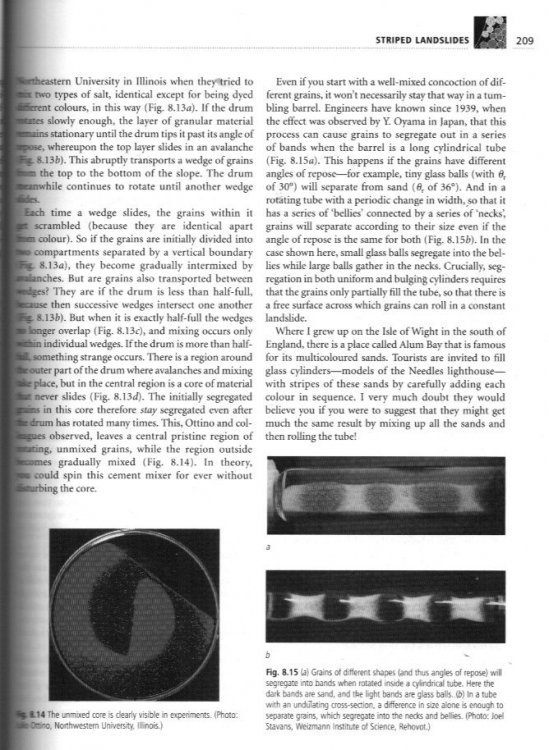
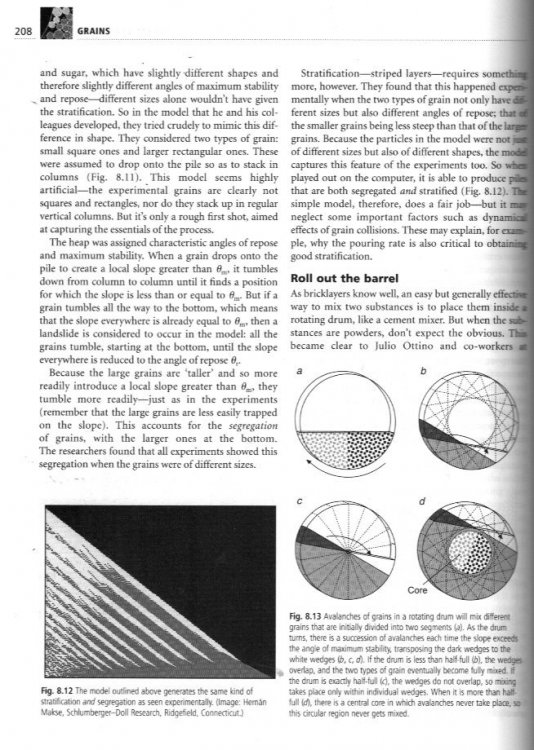
Du Sautoy is definitely into symmetry. He has written at least three books. The Alhambra stories are in the Finding Moonshine one. https://www.amazon.co.uk/Symmetry-Journey-Into-Patterns-Nature/dp/0060789417 Here are the relevent pages from Ball's Tapestry about mixing drums. My apologies for the poor scans due to the spine of the book.
-
If I might be permitted to pass comment on this discussion. I rather get the impresson that CharonY is a frustrated instructor who would genuinely like to do better by their students but is hamstrung by the system. Yes I blame the system or rather what it has developed into, rather than either the the instructors or the students. Yes there are good instructors and poor ones, but they have to teach to the system and they are human. I hold that it is fundamentally wrong and counterproductive to grade the learning process. The ultimate goal of learning is to reach competence at the end of the process. Clearly at the beginning the student is not competent and so need to follow the path of learning, practise, making mistakes, finding out what can go wrong and how it can go right. None of this should be graded except as an aid to learning for both the student and instructor. And none of the learning process should count towards the final result. The whole point of having an instructor is to assess where the student gets it right and where they get it wrong and point out the correct way and to help/guide where the competence is understanding rather than skill ie to promote that 'light bulb moment'. Since this may lead to personality clashes, it is important that the instructor has no say in the final assessment of competence. This should be made by some independent means. You are right in saying there is a big difference between turning out competent humans and self-sealing stem bolts.
-
Great summary +1. @Trần Thành 2022 I can only add that I suggest you look up 'mass defect and chemical reactions'. Here is a good reference. https://chem.libretexts.org/Courses/Grand_Rapids_Community_College/CHM_120_-_Survey_of_General_Chemistry/2%3A_Atomic_Structure/2.07_Mass_Defect_-_The_Source_of_Nuclear_Energy Note this also explains swansont's good point further.
-
Good question +1
-
Yes, I think he did say that, or something very like it. Did you read his delightful book on symmetry containing references to his visit to the Alhambra ? The interesting thing about patterns is that they can be algebraicised for incidence using incidence matrices. Another related point is that in studying patterns maths uses much the same techniques as other disciplines. In particular idealisations are extracted from observations of reality, many of these idealisations are also of great use in Physics. Another author much concerned with pattern is Philip Ball - The self Made Tapestry. Di you know the pattern to determine the optimum level to fill a cement mixer ?
-
And yet, as I noted, it is the first statement to appear in Euclid! You can't have Pythagoras, without algebra. I don't see how much Geometry you can do without numbers. There is no similarity theorem in curvilinear space eg in spherical triangles. You can't have vector geometry without the zero vector as it is involved in four of the vector axioms. Therefore the link between extrinsic and intrinsic geometry (holonomy) fails as you can't have vector fields without vectors. Without a side of zero length, Aubel's theorem in plane geometry is incomplete. What I am saying is that 'zero' is buried very deep in Geometry so that we don't normally think about it, On the other hand I fully support this comment. There is plenty of archeological evidence that maths was in at the beginning of language. (see John Derbyshire "Unknown Quantity"). However perhaps 'counting' is too sophisticated a word and a deeper, but incredibly useful, mathematical technique of tallying (putting in one-to-one correspondence) came first. Perhaps this process even came before real words separated out from grunts which simply meant "Attention!" I don't disagree with this at all. Maths is a tool. And we'd rather use maths to make a hammer than use hammers to do maths. I even think maths is at the basis of language. Even people who say they hate maths, I think, have a simpler, more basic way of mathematically understanding the world. Perhaps less sophisticated, refined, or whatever. May I respectfully remind both you and @MigL that this thread was started by a professor of Mathematics, in the Mathematics section ? Whilst I would wholeheartedly agree that maths is an incredibly useful tool in many disciplines, especially Physics, this is surely a question of Mathematics?
-
But that is part of the definition of a distance function (the Mathematical term for a metric) Without zero you have no metric. But that is not the only use of zero in Mathematics. You probably know the four colour theorem, and the two colour theorem. Can you draw a map with zero colours ? Or perhaps you would like this poem I have highlighted the use of zero bend (curvature or the reciprocal of radius) to indicate a straight line. You also need zero in projective geometry for the ratio theorem to indicate the 'missing' ratio.
-
I do understand you and please be clear. That is just not possible. There are many branches of maths. You need a bit of almost each and evry one to study fully any one branch. That is why Maths in particular is taught in what I call a spiral approach. At each turn of the spiral (say each year) you learn some more of some or all the branches, based on all that you learned in each branch the precious year. Mathematicians carry this on through their working lives. Here is a true story. When I was in junior high I was pretty good at Geometry. I thought I knew everthing there was to know about Geometry and could solve any problem. So when I move up to senior high (college for you like the american system) I was suprised to find the first thing on the curiculum was - Geometry. But Coordinate Geometry. I was shocked and blown away by all this new stuff. But it underlies calculus, applied maths, differential equations, physics and so much more.
-
Hello, Riba and welcome. Maths on your own huh ? That's both ambitious and admirable. So is asking questions so remember to come here and ask if you get stuck. Quadratic equations and basic trig ? So you are in junior high then. You haven't said which country you are in, but in the UK you will be doing some algebra (those pesky equations), some geometry, which goes with the trig, some modern maths such as sets and logic. There will also be lots of practice applications questions (both in maths symbols and in words). This is all good stuff that leads into later material, normally encountered in senior high. This is where you will encounter calculus first and perhaps a taste of differential equations. But you will also encounter coordinate geometry and other topics. There is no one order to 'do' the different topics in. This is because Maths hangs together so you need a bit of one branch to be able to work in another branch. With that under you belt you can use your new knowledge to expand both branches and perhaps a third, fourth etc. One word of warning since your ambition is (astro)physics. Any course whether at school, college or online will be designed for the questions asked to be solvable using the material taught. But no course teaches it all so they leave out the exceptions and difficult pieces, and never ask questions about them. So it is easy for a student to be lulled into a sense of false security, thinking they know enough. But in real Physics it is often the exception that you need. Go well in your studies, I look forward to periodic questions from you.
-
Euclid Definition#1 "That which hath no part." This is an early version of a metric which you cannot have without a zero.
-
Less true than it used to be. When I was first at university many of us brewed beer in plastic buckets/small dustbins. Yellow was a very popular colour. Then some professor (at Southampton I think) pointed out that the yellow colour is given by cadmium and this dissolves out into the beer. Cadmium, of course is poisonous.
-
Well that would make all mathematicians plagiarists. But then I suppose we are very fond of plagiarizing the phrase 'if and only if'
-
Can't see why. Swansont has already told you the essence of how to do it, collect enough energy from the wind. As an observation he also said So a 'lighter than air' balloon would make the collection burden easier.
-
Personally I'd be more worried about the chemicals allowed in bottled 'beverages' than either salt, soap or vinegar. More especially if you drink a lot of them.
-
Lots of great comments here. +1 I will add to just two of them. 1) Dry suits can come with weighted boots, especially those meant for fixed air lines. 2) I had to drop my weight belt once in an emergency. It was an expensive exercise. However if you are multiple diving diving a fixed site (perhaps with a line) you can leave your weightbelt on a line or for others to haul in or even have a system of hauling up bottom sourced weights with each dive, and dropping them back again at the surface.
-
Is this a genuine puzzle/brainteaser or is this a genuine physics question ?
-
What aspect of GR makes it a field theory ? In other words what properties specified and used in GR form this 'gravitational field' ? It should be noted that when GR was published in 1915 it described no such properties and did not conform to the then still developing definition of a Field Theory formalised by Kellogg in his 1929 book "Potential Theory". This definition was in use for most of the 20th century. In order to turn GR into a Field Theory it is necessary to modify both GR (via a non linear Lagrangian) and the definition of a field (theory). Quite a lot of progress has been made towards this in the last few decades and there are postgrad lectures on the subject at MIT, including youtube lectures and padf papers. https://www.google.co.uk/search?q=Donoghue+effective+field+theory&source=hp&ei=SGfdYZDOCbyEhbIP06GW8AI&iflsig=ALs-wAMAAAAAYd11WKFROtIycqoYvDENHbw-KziO8FkI&ved=0ahUKEwiQktPJyan1AhU8QkEAHdOQBS4Q4dUDCAg&uact=5&oq=Donoghue+effective+field+theory&gs_lcp=Cgdnd3Mtd2l6EAMyCAgAEIAEELEDMgUIABCABDIFCAAQgAQyBQgAEIAEMgUIABCABDILCC4QgAQQxwEQrwEyBQgAEIAEMgUIABCABDIFCAAQgAQyBQgAEIAEOgsIABCABBCxAxCDAToOCC4QgAQQsQMQxwEQowI6CAguELEDEIMBOg4ILhCABBCxAxDHARDRAzoLCC4QgAQQxwEQowI6CwguEIAEEMcBENEDOggILhCABBCxAzoICAAQsQMQgwE6CwguEIAEELEDEIMBOggIABCABBDJAzoFCAAQkgM6DgguELEDEIMBEMcBENEDOgUIABCxA1AAWJ5jYP5maABwAHgAgAGmEogBuDSSAQkwLjQuOC0yLjGYAQCgAQE&sclient=gws-wiz A new term "Effective Field Theory" has been coined, but note the caveat (from Wikipdia) it is an approximation to the real thing. @geordief you have +1 for one post, have +1 for the other as well for being brave enough to ask rational questions. Edit I should add that Effective Field Theory is not quite there yet, nor is it (yet) mainstream. But it does answer Markus' points about scale, local v global variables and quantum considerations.
-
So just as I said Lecture 1 contains many things, including analysis and synthesis.
-
Yes, and when I do (it's nearly one hour long) I will not misrepresent what he (or anyone else) says, and I would expect to learn something I did not already know, even though it was only lecture 1 of 30. I have already said that it seems a good course, and its also free. I note from the transcript that both analysis and synthesis are defined and contrasted.
-
Studiot Genady This most definitely appears to contradict my comment yet Stanford I have underlined the relevant words in the topics list appearing under lecture 1.
-
I did indeed state that fourier transforms are applied maths. You have contradicted that statement more than once now. I have also pointed out that the very words in the link you provided state explicitly that fourier trnasforms are applied maths. I even quote the passage from that link. Yet you seem to maintain that fourier transforms are not applied maths. Have you ever studied fourier transforms at all ?
-
Then you were not clear enough.