studiot
Senior Members
-
Joined
-
Last visited
Everything posted by studiot
-
I would say that sensei has raised a serious concern about the safety of electric batteries that should be addressed by proper engineering considerations by the designers. Battery technology is progressing so fast I can't keep up with it. So I am forced to look at indirect measures. In several towns in the UK trials of electric scooters are taking place and results of the trials are now available. Amongst these results has been the observation of a high incidence of impact accidents including severe damage. However no fires have been reported as a result of any of these impacts. I repeat that proper engineers would have looked into the fire safety of impacts. If anyone knows for sure I would be interested to hear their views. Meanwhile the whole business of safety and reliability is surely off topic in a thread about chips ? I am starting a spin off thread to discuss something that occurred to me recently as a result of the storms in the UK in relation to these issues.
-
What does that mean ? Why nuclear ? Why assume ? Higgs operates on isolated particles. Both epsilon and mu are tensors in the general case, not scalar constants. Be warned that you only have 5 posts total in your first 24 hours here so don't waste them. I look forward to learning more in the discussion after that.
-
I don't know enough about the Higgs field to comment, I'm sorry. Perhaps some others better aquainted with particle physics will comment on this. But the Gauss' law you refer to has much much wider applications than electromagnetism. It is a piece of pure mathematics expressing the fundamental theorem of calculus. In Physics in various guises it appears in conservation laws as it applies to a conservative field.
-
I don't seen anything I said that disagrees with your post, anymore than anything you have said disagrees with mine. In fact I think you have also made some excellent and valid points.
-
Excuse me for butting into your vendetta against CNN. This is my thread and I will thank you for keeping on topic.
-
Especially if you don't know enough to critically appraise what you are quoting. Not necessarily. It depends upon the 'size' of that universe. What, pray is a flat curvature ?
-
Thank you for this interesting article, which complements the information I gave. +1 I see that it can be obtained as a single page pdf from the link you quoted.
-
In your pursuit of gravitational potential are you interested in the application of 'the virial theorem' to cosmology ? Markus' advice to move on is good when you consider relativity. You have to look inside Einstein's tensor equation, which is not really one equation at all but sixteen coupled equations, minimum, to find the relevent part. That is why I prefer matrix methods, which display them explicitly. If you want them the derivation is about 10 pages and also involves derivatives (or jacobians) of the Einstein equation and its solutions. This will give you something akin to the Newtonian gravitational potential (one of the gijk components) and the cross products will bring in time as Markus says. But this 'g' is a variable not a constant.
-
Why don't you just pile them in a nice heap and let them rot down ? Mine go into the compost in layers at this time of the year, replacing the grass cuttings from earlier months. The layering method is useful to separate too much kitchen peelings etc.
-
I had hesitated about introducing group theory, but now you have gone and done it. +1 I doubt there is much group theory in Engineering, but the following development of your linear transformations may be accessible to Caruthers. Note that linear transformations (in the sense of Linear Analysis or Linear Algebra) are the simplest but not the only possible transformations. Linear transformations work so some texts say we need a transformation so we will start with the simplest a linear transformation and leave it at that. However @Caruthers you may be familiar with (linear) rotations in mech eng theory so I will link to them as follows. If we change the coordinates from x, y, z, τ to x', y' z', θ τ' by rotating an angle the coordinate axes in the plane (x, τ) through an angle θ from τ towards x, where τ = ict - it is common and convenient to introduce the new variable tau as ict here (Again I am moving the axes this time, not the position vector so moving the axes from tau towards x is equivalent to moving the vector from x towards tau) then the transformation becomes x' = xcosθ - τsinθ τ' = τcosθ + xsinθ y' = y z' = z Using the familiar circular trig functions but in 4D. Comparing these with the Lorenz version in xyzt and x'y'z't' (ie ordinary time) [math]x' = \frac{{x - vt}}{{\sqrt {1 - \frac{{{v^2}}}{{{c^2}}}} }}[/math] [math]t' = \frac{{x - \frac{{vx}}{{{c^2}}}}}{{\sqrt {1 - \frac{{{v^2}}}{{{c^2}}}} }}[/math] [math]y' = y[/math] [math]z' = z[/math] we see that [math]\cos \theta = \sqrt {1 - \frac{{{v^2}}}{{{c^2}}}} [/math] and [math]\sin \theta = \frac{{ - iv}}{{c\sqrt {1 - \frac{{{v^2}}}{{{c^2}}}} }}[/math] so theta is an imaginary angle since cosθ is greater than 1 and sinθ recovers the imaginary symbol i. If you are familiar with hyperbolic trig functions you will immediately recognise that this can also be done with hyperbolic sine and cosine (sinh and cosh) and real angles. These are all the different approaches you will find in the texts. Good luck with your bedtime reading with your candle in your boat cabin.
-
To return to the topic of the thread, Let me see, 2 headlights, 2 sidelights, 2 fog lights, 2 reversing light, 2 brake lights, 2 lights, 4 interior lights, 4 indicator lights. Each of these, being LED will have an average of 10 chips making a total of 200 chips. Door locks, alarms and ignition keys (do you count the mobile phone if it's a Tesla ?) perhaps another 200. Air conditioning sensors and controls. perhaps 50 It soon adds up. But yes, I agree, we may well be making cars overly complex. However a big part of the problem lies in the poor programming of the control systems which mean that many minor faults, some of which may add to safety, compromise the actual functioning of the vehicle for no good reason. The problem is exacerbated but the lack of human override capability.
-
Thank you for this useful information. I fully understand about sailing vessels. My brother goes through this routine twice a year, once to lift the boat in and once to lift it out. The club at Gillingham hires a big crane twice a year to effect this for members. So calendars and timetables have to scramble to meet the appointed dates. So it's no problem to spread your excellent conversation out. As regards rotation, I have been rotating axes for simplicity. The actual spacetime rotation is of what amounts to rotating the position vector of the moving object (a bit) towards the time axis and away from the space axes. This increases the projection of the position vector onto the time axis and decreases it on the space axes - In other words time dilation and length contraction. But to have physical meaning the time axis must be modified by a factor with the units of velocity. I am saying units not dimensions to avoid confusion with the dual use of the word 'dimension' as in MLT etc, and the quantities measured by the coordinate axes. Hopefully you are not in the storm zone with your boat.
-
You beat me to it with a better post to boot! +1 I was just about to say melt the wax and filter. The carbon particles won't be affected by the heat.
-
The attachement from the international libraries association is self explanatory. Although not specifically for scientific matters I thought it was particularly well presented and a good candidate as a sticky on this site.

-
I think sensei is right, I think it is a liquid impellor, rather than an airscrew. The picture at the bottom left suggests that it might be a prop shaft and prop for an outboard engine
-
Since 'fields' have been mentioned in connection with this subject It is perhaps worth noting that this is the Physics definition / usage of a field. It is not the Mathematics definition, which is somewhat different. If that property is a scalar then the field is a scalar field. If that property is a vector then the field is a vector field. If that property is a tensor then the field is a tensor field. The 'fundamental theorem of calculus' is the relation between the integral of that property over region and the integral over the boundary. A closed boundary will have one fewer dimensions than the region.
-
What have you done so far ? Have you assigned any symbols to the variables eg Vg and Vl for the gas and liquid volumes ? Can you start to form equations as a result, using the rest of the information given ?
-
A volume integral is not a volume. If you can assign a value of some property to every point in a particular region of space that property is either additive so that you get a total if you add up the values at every point. Such a property is called an extensive property. If the region is a line (1 dimensional) the taking a line integral gives that sum If the region is 2 dimensions then taking an area integral gives the sum If the region is 3 dimensional then a volume integral gives the sum If the region is 4 dimensional then taking a hypervolume integral gives the sum Examples would be mass, energy. If the property is not additive it is called an intensive property. Examples would be temperature, gas pressure. Intensive properties can be converted to extensive ones by taking deviations from an average. The average then represents every point in the whole.
-
I would suggest beneficial. Although it would be even more benficial for humans if it died out altogether.
-
Glad it was helpful. To put things more simply I think Markus was referring to building one of your structures with his elements like building a brick or block wall with one brick stacked on top of another. Each brick corresponds to a 'volume element'. However I am concerned with apparent suggestion that you can string together any old set of axes and multiply coordinates on them to form a volume. Here is a simple example of the nonsense that could produce. Let there be 3 space axes, the Mercator projection grid lines and plot the coordinates of the capitals of the world on two of these axes. On the third space axis plot their respective elevations above sea level. Now introduce an axis measured in seconds ie a time axis. Plot on this axis the half lives of all the radioactive isotopes (in seconds). All these points will result in a 4D space for which the concept of hypervolume, or integration over some region of the space, has no meaning. Sometimes when you multiply two or more quantities together you get a new quantity with some significance in the physical world. Area and volume and work and energy are such products. But multiplying temperature by distance has no real world significance that I am aware of.
-
Not sure what you are looking for ?
-
I have heard the proposition that it is an unfavourable outcome for a virus to exterminate (or nearly so) its host. As a result more successful viruses evolve to be less pathogenic towards their hosts. I understand this happened in time with Spanish flu, and even the common cold.
-
Thank you both for staying on topic, a practice that seems unfashionable these days. +1 Yes you have the essence of the original difference between the two, though there is a lot more to it these days.
-
Thank you for your thoughts. The general public use the noun plastic to refer to materials which have the property of plasticity. Plasticity is the correct scientific noun which refers to a well defined property, which may or may not be invoked to the application of heat. Science uses the adjective plastic (as I did with my catchplate) to refer to nouns that have the specific property. The property is that makes a material plastic is a mechanical property of they way it responds (mechanically) to stress, not a thermal property per se. Plasticity is not the 'opposite' of elasticity, it is just one of many possible responses. The principle responses being, elasticity, plasticity and brittleness. Most materials exhibit all three at different stress levels and or stress time rates.
-
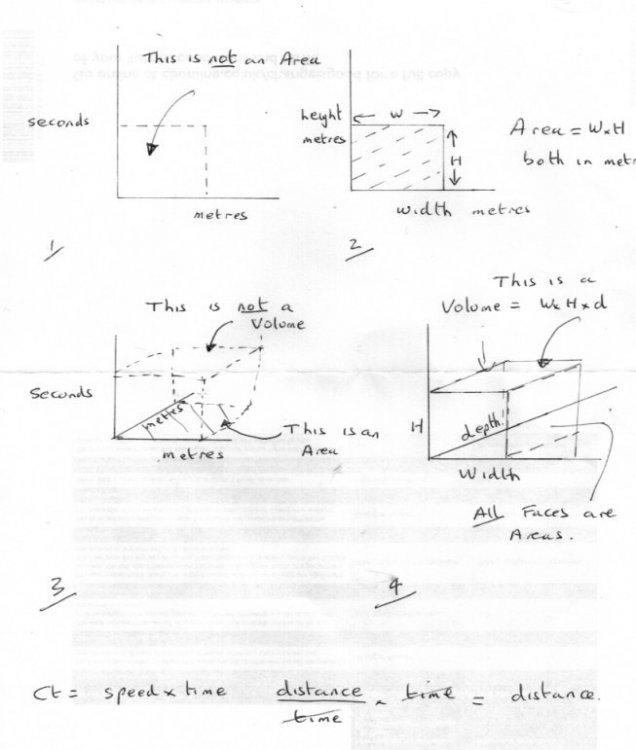
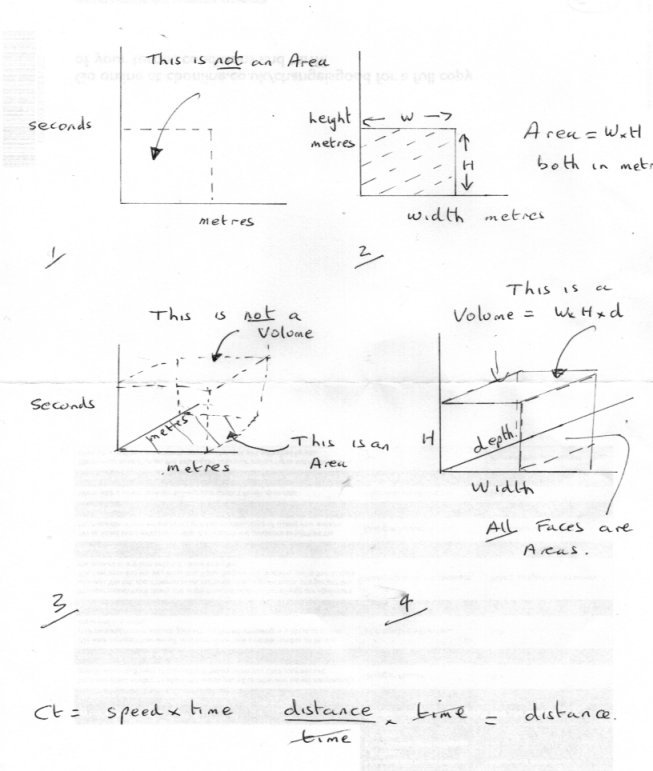
No worries, perhaps these sketches will help. Starting with only 2 dimensions and comparing two different figures. There are no volumes in 2 dimensions, only areas and lengths. In figure 1 one side is measured in seconds the other in metres. The region enclosed by the axes and the dashed lines is not an area. In figure 2 both sides are measured in metres and the shaded figure is inded an area. Moving up to 3 dimensions we now have areas and volumes (and lengths). In fig 3 we have two side lengths measured in metres and one side measured in seconds. This figure is not a volume. The base and top of the figure are measured in metres times metres ie is an area but the other faces are measured in metres x seconds, which is not an area. In figure 4 we have all three side lengths are measured in metres so the figure is a volume and is measured in metres x metres x metres. Also any of the faces are measured in metres x metres so all faces are areas. I can't depict 4 dimensions on a piece of paper, but the idea is the same and as you rightly say the next step up is a hypervolume. But the progression has the same characteristics. You can only have a hypervolume if all the sides are measured in metres and all the 'faces' are (3D) volumes. If one of the sides is measured in anything else then the result is not a hypervolume. So we can't use time directly. So I have ended with the observation that if we multiply time by a speed the times cancel and we 'convert' the time axis into a distance axis. Newton just used any old speed. Einstein introduced the idea of a special speed, c, the speed of light.