studiot
Senior Members
-
Joined
-
Last visited
Everything posted by studiot
-
I think swandont's point was about additional information. Let us conside a classical system of entanglement say two balls hidden in a bag. Measurement of the colour of one ball tells you nothing about the colour of the other ball unless you hve further information. But if you know that one is red and the other is blue then measurement of one colour tells you both.
-
Firstly thank you for a better description, though it is still not complete enough for dullards like me. Have you no diagram ? I am for instance not sure of the meaning of behind ?
-
You may have offered me an explanation I hadn't thought of, although I don't see why you have introduced a definition given by Philosophers since they have no patent on it. Possibly, even probably but I do not agree that the difference is superficial. Denying the existence of a God is much stronger than simply not possessing a God to believe in. It is noteworthy that the trusty OED uses the word 'denying' - an active state. I suppose that Philosphers might argue that the positive state (theism) is belief in a God and that atheism is simply the negative of this, which could be taken to include those who not only do not believe but also those who actively expound against.
-
Its more than juast word preference. It determines the lift of some pumps. I agree totally. +1 for the information additional to the lungs. What a pity the OP hasn't been back as he has reeceived some excellent answers.
-
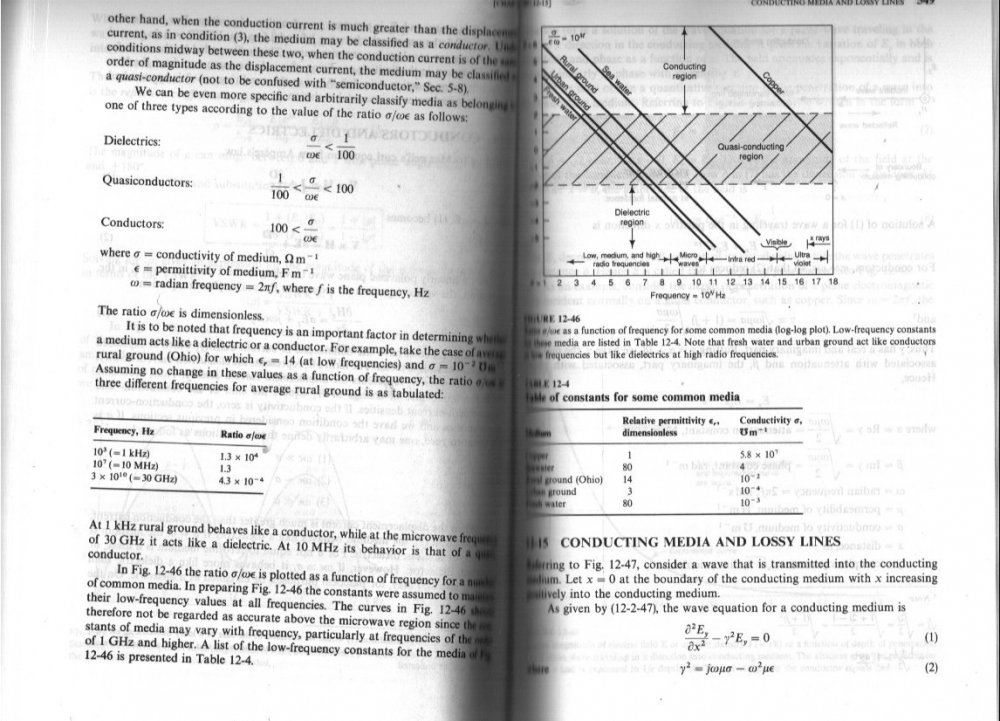
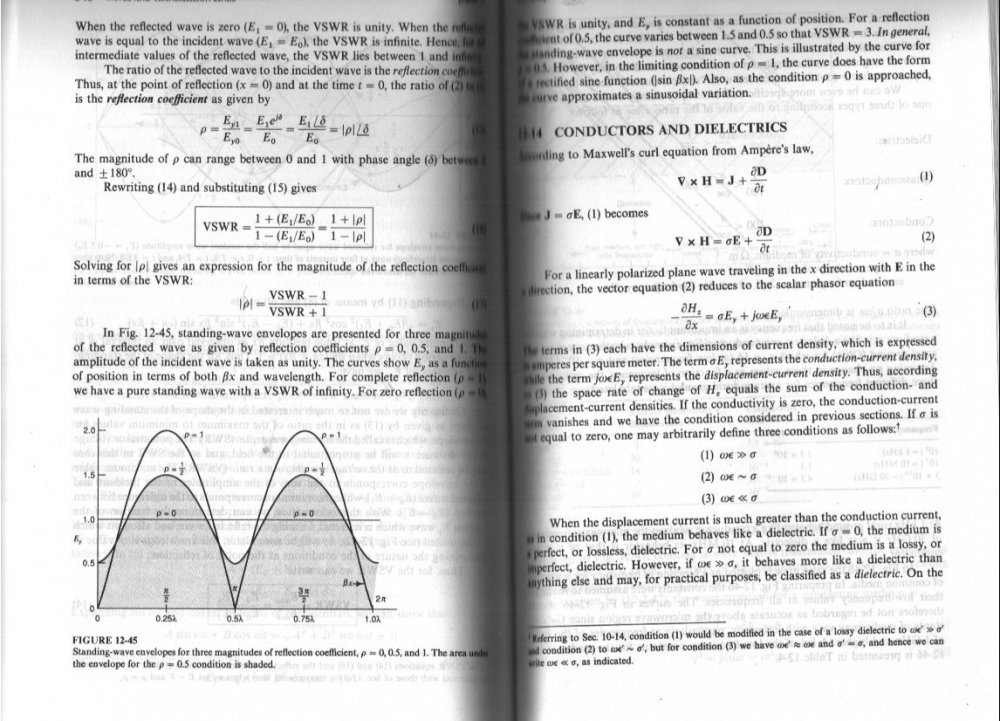
It's not as simple as Wikipedia makes out. What happens is heavily fequency dependent. Here is a short extract from Kraus. Sorry for the poor quality but it is a thick book and difficult to scan.
-
I would like to hear bangstrom's complete description of an experiment where light of one polarisation is persuaded to pass through one slit and light of the other polarisation passes through the other slit.
-
Well puzzle no longer you already know the answer. The van can indeed be considered as the fly's own little world, as with all the contents of the van. The fly starts off on some interior surface of the van and is accelerated, like everything else, to 60mph. So when it jumps off to fly back or forwards, it is alredy going at 60 mph and it only has to generate its normal flying speed to reach the other end. Since the air inside the van is also going at 60 mph it offers no more than normal resistance to the fly. Does this help ?
-
Really? You said And yet you continue to describe your pet example to others as though it is of vital importance. You asked and you received my explanation to which you have made a defeaningly silent response. Yet you say cavalierly that you have dealt with my issue. You have also not responsed to my earlier offers of other simple explanations like invariants and Bob's speed etc and my proposal to discuss a different (and better) example since Bob's was irrelevant to you and impossible for me. In short you are just trolling.
-
I really logged into this thread to say +1 to Phi for his last post but on doing so I note yet another misunderstanding by the OP In Science there are several (probably many) ways that something can be finite yet unbounded (that means no magical wall or precipice) or alternatively infinite yet bounded. Both seem illogical at a quick glance, yet physical examples of both situations exist in our experience of Nature. Absolute zero of temperature is about -273.4 degrees centigrade, yet we can never reach it. Because the closer one gets the harder it become to get even closer. The so called Gabriel's Horn is an example in Maths. But hey perhaps the OP has found the wall or precipice because his excuse for not talking to me was the insult
-
It is indeed pretty shocking. It shocked a lot of people all over the word when it was first proposed, including some very important thinkers. I don't think this is the case. There is only one train. But there are many points of view and I am offering a slightly different route into them than usual. Especially as I see you have actually been at SF for a long time so must have seen quite a few arguments about the subject. It is a pity you don't address my questions about the example you specified since that example is impossible to conduct in practice. This is why I would like to introduce and discuss a real world example, the first exerimental verification that the formulae actually correspond to observation. Discussing why is made difficult since you seem to be ignoring my comments about both your example and mine.
-
Either you want to understand or you want to argue. Which is it ? Just remember that if you want to argue you are arguing with one of the two most experimentally tested theories in history.
-
Does this mean you wish to follow / engage with my chaing of reasoning ? It is logically possible because the circumstances of different observers are well, ..... different. It is necessary to find quantities that are not different for different observers and equate them. This will enable you deduce the contribution made by the differing circumstances. Markus' muon example is one good example of this because 'number' is invariant. We can also look carefully at your depiction of Bob. Do you realise what 'speed' he is going to achieve a 100 : 1 length contraction ? It works out at 0.99995c to 5 decimal places. This is why I asked you how you think Bob can 'see' this contraction. Are you going to consider and answer this ?
-
Category mistake! I must remember this one. +1
-
This seems to me to be the key to unlocking understanding of SR for you. Some of us find thought experiments such as the one you describe add to the confusion, rather than dispel it. Please bear in mind that it is not physically possible for Bob to directly observe the measurements you describe. He can, however calculate the effects in his own terms. Modern derivations of SR are much simpler than the original, which is comparatively quite hard to follow. Modern derivations start with the idea that different observers will make different measurements on the same phenomenon. They then go with the notion of finding something that 'observers' can agree about and establishing the maths that yields the same values. In other words, the Maths follows the Physics. The something that can be agreed upon is called an invariant. An invariant is the same for all observers. Do you want to develop this route to understanding SR ? Note GR and SR are actually different; understaning GR requires further considerations.
-
I think Zap deserved that. +1 Now please be scientific and answer the question properly.

-
Depends what you mean by a vacuum. If you mean a complete void - empty space with nothing in it, not even air the no there isn't. But if you adopt a polular (also scientific) notion as being any region where the gas pressure is below atmouspheric then yes. This is often called a partial vacuum and can be measured as so many milliletres or inches of mercury below atmouspheric pressure. As a sports scientist I hope you realise that the old phrase Nature abhors a vacuum is nonsense. Most of the Universe is empty space. Your lungs do not suck air into them when you breathe in. The outside air pressure pushes air in when you expand your lungs by lowering the diaphragm. This lowers the air pressure within your lungs to below atmouspheric. There is no such thing as suction.
-
Well put. +1
-
-
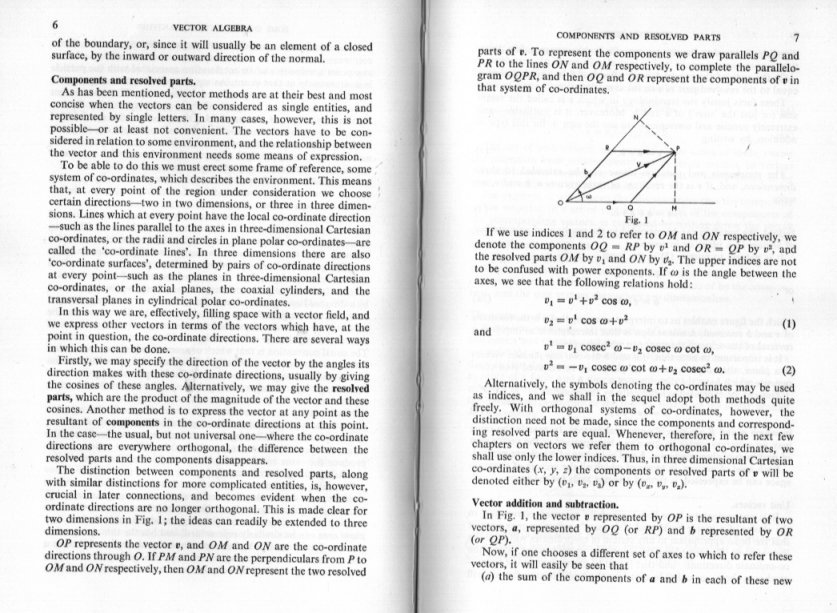
Markus has mentioned 'projections' several times recently. It is worth noting that there is a difference between a projection (called resolved parts in my attachment) and a component. Unfortunately distinction is blurred for many because they are the same thing in orthogonal coordinates, but become different in other geometries and the use of tensors. This arises because of interaction between the variables in non orthoganal systems.
-
Like all your posts I have read all your answers and responded directly to them. What you have written here is just plain rubbish You cannot slow a light wave, or any part of it. Electrical planes, whatever they are, do not travel through anything. Yes, elementary polarisation phenomena have been known since antiquity. But the important point, as I already said, was that knowledge at the time of Fresnel and Arago was insufficient to explain polarisation. I never said they did. Here is your quote from Wiki again. All this stuff is based on assumptions there is no need to make. And all the history of the development of our understanding of the phenomenon we call 'light' bears this out. We have been through several cycles of 1) We have observed some usually common characteristic or property and hypothesised explanations/mechanisms for these properties within existing knowledge and theory. 2) Someone then discovers isolated incidents where light behaves differently in some way. 3) We are then faced with extending our theory or even radically revising it. 4) But light still continues to follow the previous set of behaviours so continues to act in that way if called upon to do so. 5) And we do not need to abandon the earlier models if they are satisfactory and easier to calculate for the circumstances they were originally conceived. So, for instance we still use rays in geometric optics for most work. So this brings us to the Wiki statements which try to force us to make either-or choices about our hypotheses. There is no need to invoke rewriting the past or make a wave/particle choice if we simply say that light is a complicated phenomenon which has the capability to interact in composite-like, component-separable-like, flow-like, particle-like, ray-like, wave-like and now sometimes some other manner yet to be fully understood. In fact it is so complicated that I have probably missed some important behaviours off my list. You have indeed answered at least one of the many questions I asked, but you have not addressed all of the points in any of my post. This is regretable since all my points have been either directly aimed at answering or discussing a point you had previously made or adding something I considered germaine to that discussion. Since you clearly do not consider any of these of value I will leave it at that.
-
A shield can be as simple as a fixed deflector plate. I mentioned at least twice that it is structural support considerations that limit the size of vertical axis rotors. Perhaps you should follow the new thread on bending moments in Homework Help.
-
The signs you calculate will depend upon your sign conventions. If you are taking the dowward loads as positive then reactions will be negative. I can't deduce any more without you posting your working.
-
Jus to add to swansont's answer. @bangstromWhy do you not answer my questions ? Fresnel - Arago's work was between 1800 and about 1817. At this time interference and diffraction were known and partly studied phenomena. This was enough to lead to a simple scalar wave theory, but not enough to explain polarisation, which was known but less well understood. Basically results were all empirical at that time. An explanation of polarisation and its actions did not arrive until Maxwell published his vector theory of light in 1865. As swansont says, this was based on the vector electric field being the leading actor. It should be noted that this is not the vector associated with the scalar wave theory of Huygens. The electric field can be plane polarised (do you understand what this means - please answer this time). Since in 3 dimensions two planes can exist at right angles and a vector in one plane has zero component at right angles to its own plane and therefore cannot affect a vector in the other plane at right angles, Two such vectors cannot interfere. I was going to draw some diagrams to show how this polarisation works and how it can lead to circular polarisation but you may have seen such diagrams ? Polarisation is therefore a good way to obtain light as a plane wave, as needed for the slits experiment.
-
I gave you the Physics, what problem do you have with it and why have you not taken on board what I have said several times about diameter ? Yes, but you can shield against this effect, which you would need to do anyway as you do not want the rotor to be driven backwards in certain winds. In a wall such as this vertical axis rotors loose their principal advantage that their operation is independent of wind direction. In the extreme they would not work at all with a wind blowing parallel to the wall. So like all systems they concept has attractions and drawbacks which must be balanced against each other. I'm trying to be even handed here and keep an open mind.
-
You mean you did not understand what I offered you so you chose to insult me rather than ask for better detail. Should I report this as an infringement of the rules here?