studiot
Senior Members
-
Joined
-
Last visited
Everything posted by studiot
-
But that is one method of deriving the wavefunction of a bonding (bonded) orbital. [math]\psi = {\psi _A} + \lambda {\psi _B}[/math] Where lambda minimises [math]\frac{{\int {\psi H\psi d\tau } }}{{\int {{\psi ^2}} d\tau }}[/math]
-
Definitely some interesting thoughts here and I do appreciate that you you are trying to connect via an abacus or something but I fear that brevity may have klead to some abiguity. If at all possible I would appreciate amplification of the following points. For what purpose do you 'need to know' these facts ? How does that affect the ongoing entanglement? Yes, depending upon what you mean by 'non separability'. If you mean what swansont said ie that you cannot analyse the system as two independent parts agreed. But if you mean you can't physically separate the parts, thereby breaking the entanglement, the no of course you can break the entanglement. That would correspond to the MO method, but surely the LCAO method is a linear proportion sum of the respective parts ? Strictly you do not need to know all the quantum numbers, just the spin number of one electron. But then you would not have identified the orbital, just the entanglement. I seem to have commited the same brevity sin I accused Markus of.
-
So is anyone else brave enough to suggest that two electrons in a bonding orbital are not entangled ? Note they conform to swansont's definition here, but not to his earlier statement about being exclusively a historic event since the bond has continued existence.
-
I don't think I will be buying this book, but I am trying to dig out notions worthy of development for discussion. In particular I am offering my thoughts on what Dr Marletto might be trying to say. In particular the efficiency of boundary element calculation v those of finite element calculation is well known and documented. But I may be wrong that her thesis is an spect of that. I also think you have turned her argument around, perhaps my fault for giving the wrong impression. So thank you for making me recheck what I am getting out of this book. Edit that's twice just now I've lost connection to the site ( and written work) so I'm giving up for tonight.
-
doesn't really cut it. Particularly severely for spin. Really looking forward to continuing this discussion. You have just proved my point, that there is lots of disagreement about this subject. https://www.google.co.uk/search?q=are+electrons+in+a+bonding+orbital+entangled&source=hp&ei=bVxnYbGlMceblwS5yaCgDw&iflsig=ALs-wAMAAAAAYWdqfdSeHIMROWYCAzROmBYTFdDwWbqq&ved=0ahUKEwjxj-rQtsjzAhXHzYUKHbkkCPQQ4dUDCAg&uact=5&oq=are+electrons+in+a+bonding+orbital+entangled&gs_lcp=Cgdnd3Mtd2l6EAM6CwgAEIAEELEDEIMBOg4ILhCABBCxAxDHARDRAzoOCC4QgAQQsQMQxwEQowI6CAgAEIAEELEDOhEILhCABBCxAxDHARCjAhCTAjoICC4QgAQQsQM6BQguEIAEOgsILhCABBCxAxCTAjoFCAAQgAQ6BQgAELEDOggILhCABBCTAjoICAAQgAQQyQM6BQgAEJIDOgYIABAWEB46BAgAEAo6CAghEBYQHRAeOgUIIRCgAToHCCEQChCgAVCGF1jQlAFguJcBaABwAHgAgAG-AogByCaSAQgzMC45LjQuMZgBAKABAQ&sclient=gws-wiz Fair statement.
-
So the title gives the topic for discussion. Here is my introduction. An entanglement occurs when at least two bodies posses properties where observation (interaction) of that property value on one body (automatically) identifies the property value on the other body. A classical example would be a bag containing one red and one blue ball. Withdrawing one ball would automatically identify the colour of the ball left in the bag. But knowing the temperature one the one ball would not tell you anything about the temperature of the other ball. A quantum example would be two electrons in a covalent bond. Knowing all the quantum numbers of one electron would automatically define all the quantum numbers of the other electron. (Pauli) Please add whatever you think appropriate to the discussion or ask questions.
-
Thank you both for these replies. I have not said that I agree (or disagree) with the lady, but I would be very suprised if Oxford University was barking up a tree as far from the physics forest as you seem to suggest. In particlar I am finding many of the examples given in the book questionable. But this is a Science forum and this thread seems to be the only one actually discussing Science at the moment. As regards entanglement, that is only one part of it and I do not fully agree with you guys there. But then the lady herself indicates that experts disagree on aspects of the subject. So I have started a new thread specifically about entanglement for deeper discussion and to avoid derailing this thread with side arguments.
-
+1 What the difference between crude oil and refined oil ? Crude oil gushes out of the ground screaming "knicker. knickers, knickers" Refined oil gushes out of the refinery screaming "panties, panties , panties"
-
Hear hear. +1
-
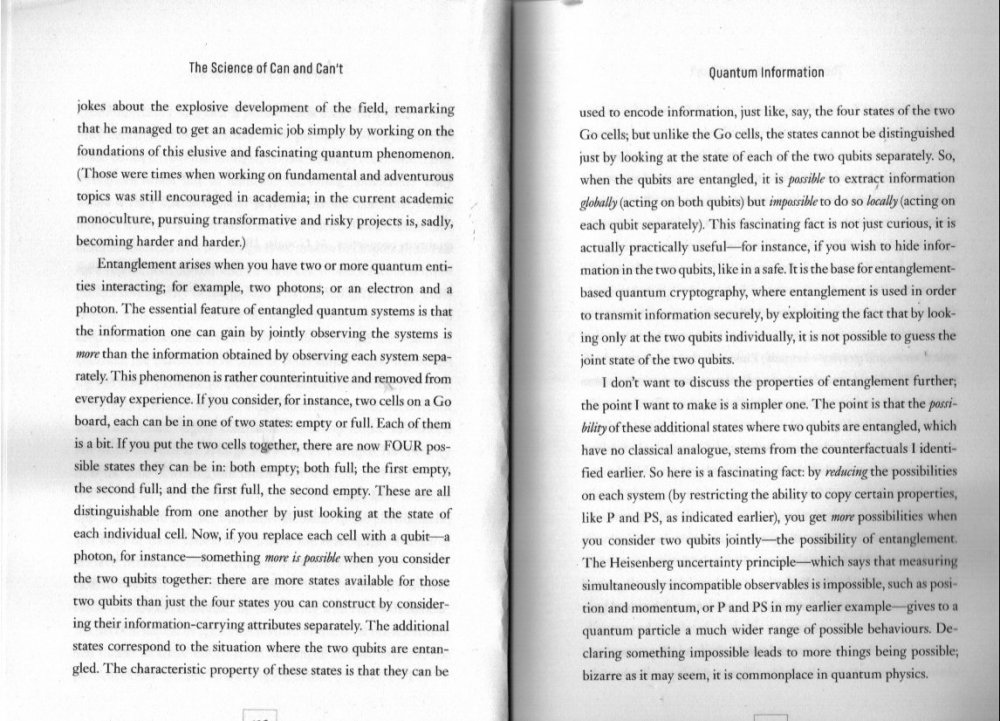
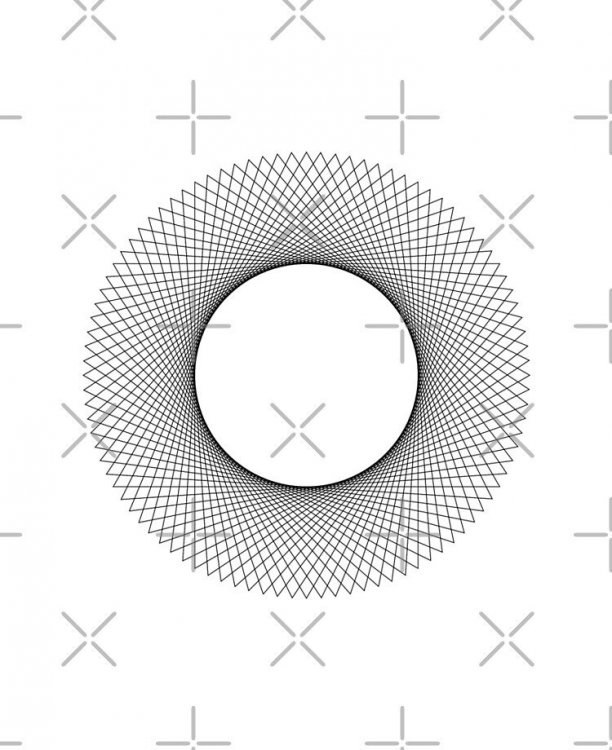
Thank you for your interest. +1 I have not read just over halfway through the book so I am no expert, but here is what the lady says about quantum entanglement, including the difference between quantum entanglement and classical entanglement. Halfway through and my impression is the book contains too much chit chat. So ideas behind it seem to get rather lost in the noise. Also there are some non intuitive definitions (as always seems to be th case) to get one's head around. Factuals and counterfactuals are a case in point. They seem to be defined as follows Factuals are statments, backed by obervations, of physics phenomena that we know have actually happened/ can actually happen / will actually happen. So yes they could be conservation laws. So I suppose they are direct staements about a phenomenon. Counterfactuals come in two formats. They are statements that are not forbidden, but have never actually happened ie they could happen, given the right conditions. Or they are statements expressly forbidding something for instance the impossibility of a pertual motion machine. So I suppose that they are indirect statements about a phenomenon. The claim is that current Physics is heavily slanted towards factuals. But (in some cases) it is easier to work in terms of counterfactuals. I am not sure about some of the examples given, but it reminds me of the fundamental theorem of calculus that relates interior properties of a region to the boundary properties. Here is my simple example Factual To draw a circle, fix one end of a string at a centre, pull it tight and rotate the other end about that point. Counterfactual. Use the string to do some curve stitching of the tangents and the result will be a circle
-
No. You offered a link to another website. The rules here explicitly state that matters fundamental to the discussion (for example basic definitions) must be posted here. Members should not have to go offsite to find information. It is OK to provide links to further develop the subject for those interested enough, or a link to something like a table of scientific facts. Such a table that for instance would tell me that there are two protons in a helium atom or the charge on the electron in coulombs. Here are a couple of such scientific facts. Our best estimate of the age of the universe is currently 14 billion years or 4.5 x 10¹⁷ seconds https://en.wikipedia.org/wiki/Age_of_the_universe Our best estimate of the time after the initial detonation of 'the big bang' during which there may have been not even fundamental particles is 10-43 seconds. https://www.physicsoftheuniverse.com/topics_bigbang_timeline.html Note these 'facts' are less reliable than my first two examples, but let us run with them in relation to complexity. In addition to scientific facts we have scientific observations. One such is that, as far as we can see the Universe looks pretty much the same in all directions on average. Now we know that because light takes time to reach Earth, the further away in distance we look the further back in time we are seeing the universe. This tells us that all those atoms, molecules etc existed as far back as we can look in time. So for the first insignificant time of 10-43 seconds the universe had no atoms etc but for the rest of its history there has been little change in composition and therefore complexity. I am only continuing this because there is a germ of a really interesting topic involved, but feel free to ask for more information. That process is called discussion.
-
Poland stokes fears of leaving EU in 'Polexit' By Adam Easton BBC News, Warsaw Published 21 hours ago https://www.bbc.co.uk/news/world-europe-58840076 Tensions between Poland and the Eu escalates and the BBC article examines the possible eventual outcome>
-
I asked you two clear questions, both of which you have ignored. When pressed for answers you resort to personal insults. How is this not trolling ? I find this a great pity since the development and meaning of complexity could be a very interesting and fruitful topic. Good night all.
-
This is the third time I have asked for supporting information, in the form of your definitions or supporting rationale of simple terms you have introduced to the thread. The fallacy of appeal to authority in not acceptable support. Reported for trolling. Reported for trolling
-
But the OP was specifically referring to lots of specific objects ?
-
You heat me to it, and you expressed it better. +1
-
Once again a masterful summary. +1 I can only add my comment that trying to deduce facts about 'free will' from the separable actions of single (elementary) particles and transferring these observations from systems of the order of 100 particles to systems of the order of 1025 particles is about as sensible as arguing over Schrodinger's Cat's Tale (Which tail(pun intended) is based on the same macro v micro difficulty)/
-
Thank you for your well reasoned reply. +1 Have you heard of counterfactuals ?
-
I can't tell if this is a single quote or a pastiche of quotes or if it is your own work with references. (if it is your own, although misguided its good work). A bald statement that something does or does not obey the Second Law is not sufficient. We need a chain of reasoning, starting from agreed known facts, leading to the claim as a final conclusion, all stated here. I asked you to define your version of complexity. Instead of an answer you have introduced more new words such as order and disorder without definition. Please discuss this properly. According to what I know about Plato, he was about simplificaction not complexification. He believed in so called perfect or ideal systems, the simpler the better.
-
I don't see anything funny in this. I am glad you decided to take things more (scientifically) seriously though. So your speculation is that increase of 'complexity' (depending upon how you define the term) is a driver of processes in a similar way to those of minumum energy or maximum entropy ? How does this work with the Second Law maximum entropic 'hot death' of the universe ? Maximum entropy is often aligned with minimum complexity.
-
+1 for putting lots of good things into this thread.
-
I'd like to start my response by stating that the first time and only I have heard of Jordan Peterson, let alone his ideas, was in this thread. I can't say that what I have learned has led me to want to know more. I note that no one has introduced the issue of 'nature v nurture' here in this thread. I consider this aspect of vital importance to the question. I understand Jordan is a professor of Psychology, which makes his stance all the more surprising to me, as it only addresses nature. Human beings are amazingly adaptable creatures, in no small part as a result of their powerful ability to learn. In other words humans can be programmed and reprogrammed - this is the nurture part. Obviously they can only be programmed to think and act according to their capabilities and capacities. But we know that some ordinary citizens (ie those who would not ordinarily even dream of doing such things) can be programmed (taught) to sneak up behind someone and strangle them with a garotte wire.
-
Not quite. Yes binary is a base 2 number representation system. But no, it does not use 2 states on their own to represent a number. That could only ever represent 2 numbers. A number system are designed to represent all the numbers in its particular range. In order to do this you can either use a different symbol for every number, which is obviously inefficient and difficult to learn. Or you can repeat symbols in some way, with each repetition having a different meaning. The smallest count of symbols you need to do this is called is 2 and is called binary. 2 is then called the base. One consequence of using 2 is that it leads to very long representations of numbers, both numerically bigger numbers and fractions. In general, The larger the count of symbols the shorter the repreentation becomes. So if use use 3 symbols we get ternary numbers, also called trinary numbers So if use use 4 symbols we get quaternary numbers So if use use 5 symbols we get quinary numbers So if use use 6 symbols we get seximal numbers So if use use 7 symbols we get septernary numbers So if use use 8 symbols we get octal numbers - note this one does not follow the pattern and is abused by computer science to also mean groupings of binary numbers. So if use use 9 symbols we get nonnary numbers So if use use 10 symbols we get denary numbers commonly, but wrongly, called 'decimal numbers'. So if use use 16 symbols we get hexadecimal numbers or hex numbers. Mixed representations can also be used, such as BCD or binary coded decimal and octal. Up to and including base 10 we use the 10 digits 1 through 9 and zero as the symbols To additional obtain symbols for number systems with a base greater than 10, we use letters from the Latin alphabet, eg hex numbers use the 6 letters A,B,C,D,E and F. Does this help ?
-
So this is homework/classwork. So it should be posted in homework help and you should tell us what you do know about the subject and at what point you came across something you don't understand. That is what have you done so far ?
-
Are we talking established Science or speculation here ? If speculation what about some supporting facts, not involving fantasies like dimensions of experience ?