
studiot
Senior Members
-
Joined
-
Last visited
Everything posted by studiot
-
I don't see how any of this disagrees with anything I have said.
-
I do think the discussion about reality has failed to demonstrate the flaws in the concept. Last night (to me) or yesterday afternoon to her, along with millions of others I watched Radacanu win the US open (congratulations to her). So whose 'reality' was correct ? Was it really yesterday afternoon or last night ?
-
Sure. In my view, admittedly coloured by the fact that I am a mathematician, I hold that Theories operate on Principles, in a way similar to the way in which theorems operate on axioms (which Physics does not have) in Maths. The view I have been promoting here in several ways is that Philosophy deals with the Principles of any subject not the detail. It could even be said that the subject itself is the detail. I also hold that it is a 'good thing' that we have an independent process or discipline scrutinising the Principles.
-
So what ? I have never seen the bottom of the Pacific Ocean or the Higgs boson. Does not make either of them unobservable, although until recently no one had seen either of them. Although I wonder is some philosophers might not argue that since the Pacific Ocean does not drain out onto the turtles beneath it must have a bottom.
-
Another case of the conclusion does not follow from the antecedant. Just because Newton (or anybody else or even everybody else) says that they could not observe something does not make it unobservable. Not even in Philosophy.
-
It is worth noting that theories and models are not the same. It is also worth noting that they are secondary (ie not primary) in the domain of rational thought, subdivision Science. finally @Davy_Jones it is worth noting that I don't believe you have mentioned the word 'principles' (or a synonym) in any of your posts. And I hold that the main (call it real if you like @dimreepr) difference between Philosophy and Science occurs in the Principles of those two disciplines and in particular in the history of those Principles. Copernicus and Galileo were considering Principles, not theories.
-
And who might the you be in the 'your' ?
-
Thanks +1 Told you I was in a rush, don't know now where that + idea came from. So the top is p2, not 2p. Moral never rush. 😳
-
I'm rushing here as I won't be back tonight, but here is a start. Let the initial concentration of AB be q and the concentration of A be p then Equilibrium equation is [math]AB \leftrightarrow A + B[/math] Dissociation equation is [math]{K_d} = \frac{{\left[ A \right] + \left[ B \right]}}{{\left[ {AB} \right]}}[/math] Also [math]\left[ A \right] = \left[ B \right] = p[/math] and [math]{\left[ {AB} \right]_{initial}} = q[/math] So [math]{K_d} = \frac{{2p}}{{\left( {q - p} \right)}}[/math] Now I think this is right but I'll check again later unless Babcock or CharonY call in with a better idea first.
-
Well I did look it up because I had not heard about this. Thank you for the reference, it adds to my store. +1 I found this description https://www.quantumdiaries.org/2011/11/18/a-tale-of-two-tables/ Which I thought rather offensive towards the man. It seems that Fermilab features highly. It dismisses his main scientific achievements with an airy wave of the hand. I would suggest that the two tables analogy (Eddington did say it as an analogy) is a version of what so many members here have been telling you. Science works with models. Models only ever cover part of the subject they are modelling. None are perfect or exact in every respect, except the subject itself. Models are subject to continual revision and refinement. Do you have any idea of the number of scientific models that were developed this way during the period 1890 - 1935 ? I can tell you it is a very large number. Some of these we still find useful today, some have been developed further others have been discarded That is Science. But to denigrate that man as the linked site does is unforgivable. It almost has the air of those quack sites designed to spread deliberate disinformation. But thank you again to bringing it to my attention. I will leave it there in this thread, but would be happy to discuss your and the comment under the Fermilab banner further in another. Thank you for your response to my question to theVat. I am aware of this process, but it is not an answer to my question about probability. I would also like to see a response from theVat himself. Again this may be an interesting side issue to discuss in another thread. In this case I would have to disagree with both Wiki and yourself (as Wiki is misleading). Falsifiable literally means 'capable of being falsified or refuted. if it is contradicted by an observation that is logically possible does not mean that the observation has been carried out or will ever be carried out or that it may sometime be true and sometimes false depending upon circumstances. The proposition "you can't get a quart into a pint pot" can be 'proved' with two suitable beer glasses. But wait How many 'quarts' of oxygen from the air can I get into an oxygen cylinder ? It may also be that the 'falsification' is impossible to carry out.
-
I'm not trying to make them hard to answer, just relevant. Good thinking on your part, both the repetition and the gallantry dimension. +1 Quite different from what I had in mind, but certainly not wrong and worth saying. I was envisaging that in the time, even before the stone age, primitive Man would have witnessed natural fires. Perhaps he was drawn to them because of the warmth and yes as you say he may have then discovered that other animals kept away (Science). Perhaps he saw a natural fire from a distance and just wondered (Philosophy). At that time his tools/weapons would have been sharpened sticks or heavy wooden clubs. Somehow one on his sharp sticks got into a fire but was charred a bit rather than burned. Perhaps he pulled it out again. And then he found the charred end of the stick was harder and stronger than the original. Or perhaps it did catch fire and he was attacked whilst pulling it out and discoverd that waving a burning stick at a predator drove it away. There was a lot of perhaps or maybe in that tale it's really all supposition, but palusible. So the Science made him think and the thoughts led to better Science, which led to better thoughts... Or was it the other way round ? Or did they develop together ? Other thoughts are welcome which is why I said it would be a good topic for another thread.
-
Yes we have discussed that aspect before. But who did the first science or philosophy ? What did the first man to wonder what fire was and the perhaps to try to make use of it (by experiment). Was he doing Science or Philosophy , even though he probably could not speak to say the words then ? And would this question be abductive thinking or what ?
-
Thank you for this answer. Now I know why I am not a philosopher. Your quote uses the words "Most likely". Quite unspecific. What, exactly does this mean in the realms of Philolosophy please ? Or if you prefer here it is as a mathematical statement. The probability of X , P(X) =1 ? I would warn you this statement has at least 3 possible mathematical meanings. PS I do like you flea/dog comment that's now in the trash can.
-
Possibly a lot of problems, but also many benefits. However the origins of philosophy, science and technology are uncertain at best and unknowable at worst. These origins would make a worthwhile discussion thread in their own right.
-
Be fair, we are discussing in a Philosophy thread. So the matter can finally be considered settled. Phew! Really ? (pun intended) I have just posted this in another philosophy thread So beware false logic.
-
Thank you both for your thoughts. Yes, we have discussed deHavilland before. Geoffrey was one of the most talented aircraft designers ever. But he obviously worked without the benefit of Roark or Klein-Logel. And for fatigue, stresses don't have to be extreme, they just need sufficient repetition. I had always understood that the worst comet failures were fatigue at the root of the alloy wings. I can't say I am keen on knowing that our most advanced and recent trains were designed in such a way as too need 'monitoring' well before much more elderly trains have been withdrawn from service.
-
Apart from the lack of commonsense demanding an answer to the above question (what is more logical) that can only be offered as yes or no, there is the philosophical difficulty of my answering 'yes'. Consider The true statement 'there are no pigs flying past my window at the moment' The false statement 'there is a cat in my garden at the moment' Which is more logical ? Which makes more sense ? Does being true or false make any difference to these ? And finally this statement which makes perfect sense, but contains no logic whatsoever, whether it is true or false 'She opened and then shut the green door.'
-
How can one statement be more or less logical than another if there is no scale ?
-
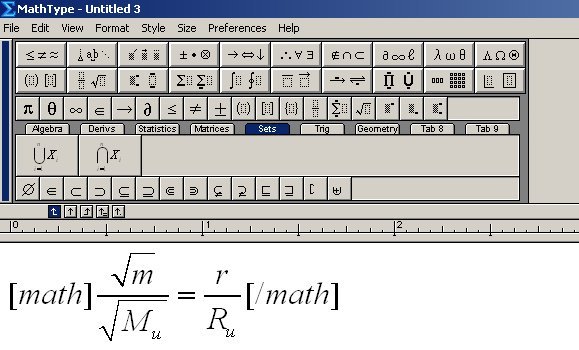
[math][math]\frac{{\sqrt m }}{{\sqrt {{M_u}} }} = \frac{r}{{{R_u}}}[/math][/math] The parser in this forum doesn't like one or both of your square brackets for some reason. This is what I saw when pasted your original into a proper parser. When I pasted it back into the forum it added another set of math tags. I am not sure why. So I removed one set of them in the forum.

-
I know I usually say that folks are too quick to demand binary choices, but I didn't know there was a scale of logicality
-
[math]\frac{{\sqrt m }}{{\sqrt {{M_u}} }} = \frac{r}{{{R_u}}}[/math] There should be no space between [math] and \frac
-
The preliminary report on why the UK's most recent high speed trains had to be withdrawn from service has been published. Apparently metal fatigue and stress-corrosion cracking were the causes of cracking in different components. Amazing that such design mistakes can still occur. What a good job they were found before any accidnets were caused. https://www.bbc.co.uk/news/uk-england-58494275 Hitachi train cracks due to fatigue and corrosion, report says
-
Please note this is not the complete equation. This is [math]{E^2} = {\left( {m{c^2}} \right)^2} + p{c^2}[/math] I await the derivation of this with interest. However I am not a cosmologist so cannot verify your other statements. Hopefully those more interested in that subject will come forward with answers.
-
I would listen to Charony's comment on this when it comes as hsitology is not my subject. I would just say that in Science generally it is always right to say what you mean exactly. Experts in a particular area may take short cuts but they may also then be misunderstood. Here is a humerous sketch that really shows this.
-
Since you were speaking in Everyday English and not philosophical techspeak, how was I to know these things ? FYI We used to sell sweets in the Somerset Rural Music School tuckshop. Some of these sweets comprised some sort of foamed jelly stuff made into shaped and multi coloured comestibles. One type of these was called 'poached eggs' - (for 'obvious' reasons) Thanks for the new expression. I had to look it up. +1