studiot
Senior Members
-
Joined
-
Last visited
Everything posted by studiot
-
I would listen to Charony's comment on this when it comes as hsitology is not my subject. I would just say that in Science generally it is always right to say what you mean exactly. Experts in a particular area may take short cuts but they may also then be misunderstood. Here is a humerous sketch that really shows this.
-
Since you were speaking in Everyday English and not philosophical techspeak, how was I to know these things ? FYI We used to sell sweets in the Somerset Rural Music School tuckshop. Some of these sweets comprised some sort of foamed jelly stuff made into shaped and multi coloured comestibles. One type of these was called 'poached eggs' - (for 'obvious' reasons) Thanks for the new expression. I had to look it up. +1
-
1) Please point me to a correct reference to the term "screamingly obvious" in Philosophy. Or even just 'obviously'. 2) Why is S2 obviously true ? This morning, when I had my poached egg for breakfast I named it Frank Sinatra. Just as yesterday I named my egg Shirley Bassy and will probably name tomorrow's egg Annie Lennox. Considering the length of your opening post, I would be very interested in your response to this recent post from another of our general philosopher members. A well thought out and rounded response. +1
-
+1 Just a note of additional explanation to add here. In many (if not most) presentations of relativity/gravitation (particularly Physics ones) it is stated that a geodesic is the shortest line. This is actually only half the story because a geodesic is a line of extremal values. And extremal values may be maximum or minimum (as Markus has here). Applied Mathematicians have therefore started to use the term extremal or state both maximum and minimum. This is further complicated in that the standard calculus technique to indentify such points and lines also identifies 'points of inflection' which are neither a maximum or a minimum.
-
Nor does it needed to be presented as hyperbole. Makes perfect sense to me that you have not read Dag1's post so I have added another + 1 to draw your attention to it.
-
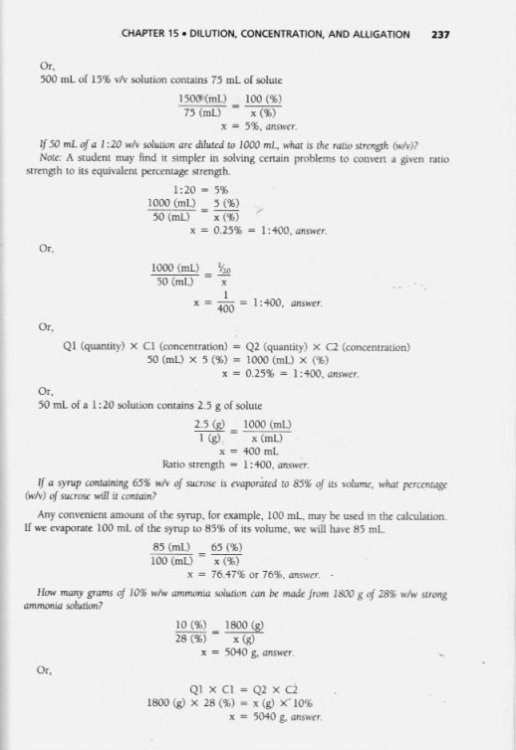
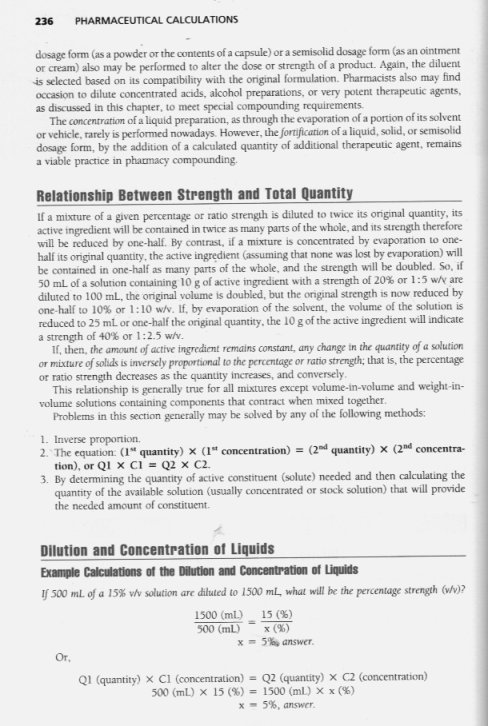
This is not correct as it is 5 in 505 which is not the required ratio 1 : 100. This is correct as it is the required ration of 5 in 500 or 1:100. There are several ways to work this out: Here are same example calculations working out the same example by different methods.
-
Yes and furthermore you also pointed out a while back, but drew no more attention that that from myself, that physicists are also human and sometime act in other human capacities than as physicists. So just a philosopher may do some science, some physicists may do some philosophy. But that brings us the question Physics is not the only Science, or the oldest. The Royal institute of Astronomy is senior by half a century and the Royal Institute of Chemistry contemporaneous. And the OP is about Science, not just Physics, monolithic or not. If we could all widen our horizons from 'Physics v Philosophy' to 'Science compared to Philosophy' perhaps this otherwise excellent thread could become less contentious. Yes both Science and Philosophy have developed and run into many brick walls. Though not necessarily at the same rate. In fact if you consider it, matching rates is far less likely than differential rates. So whilst the scientists are shown to have put forward erroneous theories from caloric and phlogiston to Hoyle and Bondi's steady state theory the philosophers should remember that alchemy (philosopher's stone) , numerology and astrology all grew out of Philosophy. So perhaps here we have another difference since I suggest Modern Science has progressed faster and further than Philosophy, though I also think that Modern Philosophy has progressed further than its pundits here allow.
-
Do you not think Physicists would be delighted if this goal was achievable? Do you not think this has not already been attempted ? I would be interested in your calculation of the temperature of these two charges that swansont asks about.
-
[tex] \frac{kg\cdot m^3}{s^2} [/tex] [math]\frac{{kg\cdot{m^3}}}{{{s^2}}}[/math] [math]\frac{{kg\cdot{m^3}}}{{{s^2}}}[/math]
-
Thank you also, +1 If this translator is any good (better than google) it might come in handy one day.
-
I did not misunderstand your point, I just did not reply to it. Edit : I actually think it a good philosophical example of meaning, but not of difference. /Edit I was noting your introduction of a vague notion of probability (not incorrectly since this is philosophy) and contrasting this with a fuller but more complicatd scientific version (since that was the op question). Vive la difference. In general I agree with the sentiments/sense of all of this particularly the last paragraph. +1 But is it about differences ? If a philosophical line of thought is added to or taken on by a scientific one are they then different ? I fully admit to having been seduced into off topic posting in some of my posts in this thread, it is very easy to do.
-
Oh dear. @Gees and @beecee I was going to say that I am glad you two have managed to discuss my words without actually swopping red cards, but I see that one appeared a few posts back. Since neither of you seem to have fully appreciated my words (probably my fault) I will level the playing field and explain my words further. 'greater' is definitely a scientific term used to purely indicate size, as opposed to any value judgement such as 'better'. Indeed I gave a semi scientific (geographic) example in some place names. I have now realised that the obvious examples are from the life sciences where greater and lesser abound. For example the greater spotted woodpecker and the lesser spotted woodpecker. No implication is made that the smaller bird is in any way 'inferior'. Now to substantiate my claim that today the buld of scientific knowledge exceeds that of the philosophic. I do not think the name of the academic qualifications awarded by some older institutions is an appropriate measure. The number of DPhil awarded by say Cambridge for scientific studies is greater than the number for philosophic studies. But then newer institutions award qualifications that reflect their scientific nature. BMedSci, MPharm, Dsc and so forth. Many of these do not have a philosophy department. And, of course, we should also look at other academic systems. Central Europe used to aspire to Privat Dozent as its pinnacle qualification, before professor. OK so that deals with academic qualifiacations. What about output ? It used to be said that the were 7 miles of shelves of dissertations on"the influence of Shakespeare on Coleridge" at Oxford. This of course is English literature, not Science or Pholosophy. But today think of the library space devoted to Scientific subjects v the space devoted to philosophy and also the number of students in each discipline. Now look to the wider world. How about the warehouses full of scientific specimens belonging to the many museums ? Or the stores of records from scientific observatories around the world, from ice core logs to oceanographic measurements to atronomical observations to mineral and oil company prospcting to meteorological data to genetic studies to flora and fauna observations to ... the list just goes on and on. Is far as I know the corresponding list attributable to Philosophy is minute. So more people are engaged in obtaining and processing more data every day in Science than Philosophy. So Science is now the 'greater' activity.
-
If you stand accused of any crime at all I would gently suggest that it is the one of not addressing a philosophical question. Or perhaps I should say the set philosophical question. The OP made it crystal clear that his question (you are right it was deliberately posed as a philosophical question) was about differences between Science and Philosophy. In fact the OP only mentioned difference in the singular and I have asked if folks think there is only one difference, a point which has generally been ignored. It was was not the question (in many eyes here including mine) you seem to be addressing which could be roughly phrased What does Philosophy think of Science and Science think of Philosophy ? This difference between the OP question and the one you appear to be addressing is probably the reason for all the pushback.
-
One more thought occurs. Much use is made of the Greek alphabet so get yourself a copy and keep it handy to refer to and become familiar with (unless you already speak Greek of course). Both upper and lower case are used. https://www.rapidtables.com/math/symbols/greek_alphabet.html
-
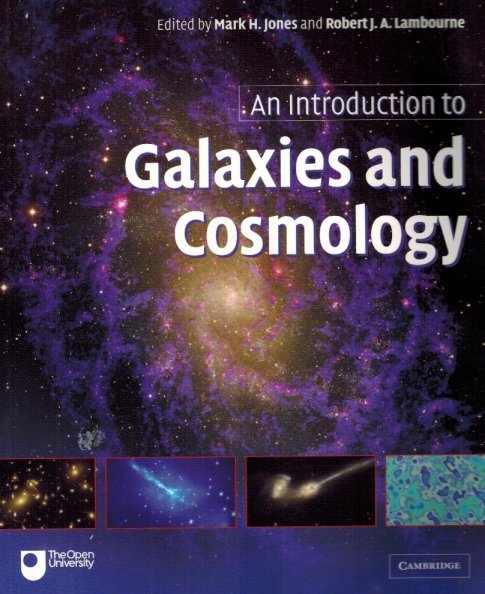
I normally find some books or other material to refer when folks ask. But this is a really tall order that all but has me stumped. But welcome anyway and if you have queries this is a good place to just ask. In the hope that your basic algebra included at least simple equations and their rearrangement I suggest you look into this book. The maths is very gentle and there is a glossary/explanation of all the (astro)physics you will need, plus lots of photos and full colour diagrams. The books covers a good range of topics without being too difficult. Science books are expensive and astro stuff goes out of date very quickly so you might like to look into a second hand copy. I also suggest you initially beware of material on relativity, gravitation particle theory. These will draw you down a never ending rabbit hole/warren of increasing complexity that you will not have the maths to understand so will gain entirely the wrong impresion. Go well in your study enterprise.
-
I agree there. Sharp being the operative word as I think that hardening a sharpened stick in a fire might have been one of the first scientific discoveries.
-
Thank you whoever like my post but I must admit a serious boo boo, rather worse than my frequent spelling errors. I meant to say What I see happening here is the attempt to apply the language, terminology and symbolism of one discipline to the language terminology and symbolism concepts of the other. I agree that both have sufficient stake in formal logic that some ptocesses may be directly transferred, even though the symbolism may be different. However for the concept 'truth' such a concept would (and does) take the form of rewriting DeMorgan, Karnaugh and so on in different notation. The concept of 'truth' you have offered in your post and I have highlighted fails for the same reason as I have already given in my example of the butterfly wingspan masurement. such terms as 'corresponds accurately' and 'state of affairs' are too wooly for Science. Both accurate and state have very specific meanings in Science.
-
Agreed it is 'reality' and 'true', which are the problems. Neither are scientific terms. Both Science and Philosophy have a commonality in that they have both developed a discipline specific language, terminology and symbolism. But that is as far as it goes because many if not most of the concepts these refer to only occur in their respctive disciplines. What I see happening here is the attempt to apply the language, terminology and symbolism of one discipline to the language terminology and symbolism of the other. It is not suprising to find that therefore that this fails because for instance the 'reality' and 'truth' of Philosophy, have no counterpart in Science.
-
How did the first man to 'do' the very first bit of Science learn Science ? I have already noted that I consider the very first bit of Science was likely to have been materials science.
-
I dunno, what am I thinking? That perhaps the only member who wants to discuss the OP is the member from stoned house.
-
Yay, you have gained something from the thread +1 So Gravity (or gravitation as the posh word) is a phenomenon that can exert a Newtonian force but it also has other properties. In particular it can affect time, which as far as we know, other Newtonian forces cannot do.
-
No since you are trying to show that describing reality is common to some part of Science and to Philosophy, yet the thread is about their differences, not their commonalities.
-
This would be the first time I have ever heard of learning as equivalent to reporting. That is stretching meanings and definitions too far in my opinion, just as before someone can experiment he must be born, get out of bed and so on. So by the above logic all these activities this must be included under experimentation.
-
I don't see where research, hypothesis, data analysis, observation, report, or testing come into it. Either you know how to synthesise this compound or you learn some Chemistry and find out.
-
The blue ones only come in six-packs.