
studiot
Senior Members
-
Joined
-
Last visited
Everything posted by studiot
-
My reaction has nothing whatsoever to do with π . I already addressed your issue with the irrationality of π in the post you quoted. Did you not read it ? If you look carefully at the post you will see (as I and other members do) that the stupid forum software 'rolls up' a quoted post so you only see the first line of my quote of your reply. IT specialists call this 'convenience' but I'm sure it leads to much misunderstanding and probably has in this case. Here is a screenshot of what I see. It's layout shows my post I quoted (but you would need to click on 'expand ' to read the whole post) Referring to that post I asked why you had accused me of making two particular statements, when I had carefully stated the exact opposite. I then quoted your post where you had made these accusations. (again you would need to click on 'expand ' to read the whole post) Edit Sorry I missed out the screenshot. Nobody's perfect.
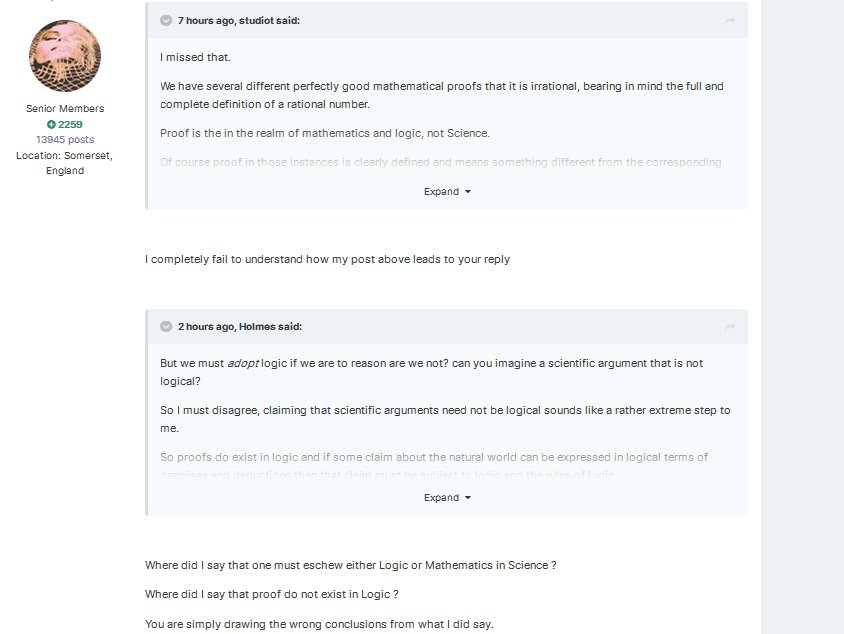
-
I completely fail to understand how my post above leads to your reply Where did I say that one must eschew either Logic or Mathematics in Science ? Where did I say that proof do not exist in Logic ? You are simply drawing the wrong conclusions from what I did say. The conclusions to be drawn are that there are matters in each of Science, Logic, and Mathematics, that are not in one or both of the other two. And, following convention, proof is one of these matters. A very easy way to understand this is to draw yourself a standard three circle Venn diagram. one circle representing the content of each discipline. Such a diagram will not show complete overlap. Such a topic is one of those ideal candidates for another thread, indeed we have had such here in the past.
-
I thought you wished to discuss the supernatural because you claim that ordinary natural analysis is inapplicable and/or inadequate. Is this not then your case ? "If we cannot discuss mathematics then we cannot discuss physics." Here is a typical example of you making a pronouncement, without any backup whatsoever. Whilst I agree the much if not most of Physics is mathematical in nature, there are important occasions when no Mathematics is involved. Indeed Mathematics cannot be used to express the reasoning involved. My favourite one involves Professor Swinnerton's description of what you see and can be deduced by looking down a microscope at the crystals in granite. I have already said that many of your pronouncements are sufficiently interesting propositions in their own right to deserve threads of their own. I actually consider many of them to be more important and more interesting than the OP here itself. An OP that we have agreed is flawed. I suggest that in future you consider rephrasing some of your 'pronouncements' so that they are not of the 'all or nothing' type as counterexamples can so often be found in the 'devil is in the detail' principle applied to totality statements made without caveats.
-
I missed that. We have several different perfectly good mathematical proofs that it is irrational, bearing in mind the full and complete definition of a rational number. Proof is the in the realm of mathematics and logic, not Science. Of course proof in those instances is clearly defined and means something different from the corresponding idea in Science, validation, which is why we have different words for them.
-
Yup that's what I said before. And of course, although a proposition can be true or false neither can be proved from false premises.
-
So you agree with the result everyone else has been saying is that the original argument proves nothing about God whatsoever.
-
What electric and magnetic field (for both particles ?) and how do you think this accounts for the interaction of each particle with an electric and or magnetic field ?
-
It is refreshing to have a non controversial subject to discuss so +1 for introducing it. This is a worthwhile addition to the discussion, though it is not always necessary to have a slope or fall in the pipes, they are often laid this way and indeed in sloping ground it may not be avoidable. +1, making your reputation now neutral. 🙂 Externet has introduced two cases when non sealed pipework is used, both being for 'drainage' purposes and you have added a third in irrigation. Just to get irrigation out of the way quickly it is normally laid on the surface for the water to follow nature and trickle down into the soil. Clearly this would never be done in cases where the soil already contains sufficient water. Sufficient water does not mean saturation by the way. But Externet asked about 'French Drains' and in particular 'tiles'. The main purpose of the drainage is to lower the water table in both agricultural and ground engineering (foundations, basements etc) applications. The term French Drain refers to the entire system, not just the pipes. The water table is the boundary between saturated and non saturated soil (or rock) and has a posh name 'the phreatic surface'. Below the water table the ground is saturated and above it will generally still contain water but at lower concentration and so be unsaturated. If the water table is too high for part or all of the season then (some) crops will not grow satisfactorily. The original drain indeed used V shaped clayware tiles, laid upside down or apex at the top. These can be traced back to Roman times. These were not perforated but simply laid, butted in a line, at the bottom of a trench. The inverted V acted like a little roof, protecting an open space beneath, from being filled with soil Because the joints were 'open', water percolated into the open space and spread along the line. A network of such trenches would reduce the whole water table in a field and perhaps lead to a deeper side ditch to drain away excess water. It is often not necessary to lay these to falls, this depends upon local circumstances Such tiles are still available but have generally been replaced by short perforated round clayware pipes, which are still called 'tiles'. More recently long lengths of perforated and unperforated plastic pipes have been introduced. Often the tiles or pipes are sourrounded by some granular material such as a type of gravel called 'pea gravel' to slow the ingress of fine soil material which would eventually clog the pipe. But the soil for supporting the crops is then backfilled over the top, as they won't grow in gravel. OK so that is the agricultural use now for the engineering use. Saturated soil exerts a much higher pressure on retaining walls, foundations, basement walls and the like, than unsaturated soil. This is known as 'active pressure' in soil mechanics. This is clearly undesirable and has been the cause of many a structural failure. To avoid this pressure structures subject to earth pressure are protected by attempting to totally lower the water level to at or below the lowest structural level. In order to achieve this the backfill behind say a retaining wall or under a foundation is made from 'suitable material'. This suitable material is usually granular right the way down from the surface to the bottom, where a porous or perforated pipe collects and distributes water in the same way as the one in an agricultural field, but this results in a more drastic reduction in the water table level. This technique is also used to stabilise earth slopes (eg in the sides of cuttings) that might (would) become unstable with a higher water table. Hope this helps.
-
"According to the Copenhagen interpretation a quantum system remains in superposition until it is observed." Agreed, but Copenhagen is just one of several century old interpretations of quantum theory as it stood at that time. We have neither discredited it nor accepted it since then but we have definitely moved on a great deal with the quantum model. Schrodinger's cat was never meant as an application of this model, it was meant to show how ridiculous conclusions could be drawn by misapplication.The cat and its life are not a 'quantum systems' as modelled then or now. This was all documented by the participants at the time. Time is also interesting because it also allows for the definite conclusion the cat is dead, if you just wait long enough before opening the box. The appendition, by Venus Princess, who I understand has left the forum for reasons which have nothing to do with this thread) of an age old 'proof by contradiction' that God cannot exist is therefore logically unsound, regardless of the status of the appended proof itself. I did not reply at the beginning of this thread because I could see no mileage in it. If we are to continue we really ought to come to some agreement as to what substitute proposition we are debating as there seems to be several differences of opinion. Further several other subjects and interesting ideas have been introduced, each of which really deserves a proper airing in its own right.
-
Not so. We are (or should be) discuscussing Religion. These are forum rules, not my opinion. Incomplete. I have already demonstrated models based on other factors (physical objects and observation) Of course reason comes into it but it is not necessarily the only starting point I have been reading through the entire thread and I see one common pattern in the discussion. Many here have prefaced their comments (right the way back to page 1) with something like Whereas @Holmes mostly states his thoughts as though they were the only gospel in town. The above two extracts demonstrate this quite well. In my opinion this debating style is the reason so many members are becomeing upset.
-
You have actually said rather more than this, without any support whatsoever for this all or nothing claim. "It wan't me Miss" , is the favourite playground bully's cry. It was confrontational because it was issued as a challenge, not a request, and this is not a pissing contest. Cooperative would be making some useful and pertinent comments on the information you did have. Is rebuttal your favourite word? Do you operate any other process ? Are you really suggesting that the proceedure is not self checking, without knowing how it works ? Of course they were, not only did you make assumptions of your own in your initial response but you directly (but incorrectly) addressed my data. Well designed scientific investigations try to identify and exclude 'what if' situations and occurrences. So what if the dial needle sticks ? We have the 'return to zero' policy What if the dial is inaccurate by say 10% ? - This is taken care of in the margin introduced in the development of the proceedural policy. What if the dial is inaccurate by 100%, 1000% ? We use the test against known load and get a new dial if it is that far out. and so on. We can take a very long time to go through every possibility and ther is a danger of loosing the wood for the trees.
-
A prime example of the confrontational playground response I was complaining about. I believe in the principle of 'first things first' , so I introduced the problem and known facts first. A coil of rope and a set of reading on a dial are not assumptions. In fact the only thing I was avoiding (not skirting around) was making any assumptions. For instance, the box to be lifted may be marked 50T but it cannot be assumed this is correct. The rope may be marked or look like 100T braking but again no assumption as to the correctness of this may be made. There is no hypothesis as this is not a statistical issue. The issue is applying rational thought to develop a proceedure to decide whether or not the rope can be used to lift 50T. Obviously if we attach a 50T load and it breaks then it is not suitable so rationally we are looking for our tests to show a larger breaking load. But just being greater than 50T is not good enough. The rationale comes in the rest of the proceedure. This is one situation where science offers a rational way forward. I have though of another where we observe a phenomenon and seek a theory to explain it. Since the widespread introduction of plug in curcuit boards in the computing industry it was observed that plugged in boards tended to 'wander' out of their sockets. In this case we are not discussing what to do about this phenomenon ie debating stronger spring contacts v retaining clips or screw fixings We trying to achieve a theory of understanding of what is happening, without assumptions of little green men pulling our boards out while we sleep. Any thoughts ?
-
One strategy to stay ahead in an argument, is to keep introducing new undefined terms and blaming the other party for them. Can you offer any instance of a Scientist offering the 'unquestioned absolute truth' as part of a scientific statement ? One thing no one has mentioned about scientific statements is that they should always come complete with caveats and descriptions of their applicability and limitations. Sadly these are often overlooked even if offered. My simple law does not overlook this aspect however. I also thought you were undertaking to so how is this not a further assumption in the same sentence? I note that you have also now introduced the word 'assumption' as a general term in place of 'axiom'. Further you have relegated axiom to Mathematics, where it belongs. This action I applaud as I have a lot of sympathy with the view or observation that most things depend upon assumptions, not only in Science but more widely as well. The thing is that the moment you introduce assumptions, be they axioms, principles, laws or other such statements, you must also introduce definitions. Definitions are so similar to assumptions (but generally more numerous) that there has been over 2000 years of controversy about the definitions supporting the prototype axiomatic system - that of Euclid. So on to my theory. You need to know that we are dealing with rope and the list of loads are the breaking loads for a particular length of the rope. The theory concerns how we go about establishing that a length of this rope is safe to lift a 50 tonne weight. No assumptions have been made, we have only (as Perry Mason would say ) the facts in evidence. The theory also complete complete with its limitation. Notably that all ropes gradually deteriorate with time so cannot be relied upon indefinitely into the future. As I said it is not a grand theory, but it has saved many lives and much property over the years and continues to do so every day all over the world.
-
Why assume anything ? T stands for Tonne.
-
Actually you can. Not a very great theory but a truly scientific theory none the less. Here are the measurements. 135T, 120T, 104T, 119T, 119T, 114T, 124T, 112T, 120T, 121T Can you guess what the theory is ?
-
Sigh I had really hoped that you would become a solid contributor. Sadly it seems I was mistaken. Been nice talking to you
-
I understand, thanks but no thanks.
-
Actually you did since you claimed simple 'the laws of Physics'. Since you made no exceptions or distinctions it must include all laws, including the conservation laws. A couple of years a go now I posted here a derivation of mechanical energy and momentum conservation laws based on the fact that we can arrive at an equation for an isolated system where these conserved quantities equal a constant. This is not proof by induction. If anyone can remember that that thread I would be grateful for a link.
-
First let me state quite clearly. QM and GR are not necessarily incompatible. Indeed they work quite well together in some cases. But as you point out they are different systems of thought. Now I digress a little to quote from your excellent thread in the science education section. I do not know what you mean by technology, but if you mean IT then you may find my offering easier to follow. Eddington's book S, T & G is an excellent book and you will find nothing actually incorrect in it. But it is almost one hundred years old now, and predated modern QM by a couple of decades. Up to the 1930s, work on QM was based exclusively on extending classical non-relativistic mechanics to derive mathematically the observed phenomenon of quantisation. Then in 1928 and through the 1930s Dirac introduced relativistic wave equations to replace the schrodinger equation. Developments have gone on ever since. Now quantisation arises quite naturally in the solution of energy equations like schrodinger, which ignores gravitational forces as small compared to the electrostatic ones operating inside the atom. But there are no (known) relativistic equations operating under gravity alone that result in quantisation in their solution. So the big question is Is gravity quantised, which under GR is effectively asking are space and time quantised or to put it another way are they granular? Moving on a hundred years form Eddington we are still asking this question. And an interesting modern book edited by Professor Shahn Majid explores where we are with this question. If you understood S, T & G you will be able to follow this. On Space and Time Shahn Majid Cambridge University Press 2008 Now asked if you were in IT since they have moved from the classic mathematics of continuity (analog computers) to discrete systems (digital computers) Which is a parallel change. The other big difference between QM and GR is the introduction of probability. GR is a totally deterministic system of 'continuous' mathematics, using all the apparatus of topological continuity. QM has a (highly successful) interpretation in terms of probability theory. although it is often misapplied. There are no probabilities in GR Does this help ? If you need clarification of anything (in particular I assume you understand when I say quantisation), please ask.
-
As a matter of interest I always preach the gospel of cooperation over confrontation. I try to practise it as well. Nobody knows everything or is right all the time. Clever people putting their heads together can demonstrate the old adage Two heads are better than one. Since I started this you have added confrontational material to your last post. I can be a smart ass too. How is cooperation to be achieved between two people speaking different languages ? Surely it is better they use the same 'dictionary'. In the interests of a level playing field I recommend a 'standard' written by a third party. Since you make unsupported claims to know the derivations of 'the laws of physics' I would be grateful if you would display or refer me to the derivations of the conservation laws for mechanical energy, linear and angular momentum. I have no idea of the relevance of the quote you append to your reply to me as it does not address anything I have said.
-
+1 I will add flagrantly flouting the rules here to that
-
It seems a pity that no one has mentioned direct interaction between (inspiring) people. When I was around 11 plus age I wrote to Patrick Moore (not Sir, just plain in those days) about the greenhouse effect and ended up with a very illuminating and inspiring correspondence.
-
I must profoundly disagree with you here. There are no axioms in Physics, theoretical or otherwise. In Physics you will find Principles, eg 'The Principle of Relativity' Principles are the nearest Physics gets to axioms. But then Physics is quite different from Mathematics (and Logic) which have axioms. Axioms cannot be derived or proved. The best one can do is to establish self consistency with other axioms and derived lemmas and theorems. That is how they work in Maths and Philosophy. In Physics the equivalent of derived theorems are derived laws. For instance 'Conservation of Mechancial Energy' can be derived from the Principles of Mechanics. This derivation can be achieved in more than one way, not all of these ways having an equivalent in axiomatic systems like Maths.
-
Gosh can you not read ? I said before that it depends upon the conditions. So I posted conditions where they are the same and conditions where they are not the same.
-
There you go again laying down the law about something you do not properly understand. I already offered you proper scientific discussion about this in the other thread you started this morning, but you appear to have declined. It is instructive to consider the following chemical compounds. 1) CH3.CH3 and Ch3.CH2.CH3 and 2) CH3.COOH and CH3.CH2.COOH In the first pair the carbon atoms in the first molecule are chemically 'the same' but in the second molecule the centre carbon is slightly different from the other two. In the second pair none of the carbon atoms are 'the same'.