
studiot
Senior Members
-
Joined
-
Last visited
Everything posted by studiot
-
Well I wouldn't call any of these conversion factors. Here is an example of what I would call a conversion factor. Convert 8 kilometers to miles. the conversion factor is 5/8 and it is multiplicative (you multiply what you have by it to get what you want.) So 8 kilometers is 8 x 5/8 = 5 miles. So what were the exact words of the question ?
-
Conversion of what to what ? The molar mass of Lithium is 6.941 grammes per mole. Do you understand what this means ?
-
I suppose it boils down to what you have been taught about moles. The first line is true The second is not. 331 is a pure number that has no units because it is the ratio of two masses. Tha mass of one gram-mole of substance (lead(II) nitrate in this case) is 331 grammes. So if N is the pure number of gram-moles in one litre of solution, Then the mass in one litre of solution is N times the mass of one gram-mole. So you would weigh out how many grammes ? As a matter of practical interest, since chemistry is a practical subject, how would you make up exactly one litre of solution ?
-
In my catalogue space expanders are £1 million and space compressors are £1.5 million per unit. Since gravity shields are impossible, they cost a little more £100 million per set. How many do you wish to buy ?
-
Lots of claims but no supporting evidence or references. More to the point, what is the specific point you wish to discuss or question you wish to ask?
-
Yes that paticular papyrus was indeed written about a thousand years after Giza. Writing and papyrus documents were well known at the time of the building of Giza so any knowledge that was recorded could have been copied forward, just as the knowledge in the scan I posted was transcribed forward over thre and a half thousand years. I understand not many papyri from antiquity survive and fewer as we go back in time. Today of course we rely on the hand copying forward onto parchment, for the knowledge of a thousand years ago. So, although we cannot have proof positive that the Early Dynasties did not know about Pi, we cannot disprove it either. I omitted the reference my attachment before. Sorry. It was from Algebra by Archbold Pitman 1958
-
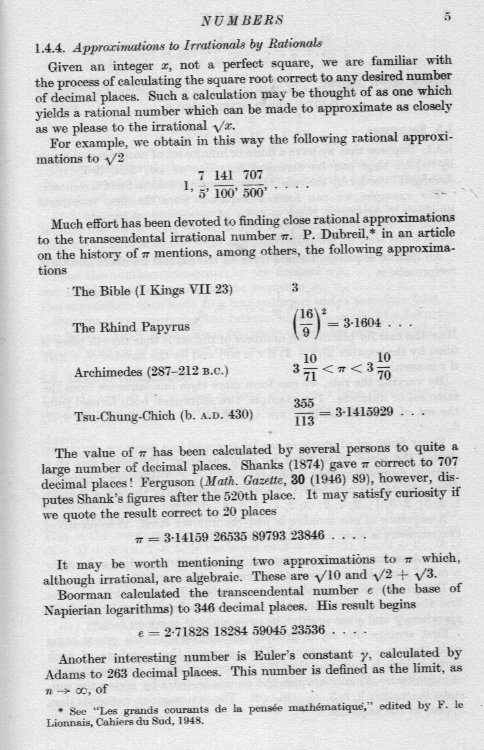
Yes I have seen this before and quoted it here in that long thread about the building of the Pyramids we had a couple of years back. However the ancient Egyptians knew about Pi See the Rhind Papyrus (about 1650 BC)
-
I only just saw this one, but +1 for coming back to report even though no one answered you. Since you have solved the problem (?) I will confine my remarks to discussion about other methods. First it is necessary to correct your error on the pdf. You have interchanged reactions Ax and Ay on the FBD. Perhaps this is why your spreadsheet didn't work. Putting this right, yes there are several other methods available. First to recast the equations of equilibrium correctly [math]{A_x} + {D_x} = F............horizontal\;equilibrium.........1[/math] [math]{A_y} + {D_y} = F............vertical\;equilibrium.............2[/math] [math]F\left( {\frac{L}{2} + \frac{h}{2}} \right) = {D_y}L....moments\;about\;A................3[/math] [math]F\left( {\frac{L}{2} - \frac{h}{2}} \right) = {A_y}L....moments\;about\;D................4[/math] [math]{D_y} = \frac{{F\left( {L + h} \right)}}{{2L}}.....................................................5[/math] [math]{A_y} = \frac{{F\left( {L - h} \right)}}{{2L}}.....................................................6[/math] Equations 5 and 6 are rearrangements of 3 and 4 to obtain expressions for the vertical reactions Ay and Dy If you add 5 and 6 together you recover equation 1 (a good check) but this means that there are onlt 3 effective equations. There are thus 4 unknowns (Ax, Ay, Dx, Dy) and only 3 equations so the frame is singly indeterminate. As can be seen the lecturer's comment that you can calculate the vertical reactions from the given information, but not the horizontal ones is correct. To calculate these you can use Castigliano's second theorem (also called the principle of least work) or use the slope-deflection method, integrating around the whole frame.
-
A good clear statement as usual. +1 Thank you for that correction, I had not heard of the distinction. But technically you seem correct. Although Google has thousands of hits when asked about the synchronisation of the cylinders of an internal combustion engine and none for the syntonisation of an ic engine. What did you say about colloquialisms ?
-
No. Can we have a brief statement of why it is relevent and what in particular we should look for in it ?
-
I find this response extremely disappointing. It has little to do with the information I offered you and in fact appears to be a smart-ass attempt to subvert it. Time and space are different entities. In some cases each applies a situation that does not and cannot involve the other. For example no amout of space will change or affect the fact the you have missed your train, if you arrive at the platform after that train has departed. That does not mean they do not interact. Indeed in other cases there is a very precise and well defined connection. Equations of motion are one such situation that describe such a connection. Clearly in situations where there is a connection, changing time or space will affect the other through that connection. So yes two identical internal combustion engines, if subjected to the regime of motion you indicate, will be affected by that motion regime. But the RPM is a red herring. If they run in sync (ie at the same RPM) when standing side by side, they will again run in sync when one engine has travelled away and then returned so that they again standing side by side. However they will be very unlikely to be running in phase. But this is just one special case of the uncountably many possible situations.
-
I wonder if the ancients didn't have a better intuitive idea of time than we do now we are so sophisticated. But it isn't necessarily. I'm glad you used the word 'model' here. 'Time' offers something that is not and cannot necessarily be described by space. It offers a concept of the 'correct' order. Here is an example. The internal combustion engine must be supplied with fuel, oil, air and sparks, all in the correct order. It is no good ordering them in space since they all have to appear in the same location at their appropriate moment. Their separation and ordering is purely in time Engineers even have a a term for this, as well as theory to go with it, - engine timing. Now I said we are perhaps too sophisticated and forget this. What I mean is that today we are used to our continuous number systems (real numbers, decimals etc) and clocks that follow these accurately to the second or microsecond. But ancient world ideas of time were simple and their clocks were irregular to say the least. Note it is also possible to find physical processes which do not depend upon time, but rely on spatial location alone for correct operation. It is even possible to find physical theory that is independent of time. All that tells us is that however long or short a time a process takes is unimportant to the end result.
-
Please explain the neolithic science of concrete. 🙂
-
A pretty good summary for one who did not introduce parallel lines. +1 As ever there is more to this subject than first meets the eye. More dimensions introduce aditional possibilities. Take a sheet of paper. Draw a series of parallel lines on a sheet of paper or use lined paper. Now roll the lined paper into a cylinder so that all the lines run along axially the surface and do not form loops around it. The lines are parallel but- You can pick a plane containing any two lines, but never three or more lines. In the other hand, if you rolled the paper into a cylinder the other way then all the loops would be parallel, although no two are in the same plane! A surface with this property is called a developable surface or a ruled surface. You are also right about terminology and this thread was one I had in mind when I started another one in the Philosophy section that has bearing on your question. https://www.scienceforums.net/topic/125094-consideration-of-the-difference-between-the-use-of-the-term-space-in-physics-and-mathematics/ My sheet of paper does not extend to infinity. Mathematically the lines drawn on it do. But they are 'mathematically' superimposed on the paper. There are difference between maths and physics about the meaning of some subjects such as space, 'the universe', that need to be borne in mind.
-
So how did you describe the sample in the picture ? (This is coursework after all) What mineral crystal structure can you identify ?
-
I'm still trying to kep it simple and walk before we try to run. You have said nothing about the relative magnitudes of the proposed force interactions. You surely know that atoms of normal matter are not held together by gravity. At the scale of atoms, the force of gravity is many, many orders of magnitude weaker than the electrostatic forces which bind the particles together in to atoms. So the force of gravity plays little or no part in the internal mechanism of atoms. So why should this repulsive interaction force be strong enough to disperse dark matter particles ?
-
OK I agree with this but consider. What do you need to have as a minimum for a vector space ? 1) Well you need a set of vectors. 2) You need a set of rules (the vector space axioms, which are really rules of combination of the vectors and elements of the field set) 3) You need a set of objects that form an algebraic field 4) You need a set of permissible operations. Now for the minimum (4) is combined into 2 as the one and only operation specified. When more operations are specified then more rules are required and more structure is available, using member set (4). You may also then need a set of definitions. So a vector space is a set that contains at minimum 3 sets (not subsets) as members. Note that in general the rules in the rule set do not apply to the 'space' itself. Therein lies one difference from Physics.
-
Did he ? I wonder if the question was prompted by the cant that is so often taught to juniors near the beginning of geometry. "Parallel lines meet at infinity" MPMin did not actually ask his question in your terms; he asked if an infinite universe was an (inevitable) consequence of flatness. I don't see anywhere that he mentioned parallel lines, but if he somehow equated flatness with parallelism then it is easy to see how this is a very good question, as iNow said in his post. Nor did MPMin actually indicate if he thinks the universe is finite or infinite. Yes i fully agree and commend this approach, but how much of a beginner is MPMin ? I look back at that long thread where he was introducing Swartzchild geometry, black holes and other heady stuff, whilst (some) other members were throwing the vector calculus version of Maxwell at him and I offered a few basic comments along the lines you indicated. For my pains MPMin and I exchanged the following Yes it does thank you
-
No that is not what I understood you to have meant. I understood you to have meant that in order to have a mathematical space you must have both a set and also a metric specified on it (and perhaps more besides) So my comment about the spirit of the mathematical space referred to this. So I offered you a set, which is the space of positions two (a pair of) dance partners may take up and asked for a metric for this space.
-
So what metric would you offer that satisfies your conditions ?
-
Thank you for your answer. I think you have captured the spirit of what I consider to be the difference but your example is not necessarily a mathematical space. Consider the set {AB, BA} What metric would you offer on this set ?
-
Again and again members ask the question "what is space ?" Indeed we have at least currently active threads which include discussion of this question. So what do members consider the difference between the two uses to be ?
-
Thank you for your reply. However you have completely missed my point. 'Parallel lines' that do not 'remain parallel' are, by definition, not parallel. Yes lines of longitude are a good example of 'parallel lines' that intersect somewhere. (Yet lines of latitude do not intersect). 'Non intersection' has long been recognised as an inadequate definition of 'parallel', although it is often offered at primary/junior level geometry, Equally the notion of maintaining a constant separation distance is untenable. Furthermore we live in a 3 dimensional universe, where lines are either intersction or non intersecting. Non intersecting lines are either parallel or skew. Parallel lines are in a common plane, skew lines have no common plane.
-
Back to your clear and concise self I see. An excellent answer. +1 I would, however, like to offer a small correction. Is "Parallel lines stay parallel" not a tautology ? Further how can you say "locally flat" and say "no matter how far you compare their distance between them" ? Local means nearby, not far away.
-
Here's proof of the wisdom of the 5 post initial limit agains spammers. Suggest using this to explain the limit to genuine new members.