studiot
Senior Members
-
Joined
-
Last visited
Everything posted by studiot
-
Please, Please, Please Not another Flat Earther ? Does anyone remember the one from Lake Balaton (Hungary) ?
-
I still disagee with the others here about the answer. Yes something (for 12 year olds) eg a system (for you) is in superposition or it is not. If it is not in superposition it does not mean that that not being in superposition is the opposite of 'supersition'. 'The state of not being in superposition' is the opposite of 'the state of being in superposition. ' However 'superposition' by itself is also a process; the process of supersition can be illustrated by the following examples. A single frequency sine wave cannot be in superposition or not in superposition since there is only one of them. We can construct a waveform by adding together different sine waves which are said to be 'put in superposition' We can also deconstruct the same waveform into the component sine waves, a process that is the direct opposite of the construction. Another example might be the mixing of two gases, say oxygen and nitrogen. Individually each gas exerts a pressure, known as the partial pressure, When these two gases are mixed, they are placed in a form of superposition, the mixture now possessing a new partial pressure which is the sum of the original two partial pressures. Equally such a mixture may be separted out of superposition into two separate gases, each with its own original pressure. However simply placing two objects into the same space or container, (this is the literal derivation of super-position = to position over) does not necessarily place them into superposition. Something new has to result from this placement for superposition to occur in Physics. For example placing a red block and a blue block into a box does not place the blocks into superposition, although they both occupy the box. This last part should help answering your comment about 'super' (latin for above)
-
I think it rather depends upon what you mean by superposition. Physics uses the term is a different way from mathematics as it introduces the idea of 'interaction' or if you prefer 'combined action'. So two sound waves from two separate sources in the same room (superposed) will interact to produce one single mathematically describable wave. But two light waves from separate sources will not.
-
Partition
-
Hi Moon, glad to see you are keeping yourself busy after your bereavement. 🙄 Depends on the 'plywood'. Working to 5/64 of an inch means you would normally cut oversize and sand to finsh. Also depends if you are going with or across the plies as plywood can be 'micro flaky' MDF is better in that respect. But if you are cutting concealed fitting joints this may not matter as slight imperfections will not show. However accurate hand cutting of such joints takes years of practise, jigs help, but sanding to fit is the most dependable method for the occasional woodworker.
-
What I don't understand is why after extensive explanation and help (from some very knowledgeable people) asking this very question at PhysicsForums you seem to be looking for some different answers here. It should be noted that electrolytic capacitors are not the only components with a definite life. They are just the most notorious offenders. Personally I have mostly been lucky with them. The last capacitor that died on me was last year in a high end CD deck. It was a resin encapsulated super mains filter capacitor. The problem is that for some unlucky folks their mains supply is very 'dirty' (has many spikes and transients). Capacitors are meant to absorb the energy of these, which they do, But each time this happens a small amount of damage occurs to the capacitor until eventually it burns out and needs to be replaced. As components become smaller and smaller this effect has become more marked as the energy density is necessarily greater in a small component.
-
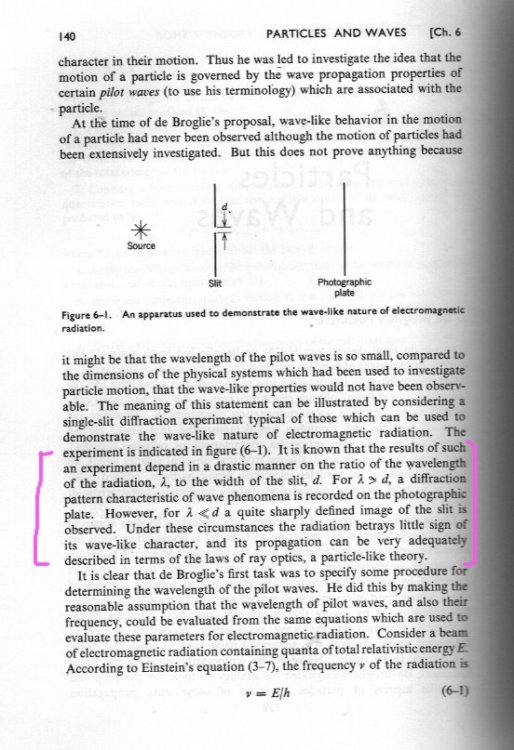
I am referring to this issue. The most relevent paragraph is indicated by the pink bars.
-
In Fig 2 seems to be suggesting that the photon travels the distance between distance between two wave peaks in the same time the electron makes one orbit of the atom. Since the orbit circumference is much larger than that of this distance it seems to be suggesting that the electron (with mass) is travelling at many times the speed of the photon. How can this happen either classically or quantally ? This is a key statement. +1 If you illuminate a barrier with one slit and direct the output light from the slit onto a screen on the other side from the source what will you observe as the size of the slit is reduced ?
-
Have you considered how far a 'photon' will (must) have moved in one second or even one attosecond, in relation to any reasonable 'size' one might attribute to it ?
-
She could OR she could not. . .. It is not for our scholastic presuppositions to determine that . .. It is for the Lady Gorilla herself to decide for her own stomach . .. . I'm sorry to tell you that your command of the English language has failed you, for you have not answered my question, even though I emboldened the important words. The issue of the banana and the gorilla was an example of my meaning set as a rhetorical question, and not requiring an answer in itself. It would seem that you did not read my mathematical post either because in your own words this is If you wish to take issue with my mathematics, you should say so, not plough on and ignore it as though I had not bothered to write anything.
-
Why before ? what is wrong with if ? If there was a hundred foot banana could a 500 foot gorilla eat it ?
-
In fairness, I take this as a slip of the pen on Reza's behalf. The limit of the scalar total energy of a particle as its velocity, u, tends to zero is m0c2, which is of course, the famous Einstinian mass - energy relationship Sensei has referred to. But I think a slip of terminology also occurs here since c is the speed of light - a scalar invariant constant and is included in the equation. To see this it is necessary to use the correct quantites and equations. In terms of the scalar invariant, m0 (rest mass) The variant scalar speed of the particle, u The invariant scalar c, - the speed of light The total scalar energy, W may be written [math]W = {m_0}{c^2}\left( {1 + \frac{{{u^2}}}{{2{c^2}}} + \frac{{3{u^4}}}{{8{c^4}}} + ...} \right) = {m_0}{c^2} + \frac{1}{2}{m_0}{u^2} + {m_0}\frac{{3{u^4}}}{{8{c^2}}} + ....[/math] If we take the limit as [math]u \to 0[/math] We find this is [math]W = {m_0}{c^2}[/math] If we look the other way (u increasing) then the series diverges rapidly as [math]u \to c[/math]
-
That was a great start to your membership. +1 Looking forward to more bang on stuff.
-
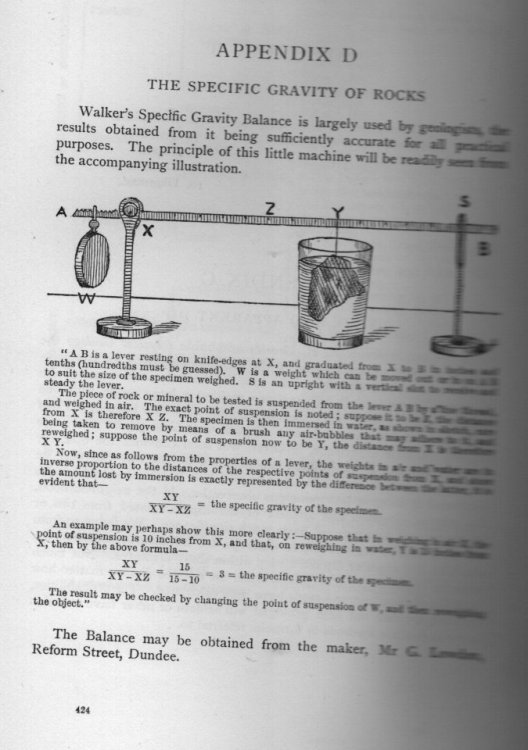
To supply some real hard information and equations to discuss here are details of a specific gravity balance available well before WWI, let alone WWII (ca 1890 to 1910). It also shows why you are incorrect in you statement about density. I apologise for the poor quality of the scan, but the book it came from is rather old and thick and I can't lay it flat.
-
No you most certainly do not. You even commented the opposite yourself either backalong in this thread or its parent. And you still have not addressed my comments here about the differences between objects and substances and their densities and specific gravities.
-
Thank you for this response, which indeed contains much truth. But there is also much missing from that analysis. Further most of the comments in my post regard your discussion in this thread and you have not addressed these at all.
-
Could that be because you are not replying to my post ?
-
I can see that density and specific gravity are different concepts that are sometimes inappropriately substituted for each other. Often this substitution is unimportant, sometimes it matters. But what I can't see is why either were originally introduced into a thread about global warming. Further there is a difference between the density of an object and the density of a substance, and also between the specific gravity of an object and the S.G. of a substance. Then there is the problem of mass. It is not necessary to measure mechanical inertia to measure mass. (or density or S.G.) Nor is it necessary to measure mass to measure S.G.
-
I would be interested to hear you describe this 'stream' To me a stream implies different properties than a wave. (Huygen's Principle)
-
Excellent. I'm sorry my post was so stuffy and 'theoretical'. The rest is much more practical. Now I mentioned 'circuit elements' These are ideal black boxes - ideal in that they 'do what you want but you don't have to know how or why'. The element or box has one, two, three or four or sometimes many 'terminals' with which it interacts with the rest of the circuit elements via the nodes. One terminal is special - I only know of one example we call ground or earth. Two terminals are simple so let us take one of those. Say we connect one terminal to node A and the other to node B. Ohm's Law tells us that the current though this element is given by the product of a coefficient (called the conductance) and the voltage difference between nodes A and B. Of course the conductance is the reciprocal of the resistance for direct current or the reciprocal of the impedance for alternating current. (note the voltage difference between A and B may or may not be changing as a result). Other two terminal elements are voltage sources and current sources. Three terminal circuit elements allow three nodes to be accessed - examples are transistors thyristors etc. Elements called 'Four terminal networks' are really the bee's knees. Nearly every circuit element your could think of can be modelled by a four terminal network - transformers, motors, radio antenna, amplifiers, transducers and interestingly two, and three terminal networks (elements) I don't know where you are at in your EE studies - some of this you may have heard of, some not so ask if I am introducing stuff you haven't met before.
-
So the electrical engineering model it is. The engineering model is designed and intended to make things (electical equipment in this case) work. Engineers only delve into the finer points as far as they have to. So the model is based on two physical quantities, current and voltage. Other physical quantities such as conductor length are normally considered immaterial. The two quantities are further split up into currents and voltages in different parts of the equipment (called circuits) and the external effects on the environment (called loads or inputs or outputs). Sufficient (simultaneous) equations introduced to fully calculate conditions in the circuits, though short cuts are often availble if a full solutuon is not rquired. The circuit is represented by a collection of points (called nodes) at which the voltages are calculated and links or paths between the nodes through which the current flows; with each path having 'circuit elements' offering specific properties. These properties are stated in terms of coefficients applied to the currents passing through the link and the voltages appearing between specific nodes so that the already mentioned equations can be stated. Now the thing is that it does not matter to electrical circuit theory what a current is made of or how it works, it just matters that the currents and voltages follow the model or idealisation. And, of course the currents may be direct or alternating or transient (your pulse you asked about). In alternating current there is of course no positive or negative in the same way as with direct current. How are we getting on ?
-
What sort of electromagnetic waves are you describing, there are many different sorts, some of which are still under investigation. ? Have you heard of pilot waves, non linear waves, self resonant cavities, soliton waves.....................? This is neither completely true nor anything to do with the offered topic. I remember my physics teacher demonstrating resonance with his handkerchief to show how a discrete mechanical phenomenon can generate a periodic mechanical motion. Similar mechanisms are exploited in radio etc. Again doesn't this depend upon your model of electromagnetic waves ? And also on you model of quantum wave mechanics ? Nobel prize winner Wilczek champions this hypothesis, but has yet to achieve breakthrough.
-
What is to happen when the batteries wear out ? https://www.bbc.co.uk/news/business-56574779
-
First question, If you are studying electrical engineering, why post in Physics, not Engineering ? The short answer to your question is that negative charges do not 'travel to or accumulate around the negative terminal' in either the Engineering model or the Physics/Chemistry model of the physical processes that are going on. I wonder why the book said a non-zero resistance ? The smaller the resistance the bigger the energy pulse! And zero resistance (an engineering short circuit) will result in a flash and some melted metal. Please confirm which model you want to work on, they are quite different and meant for different purposes.
-
Compare the following Andesite Diorite Granidiorite Quartzite Granite (Pink) Rhyolite