studiot
Senior Members
-
Joined
-
Last visited
Everything posted by studiot
-
Is this a school project ? Exchemist is quite right to look at gluing characteristics as glues are affected by pH. +1 However to start at the beginning. Plant fibre is composed of two natural polymers. Cellulose and Lignin. Both are neutral pH substances. But the water, salts and resins in wood make the natural wood somewhat acid. As the wood is seasoned it dries and the pH becomes less acid. But the natural acidity can return if the moisture in the wood increases again. On effect of the acidity is that nails etc will rust in wood. That is enough to be going on with until you describe your project and what you have found out for yourself.
-
I do hope that no teacher of Physics, Mechanics or Engineering Science would ever show such a diagram to the class, whatever the angle of the ramp. Understanding of Forces means understanding where to properly place them on diagrams.
-
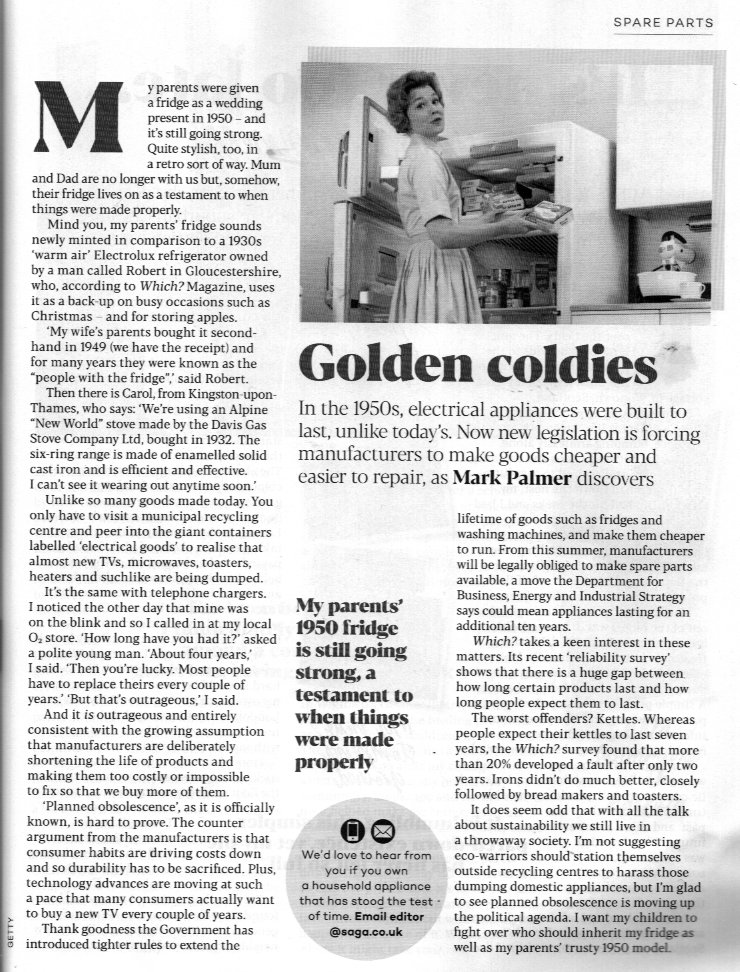
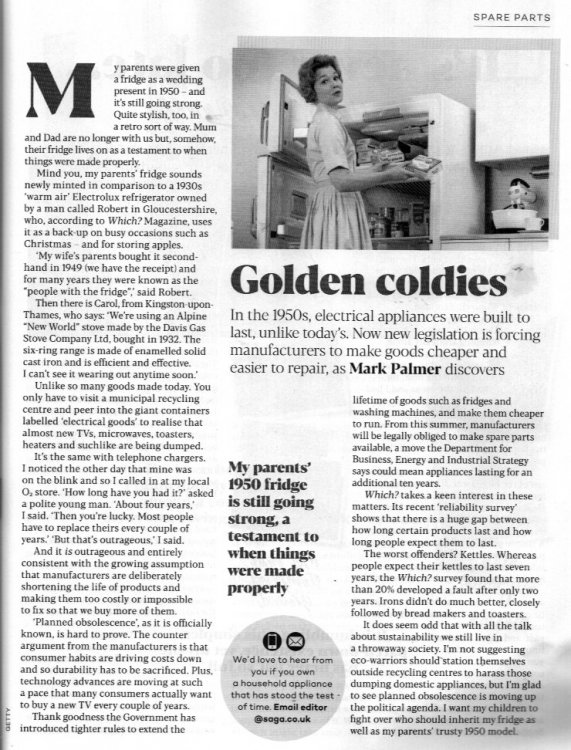
Back on topic, I have had 5 fridges so far in my adult life. If I only ever had one and imagine this saving multiplied by the population and multiplied again by all the other 'throwaway' gadgets.......... Fridges in particular are a special point sinceeaach one contributes refrigerant to the envoronment. Article from this month's SAGA magazine. Enjoy the pun!
-
Nothing nonsensical about your question - many people have asked it over the centuries. I don't think this is a speculation, however. It is a straightforward mathematical question that deserves a straightforward mathematical answer, that you algebra book, despite its 600+ pages (Wow) probably doesn't offer you. The very short answer is yes it does, but you need to know a little bit of electrical engineering. In AC power engineering there are two quantities known as the real and apparent power in a circuit. Put simply the real power is the power measured on a true RMS power meter and is the power an electric fire would draw from the mains. It is calculated without using complex numbers. Most other electrical devices draw (ie those with motors, flourescent tubes, transformers etc) draw what is known as apparent power which uses complex arithmetic to calculate the values. This is not an inefficiency of these devices it is inherent in their mode of operation. It should be noted that there is a difference between imaginary numbers and complex numbers - they are not the same and do not follow quite the same algebraic rules. i is an imaginary number, not a complex number. The term complex derives from the fact that it is in two parts, unlike the real numbers (and the imaginary ones) which have only a single part or are simplex numbers. All complex numbers have a real part and an imaginary part so are a combination of two parts. Complex numbers are written in the form (a + ib) (They also have other formats) which clearly demonstrates this 'a' is the real part and 'ib' the imaginary part and the + sign denotes the combination of the two. But there are also 'complex' number systems that are composed of two real parts for example (a + √3b) called surds or extended real numbers. In this case no imaginary parts are involved.
-
OK thanks and my apologies. Reading more carefully I see that you did in fact say grade 9 not year 9. So the real lesson there is to always read the instruction (question) properly. As regards to what you should study. In Maths I would suggest making sure you are good at manipulating equations so that you can solve single equations and simultaneous equations. They will appear again and again in both Maths and Physics. In Physics I would recommend concentrating on the ideas rather than the detail at this stage. Pay particular attention to mechanics as most of the rest of Physics is presented in terms of the ideas of mechanics. So make sure you know what a force is and the difference betwen a force and pressure. If you have any particular questions just ask.
-
How can the concentration be dominant ? The value of K is only one of several (simultaneous) equations that a chemical reaction must satisfy. So to take the case of in the case of A + C = D , K = [D]/[A][C] again, what does the reaction equation say ? The reaction equation ( A + C = D) says that for every molecule or gram-mole of D created two molecules or gram moles (one of A and one of C) are removed when the reaction reaches equilibrium. But we do not have to start in equilibrium (or there would be no reaction). So we could start with quite different concentrations of A and C, say 1M for A and 0.1M for C. Initially we have [A] = 1.0 ; [C] = 0.1; [D] = 0 so the total quantity of reactantants = 1.1 mole/L and of products = 0 mole/L In that case the reaction could not reduce the concentration of A below (1.0 -0.1) = 0.9 mole/L because at that point it would run out of C. At that point we would have [A] = 0.9 ; [C] = 0; [D] = 0.1 So now we have a total of 0.9 mole/L of reactants and 0.1 mole/L of products, making a grand total of 1.0 mole/L ie a reduction. Perhaps you would like to consider the implications of what happens if K is 0.9,, 1.0 and 1.1 respectively ?
-
Good question, keep them coming. +1 First it is worth noting that rocks in general are not molten at the depths concerned and that rocks are made of minerals which are ionic crystals when solid. When these rocks melt they are called magmas. They melt for two reasons, heat and pressure release. Heat is generated as rocks are drawn downwards from above (subduction) or simply buried by earth movements and also rises from yet deeper layers. This rising heat is not evenly distributed but concentrates in vertical convection cells (plumes). However the deeper the rocks are the greater the pressure on them and so they cannot necessarily melt (turn into a liquid and flow) even if the temperature is above their melting point. The extra heat from below is one way to generate the molten state that is magma, and why volcanoes etc occur in some locations and not others. When such rock is moved upwards by earth movements the pressure is lowered or released and more rock melts to magma. When the melt occurs cations (+ve) and anions (-ve) are formed. Oxygen is often combined with elements such as silicon to form complex anions (SiO4)- which are stable at such temperatures and pressures. Water is also available and involved. Britannica has a good not too technical description. Note the opening statement. https://www.britannica.com/science/igneous-rock/Nature-of-magmas Does this help ?
-
That's even less clear. Say you have a reaction [math]A + C \leftrightarrow D[/math] or [math]A \leftrightarrow C + D[/math] What difference does the concentrations [A] ; [C] ; [D] make to K ? You haven't answered my question is this homework ?
-
Good advice from exchemist +1. One thing I am not clear about. What is year 9 in the Philipines ? Wikipedia says you talk of grade 9 not year 9 and there are some differences in different countries. So the UK year 9 is equivalent to the Us grade 8. Here is a useful converter table. https://www.pearsonclinical.co.uk/Sitedownloads/Miscpdfs/Gradetoage.pdf This is quite important as year 10 in the UK can be the year of the first important career exams.
-
Firstly welcome Zeusetc. Is this a homework question - it looks rather like one, except that you are not specific enough ? What do you mean by the concentration of the product (in the singular) and the concentration (again in the singular) of the reactants (in the plural ? Have you heard of addition or condensation reactions ?
-
It's not that simple and Bill has a point. It's just that The bending of light in variable density atmospheres by refraction was known a century and a half before 1973 and studied in connection with the anomalous astronomical readings as a proposed mechanism a century before 1973. Surveyors and Astronomers routinely use a correction to observations for refraction. Bill's problem is that refraction just doesn't produce the observed deflections. It was indeed the experimental readings from Principe and Sobral that matched the calculations of GR, when the refraction calculations didn't.
-
The Hill Sphere is not about or much to due to the shape of the body. It is the region of space around the body where gravity is controlled by that body. As such the region is subject to purturbation by other bodies, so the Moon purturbes the Hill Region (Hill was an astronmer) and the Earth purturbes the Sund's region etc. Within this region a smaller orbiting body will remain orbiting and not escape. It is said to be locked or gravitationally locked or tidally locked to the larger one. It may be noted that there is a small region round the Moon where the Moon has greater influence than the Earth and so a satellite could potentially orbit there.
-
No the Earth's Hill sphere is not spherical. Wikipedia has a good article on this, including excellent diagrams. https://en.wikipedia.org/wiki/Hill_sphere
-
Should a skilled orator like Hitler have been allowed free speech ? What about this lot ?
-
~A slippery slope to what ? The trouble with insisting on your rights/freedoms is that since people interact every such right/freedom affects the freedom/right of another person in some way. That is why rights/freedoms come with the caveat to use them responsibly. Aren't most members here glad that we have some arbiter - that hard worked person called a moderator - to stop further discussion on gibberish ? Edit Nice one Zap +1
-
Thank you all who responded. I do not think it is just a question of risk. A question of acceptable risk maybe , but not absolute risk. There was a case a few years a go where a badly designed rear wheel bearing caused some rear wheels to fall off above (i think it was) 35 mph. There were a few resultant deaths, although many rear wheels did not detach. No one considered even one single death an acceptable risk. It just should not have happened. The manufacturer called in all the affected cars for urgent modification. Tesla in this case could have designed the car to be inoperable without someone properly in the driver's seat. I think it is BMW that has such a system if all passengers are not wearing their seat belts.
-
What if an obviously incorrect 'theory' is repeated posed and simply wastes the time and efforts of others (perhaps many) and confuses those who are not so good at the subject ? For example those few who continuous challenge the accepted value of Pi with an easily demonstrable incorrect value.
-
We have had several threads and discussions about this topic this news qwould seem to indicate we are not yet there.
-
I am sorry for any comment that could have been taken as offensive. Thank you for not being offended by my coment. I assure you no offence was intended. There is one more type of systems , that is really a variant of an open system. Flow systems are often modelled by the use of a 'control volume' , where the mass flow in is exactly equal to the mass flow out. Such a system is called quasi-static since the composition within the control does not change by energy and momentum flow through the box. The boundary is more problematic. Take for instance conformal mapping of flows or fields. 2D maps have sources and sinks which draw on materials or field lines from another dimension perpendicular to the plane. 2D manifolds may have not boundary, yet be finite eg the surface of a sphere. 3D manifolds may be finite in 3D and unbounded, yet flows or fields can require activity in fourth dimension. So the logic of the question "where does the energy come from ?" remains unanswered. The issue of working in X dimensions and borrowing from another introduces many wierd effects in Maths, some which spill over into theoretical Physics. You may have heard of Gabriel's Horn. An infinite surface that bounds a finite volume. https://en.wikipedia.org/wiki/Gabriel's_Horn This is one reason why the Lebesgue integral and measure theory was introduced to extend ordinary Riemann integrals.
-
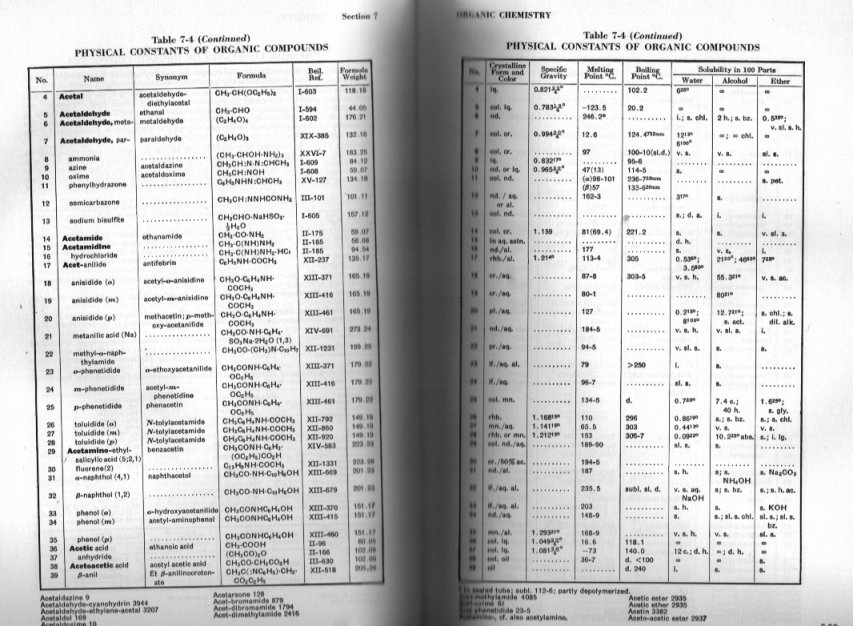
What a shame you have started with a reasonable observation that many do get wrong. I agree that it is very difficult to apply a pulling force to a material object without also applying a pushing force. But it is not impossible. This is because most pulling forces (tension) are internal forces. However the rest of you postings appear to me to become increasingly fantastical and outlandish. John Cuthber has asked a couple of exceedingly perceptive questions, to which I look forward to reading your answers. +1 I would add the following one to these What did you contain your tungsten sample in given that the melting point of tungsten is about 3500 degrees and the boiling point about 5500 degrees ? Further your version of what Science and the Scientific Method is about is woefully inadequate. Since we are using melting and boiling points as examples, Here is a random page from my Lange's Handbook of Chemistry, which contains thousands of such pages. How on earth do you suppose all this data got measured, verified, collated and presented ? Science is not all about hypotheses Between every two hypotheses lies amountain of dedicated scientific infill work, far less glamorous that say gravity or electromagnetism, but equally necessary and often unsung.
-
OK so you have described how you see it (your problem) so no apology needed. I don't know about you skills since although you say you are not a scientist you clearly have a reasonable measure of knowledge and understanding. Your phone is probably not the ideal recording device, however. You need a gadget or gadgets mechanically coupled to your floor or other parts of your apartmenet structure. Such a device is called a seismometer or an accelerometer for higher frequencies. https://www.google.co.uk/search?q=seismograph&sxsrf=ALeKk01_X_O2wDFnlkHwFbfzkOrsxMsN9A%3A1618773670675&source=hp&ei=poZ8YNTqJq6JlwSKvrywAw&iflsig=AINFCbYAAAAAYHyUttRlHmbsMbU_OlZSqZM_jiiz5lU1&oq=seismograph&gs_lcp=Cgdnd3Mtd2l6EAMyAggAMgIIADICCAAyAggAMgIIADICCAAyAggAMgIIADICCAAyAggAOgQIIxAnOgsILhCxAxDHARCjAjoICAAQsQMQgwE6BQgAELEDOgUILhCxAzoICC4QsQMQgwFQ2ApY-iBgtD1oAHAAeAGAAegKiAHaPZIBCzMtMS4wLjIuMy4zmAEAoAEBqgEHZ3dzLXdpeg&sclient=gws-wiz&ved=0ahUKEwjU1fDswYjwAhWuxIUKHQofDzYQ4dUDCAg&uact=5 Although these can be very expensive simpler ones can be bought cheaply or even made by an amateur. They are indeed made as projects in some schools. This would give you an indication if there is something there and a permanent record of it as well. Another possibility for a trial would be an old fashioned gramophone cartridge with its stylus resting on a hard surface fixed to the floor (eg a ceramic tile) and connected to a data logger. It all depends upon you skillset and purse.
-
I recognise (at least) three (thermodynamic) system types. Isolated : Neither matter (mass) nor energy may pass across the system boundary to or from the surroundings. Closed : Energy but not matter (mass) may pass across the system boundary to or from the surroundings. Open : Both energy and matter (mass) may pass across the system boundary to or from the surroundings. Some rather parsimonious authors only detail two of these and say closed when they really mean isolated. "in that case the point-mass is the universe." Yes indeed so that is the point. But such a universe is isolated so how do you determine its energy, whether kinetic or potential. ? It is also worth noting that both the First and Second Laws of Thermodynamics refer to processes acting across the system boundary. That, of course, presupposes there is a system boundary. And, of course, that there is available energy on the other side of it whatever that means in terms of the universe. So I am saying we have run smack into the perennial problem of trying to extend properties of a finite system to a (perhaps) infinite one.
-
Perhaps not quite what you are looking for but here are some Chemistry links for you to explore. Chemdraw https://www.google.co.uk/search?q=chemdraw&sxsrf=ALeKk01PO048lS-m5UVKifuDGYj-5mGmkg%3A1618674249763&source=hp&ei=SQJ7YOWyLPGjgwfRxpzQCw&iflsig=AINFCbYAAAAAYHsQWZSfkesJqZhYUdT2ydUYVTrAEQH_&oq=chemdraw&gs_lcp=Cgdnd3Mtd2l6EAMyBQgAELEDMgUIABCxAzICCAAyAggAOgQIIxAnOgUILhCRAjoICC4QkQIQkwI6CAguELEDEIMBOg4ILhCxAxCDARDHARCvAToLCAAQsQMQgwEQyQM6BQgAEJIDOgsILhCxAxDHARCjAlDkEFiyPGDcPmgBcAB4AIABvgqIAeAfkgEPMC4yLjMuMC4yLjAuMS4xmAEAoAEBqgEHZ3dzLXdpeg&sclient=gws-wiz&ved=0ahUKEwil-6W9z4XwAhXx0eAKHVEjB7oQ4dUDCAg&uact=5 Chemsketch https://www.google.co.uk/search?q=chemsketch&sxsrf=ALeKk01dtdCGvDqE6Dkx8i0m0VwV8nCC2Q%3A1618674259389&ei=UwJ7YImmF5PygQax2prQDQ&oq=chemsketch&gs_lcp=Cgdnd3Mtd2l6EAMyBAgAEEMyBAgAEEMyBAgAEEMyAggAOgcIABBHELADOgcIABCwAxBDOgQIIxAnOgcIABCxAxBDOgUIABCxA1DktwtYitELYOrSC2gBcAJ4AIABxASIAbgLkgEHOS4xLjUtMZgBAKABAaoBB2d3cy13aXrIAQrAAQE&sclient=gws-wiz&ved=0ahUKEwjJm_PBz4XwAhUTecAKHTGtBtoQ4dUDCA0&uact=5 Crystal structure animations (mineralogy) http://www.wiredchemist.com/mineralogy/instructional/crystal-structure University of Liverpool UOL offers some excellent animations in Chemistry and spectroscopy. https://www.google.co.uk/search?q=university+of+liverpool+molecules+animations&sxsrf=ALeKk00JfY6HhmqA0g2YeACTA6l2Ixn24w%3A1618674452382&ei=FAN7YP7qFtCfgQbhqY0Y&oq=university+of+liverpool+molecules+animations&gs_lcp=Cgdnd3Mtd2l6EAM6BwgAEEcQsAM6BwgAELADEEM6BAgjECc6BQgAEJECOgUIABCxAzoICAAQsQMQgwE6BQguELEDOggILhCxAxCTAjoCCAA6BwgAEIcCEBQ6CAguEMcBEK8BOgUILhCTAjoGCAAQFhAeOgcIIRAKEKABOgUIIRCgAToICCEQFhAdEB5QgIEQWKCwEWCishFoBHACeACAAa4FiAHSK5IBCzI0LjIyLjEuNS0xmAEAoAEBqgEHZ3dzLXdpesgBCsABAQ&sclient=gws-wiz&ved=0ahUKEwj-xPad0IXwAhXQT8AKHeFUAwMQ4dUDCA0&uact=5 Online ph calculators https://www.google.co.uk/search?q=online+ph+calculators&sxsrf=ALeKk02RZMtO06VYoRPoWqV5g7qgF4dgmg%3A1618675059887&source=hp&ei=cwV7YOL3M6-cjLsPltm0sAU&iflsig=AINFCbYAAAAAYHsTg8X6pLI1qXxSv0vE35PzD7VaDShf&oq=online+ph+calculators&gs_lcp=Cgdnd3Mtd2l6EAMyCggAEAgQDRAKEB46BAgjECc6BQgAEJECOgQIABBDOgUIABCxAzoCCAA6BAgAEAo6BggAEBYQHlDmAlj0JmCQXmgAcAB4AIABogeIAe5KkgELMi0yLjEuMy40LjaYAQCgAQGqAQdnd3Mtd2l6&sclient=gws-wiz&ved=0ahUKEwii_cu_0oXwAhUvDmMBHZYsDVYQ4dUDCAg&uact=5
-
I have no idea what you mean as a reply to my comments. [ ] head scratching icon with puzzled look on face [/]
-
Caught me a bit short here, but I used Labview a good few years ago. https://www.ni.com/en-gb/shop/labview.html?cid=Paid_Search-7013q0000020cz6AAA-Consideration-GoogleSearch_LabVIEW_LabVIEW&s_kwcid=AL!6304!3!449107487676!e!!g!!labview software&gclid=Cj0KCQjw6-SDBhCMARIsAGbI7UhYjOk-HTJWavP8DJsgGGHUSgrvuIhTuM16XeqosQwuJnCmHNBRluYaAr86EALw_wcB Are you looking for free or commercial software ? What about add ons to say MathCad, Mathematica, Wolfram Alfa etc ? I also used to use a delightful software called DesignView. AutoCad now has a pale imitation copy as an add on. Sorry this is a bit rushed. There used to be a Visio module for this as well. You could help by narrowing the field of interest. We already have a few threads on Chemistry molecule and reaction software. Hope this helps