studiot
Senior Members
-
Joined
-
Last visited
Everything posted by studiot
-
OK An old farmhouse with a blackened masonry arch (fireplace ?) in the kitchen. What makes you think the cavity (I see no hole) was not always there ? If there was a slight spalled cavity on the stonework surface years ago perhaps they filled it and the filling got covered and disguised by the blackening ? In the days before polyfilla they used to do what was called pargetting - sometimes they literally used pigshit. Anyway a filled surface cavity or just a bit of surface spalling it could have been the hot moisture from the microwave and its predecessors that 'weathered' it off. True water vapour is invisible.
-
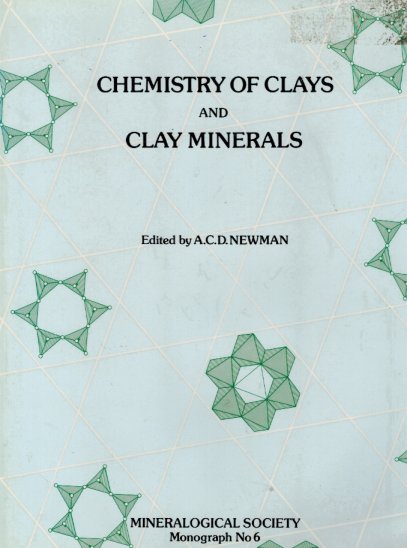
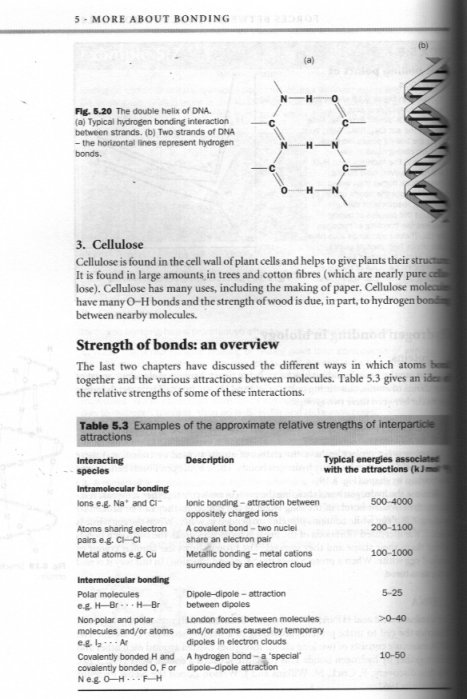
OK so here is some more Chemistry which I hope will also be useful to Oneworld. As I have mentioned before, homegeny depends upon the scale you are working at. So starting inside the atom things are definitely not homogenous. There is a massive nucleus surrounded by a lot of empty space containing some electrons. Uniformity is represented by saying that every atom of a particular type is the same as every other atom of that type. For example all hydrogen atoms are the same. (for those who know about isotopes I am ignoring them) If we use those atoms to build molecules then again individual molecules are not homegenous since they are often made of different types of atoms. Even those that are combinations of atoms of the same type are not internally homogenous, in much the same way as atoms. So one hydrogen molecule looks much like another. We represent molecules by the 'ball and stick' models shown in exchemist's post, where the balls are individual atoms and the sticks represent the forces that hold them together. And yes, these forces are entirely electrical in origin. For small molecules again all molecules are essentially the same as with atoms and of definite composition, for example methane, ethane propane etc. Individual molecules can be isolated and, in principle at least, you could hand me one molecule of methane. So a large aggregate (number) of them is homogenous in that there would be the same number per cubic centimetre for each cc on your grid. Note that we live in a 3D world so we really need to work in terms of volume not area. This is why I talk of 'bulk clay'. However clays are in a different category. That of super large molecules. Super large molecules happen when a non specific number of atoms join together, unlike methane which always has 4 hydrogens joined to one carbon. A diamond crystal is an example of this. You could not, even in principle, hand me one 'molecule' of diamond. Another example would be a common salt crystal. Clays are like this only their structure is vastly more complex. But they all still can be represented by balls and sticks. As regards the sticks or (chemical) bonds there are several types available. The strength of these bonds are usually measured not in force units but in the energy needed to break them. Here is a table Now my table lists intramolecular bonds, which hold the atoms together in simple molecules and intermolecular bonds which can bind simple molecules such as water to each other hydrogen bonds. And yes the internal bonds in a single simple molecule are stronger than a single hydrogen bond, in general. But in large molecules there can be many many hydrogen bonds holding the parts together. For example in DNA the two strands or chains are held together by literally hundreds of hydrogen bonds this is called 'cross linking' Clays come in sheets rather than thin strands so the effect is even more marked. The subject is of such importance that books such as these have been written just about these clay minerals. Now to return to my original contention. For pottery the scale Chemistry works at is too fine and we should step up into the realms of mechanical properties. Here the clay may be considered homogenous for Pottery purposes since it will have come from a relatively thin piece of clay. I say this because geolically clay may have been laid down in very thick beds, up to thousands of metres thick. When this happns the clay may be stratified because as the particles which form it settle out of the water the larger, heavier ones settle first so will be at the bottom of any strata which mark the start and finish of a period of formation. But pottery type clays will be dug out within a couple of metre depths so will be homogenous. Next post we can examine the mechanical properties that demonstrate this question of homogeny and uniformity. You may have heard of the Atterberg Limits for field testing clays.
-
Yes but you do not need an electron or any other microscope. This question is very complicated, because it depends upon the scale you are working at, especially if you go down to the 'molecular' sizing. I have been digging out some information both for you and for exchemist; I will post it in due course. Remember also that some of the issues lie properly in the domain of soil mechanics as do their answers. One point mentioned by exchemist is that the water holds the bulk clay together. But then he says that creation of pottery dries out the clay. So a good question is, What then holds it together? The answer is vitrification. As a potter are you familiar with this idea ?
-
Just to add to this, Every sub unit - hard drive, memory cards, graophichs cards, motherboard etc has a unique code number. That is not every type of sub unit but each motherboard etc from each computer has a different code number. When you replace units for repair or upgrade, Windows allows a certain number of replacements. After that you have to obtain authorisation through Microsoft - Theya re quite good if you can convinve them you are repairing a PC and will give you an unlock code. You can often change the motherboard once, particularly with Dell units, but after that you will need this code and some of the other parts need to be still original.
-
I'm sure I've got some info in a book somewhere, I tried quickly to look it out but couldn't immediately see it. I will try to dig it out for you.
-
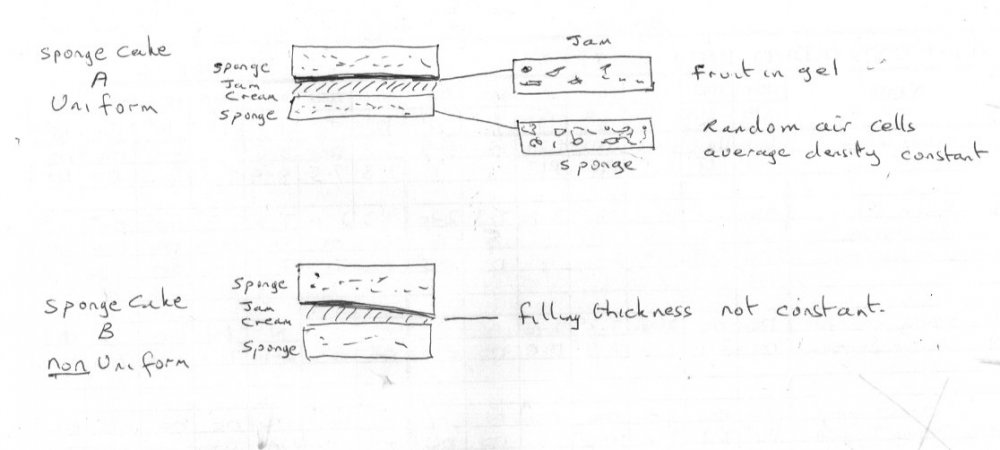
Generally good stuff and a good addition/expansion of my offering, if a tad technical. +1 However beware of the common statement that hydrogen bonds are weaker than 'normal' bonds. Some hydrogen bonds can be as strong or stronger, especially in organic chemistry. Glad it was of some help. To further understand the difference between homogenous and uniform look at my diagrams of two standard sponge cakes. A standard cake has a filling sandwiched between two slabs of sponge. Cake A is uniform but not homogenous because of the layers. Each layer is considered homogenous because it is made of a single substance. So cream or jam is not sponge. If it were homogenous it would be made of the same composition all the way up or through. Cake B is not homogenous as before, but it is not unifrm either as the cream layer varies in thickness. So some slices will have more cream than others, even though they may be the same physical size. OK so on the right I have expanded the scale of the layers. Now I note that the jam is not homogenous because it is amde of large bits of fruit in a gel. The sponge can still be considered homogenous at thiscscale because it is composed of the cake sponge material which contains lots of tiny holes or voids or bubbled where it has risen. However if we take a sensible sized small piece of this sponge each such piece will have the same average density of holes and cake. However at the scale of an individual bubble the cake sponge material is no longer homogenous. This echoes exchemist's comments which go down to an even finer level - The atomic/ molecular level. Hope this helps.
-
@IndianScientist Here is a site which expains the Fundamental Theorem of Algebra in our context. It is vry easy to follow. https://www.mathsisfun.com/algebra/fundamental-theorem-algebra.html It goes up to include the use of complex numbers for quadratics that do not have a real solution. Any questions ?
-
Cool. So whi8lst in the reals numbers, to use actual examples, we have the numbers +13 and -13 which are additive inverses in the real number system, we have no equivalent in the reals of (13 + 13i) ; (-13 -13i) ; (13 -13i) and (-13 + 13i) So there are four complex numbers, because the 13 can be positive or negative one sign convention and that generates the four different permutations. This is what I meant by saying there are two different conventions involved. The sign of a and b The operations of adding or subtracting
-
Yes that was the question and I hope you mean (-a-ib) 🙂
-
Thanks but that doesn't answer my question. No one would expect complex numbers to be identical to the reals in every respect or there would be no point having them. Real numbers have only two big divisions, complex numbers have four, in this sense. So clearly a single pair of + and - is insufficient to label all the complex numbers.
-
Thermodynamics works perfectly well to address and include radiative heat transfer.
-
No. When you are ready to learn some Physics we will explain it to you.
-
Thank you but remember my initial response to the OP was to try to tighten it up by pointing out that we have the verb 'to exist' and the noun 'existence', each of which comes with its own implications given by the context. Verbs come with the additional context of tenses, past present and future. What may have existed in the past may not exist in the present or the future etc. My room has a length of 5 metres. It is necessary to provide at least that much space for my room 'to exist' in space. You cannot choose (or limit your discussion to) a particular metre or section of space and use it to discuss the existence of the entire room. Similarly my room has 'been in existence' for 82 years. Again there are implications for choosing a section or shorter duration of time than this to discuss the entire existence of my room. Further again if we are condidered to be travelling through time then there is the question of existence of anything at that section in a way that doesn't occur with space.
-
Aristotle was understandably wrong in some notions, due to the knowledge level of his time, but he was certainly not stupid. In particular he recognised the notion of a contradiction, which your statement is. If there are bodies, movable or otherwise, there cannot be emptiness as well without further qualification. Aristotle was also familiar with sponges, so he was familiar with the pores or spaces within a sponge, and whether they were empty or full or partly full of water. Why do you keep posting these ridiculous threads when you have been 'advised' not to by a Moderator ?
-
So what is the additive inverse of the complex number z = (a +ib) , given that a or b or both could themselves be either positive or negative ?
-
1) I think you completely misunderstood my point. 2) Possibly I misunderstood the second part of your reply, that is why I said I was not sure if I had correctly understood what you were saying about human though an existence. We are agreed about this second point then.
-
I see two problems in your deep philosophical analysis of existence. Firstly the difficulty of using the formal structure of Philosophy to analyse something more basic than any of the concepts you employ. This is like trying to count before you have any idea what a number is. Secondly the notion that you seem to be propounding that existence is merely a property bestowed by the human mind. Things are known to have existed before there were any humans. Further humans are still discovering the existence of things that now human has had in his mind before the discovery.
-
Here are the first couple of times (pun intended) I mentioned it. What I am trying to describe is the notion that just as we might say "There exists a road from Ghent to Aix" , ie it has a spread in space, we should consider how something exists in time.
-
🙂 Thank's Eise for this and all the rest +1. It's good to see you back and on top form. Lots of cogent food for thought in your post. However there is one thing I would like your opinion on, though you perhaps missed it, The link I drew between existence and time. Your rain example an my process examples for instance. Interestingly there is a parallel between Eise removing the material round a hole and the notion of removing all the haecceities. If these are removed, does the object still exist ? For instance if I remove all the sweetener from a child's sweet does it still exist despite the excipients ? What about the placebo in a drug trial? A tablet is a small lump given to a patient against a particular condition. The placebo is still a tablet, despite the absense of active ingredients. Thank you by the way for introducing me to yet another new word.
-
How does that old saying go ? "There's none so blind as won't see"
-
Don't they also observe your actions, directly or indirectly ? Aren't the drugs also more humane then ECT ? I am sorry if you have suffered personally, I only have second hand experience of these treatments, but my observations are that matters have improved quite a bit in the last 40 years, although they have a long long way to go yet. I do know of one medical Professor of the subject who refuses to diagnose initially, but says, Let's start with the least intrusive (some tablets for depression) and if that 'cures' it then that is your diagnosis. If not we can work up the scale. One important consequence is that certain diagnoses incur certain legal and social restrictions so it is best not to have them.
-
I see you joined us quite a few years ago, but have not been very active. With posts like today's hopefully this will change and we will see more of you. +1
-
Actually there is another 'explanation'. This is a another case where not one but two sign conventions (as in the use of the symbols + and - ) are in play and both have to be satisfied. Each has a different technical meaning or operation. This is similar to situations in Thermodynamics, Mechanics and Electrics. Brackets can be employed to highlight this situation.
-
I assume it was still April 1st in your time zone when you posted this. Happy Easter.
-
Once again you have a point but coupled it with 'attitude'. There is a difference between sound waves and light waves in that in is only possible to combine light waves in very special circustances, but the whole essence of 'music' is due to harmonic combinations. I don't know how much maths you understand but whole numbers are important in harmonic combinations.