CharonY
Moderators
-
Joined
-
Last visited
Everything posted by CharonY
-
I have not read in detail all the posts, but I would like to point out that there ares studies on the use of human or other waste in agriculture. One aspect that has been promotes was the use of biosolids, which are processed byproducts of wastewater treatment. Now, there are a couple of issues, but from what I remember they are not unique to human manure. A couple of things that one found is that even after treatment (compost or biosolids) antimicrobial resistance determinants persist. That is a health concern, but again, not specific to human waste). In waste, we often also are able to measure a range of chemicals (e.g. pharmaceuticals, pesticides, heavy metals and other contaminants). In some studies, some livestock and surprisingly many wastewater samples (i.e. human waste) had heavy metal levels beyond safe limits, which have raised question regarding the safe use of biosolids. However, not all of that might be attributed to human waste exclusively as some sewer lines might also connect to industrial waste (but many pharmaceuticals and personal care product contamination is likely caused by human urine/feces). There is also some work on microbial risk and I think human urine is comparatively safe it has usually lower microbial contamination. Others, remain a risk (and again, composting or even heat treatment is insufficient), but I am not sure whether there is an increased risk over agricultural manure (neither are risk-free, though). Generally speaking, the use of manure (human and animal) is strongly associated with risk of contamination with harmful bacteria (including mentioned E. coli as well as Salmonella, Listeria, Shigella, etc.). If present, even regular cooking might not enough to fully decontaminate, especially as certain toxins are fairly heat stable. Some have raised the issue that pathogens present in human feces might be better adapted to re-infect humans, but I do not know if studies have substantiated that (as in, I have not looked, not that those don't exist).
-
I should have clarified, what I meant are not tool uses, but the constant need to interact with it, even when there is no functional need. I started off with listing examples, but it got a little bit unfocused, so I am giving only one example for now: When there is any down time, even if it was for a minute or two, especially younger folks immediately grab their cell phones, not to look up or note down info for example, but searching for distractions (social media, videos, messages etc.). In cases where they are not allowed to, they get visibly upset and fidgety, not unlike smokers who are not able to get their smoking breaks. This extends to odd situations, for example if they are not able to follow training. I originally thought that they were looking up other instructions (rather than asking me directly) but as it turns out, they are actually looking at posts and videos to distract themselves. When confronted, they argument is that they are stressed out and needed something to feel better. This is is just a limited example, but the use of a cell phone as soothing mechanism (or to give a dopamine hit), even if detrimental on many levels and the need to use it, even in inappropriate situations and to their own detriments does have strong similarities to addictive behaviour. I will also add that we all know that the various engagement platforms use addiction-promoting algorithms and I do think that we are seeing associated behavioural patterns emerging because of that.
-
While OP is a complaint post more than anything, I think there might be an interesting question regarding reliance on a specific type of electronics. While in isolation it is perhaps just a hassle, cell phones have become an universal tool for everything, ranging from purchases to entertainment. The way some folks interact with it, is pretty much close to addictive behaviour. By increasingly requiring it for services is likely going to make it more difficult to disconnect.
-
A big issue is that the lack of critical thinking creates a positive feedback loop where you do not even need forces with an agenda to create harmful movements. I think in the past it was necessary, as otherwise these trends would fade away, but due to the viral effect of the internet (which is a fitting description in more than one way), it can sustain itself. In some cases I suspect that the propaganda was not actually started by certain players, but that it was harnessed by them. Many of these are examples have started as joke and got accelerated themselves to a point where they could be weaponized. I think one has to start thinking of these issues less of a targeted weapon by enemy forces, but rather a self-perpetuating disease where the only defense is inoculation with skills that allow us to critically evaluate and gain knowledge.
-
Wait, are you suggesting he bought it without being high?
-
Ooof, I hear you. My perspective is certainly skewed as I work in an area where we try to sharpen critical thinking. It is critical tool to actually learn anything related to science, after all. We do see it in this very forum where intuition is often used as an alternative with some, let's say interesting results. The issue I see is that with the terminal online generation, there are fewer sensible folks walking away from nonsense. Or even able to understand that there is nonsense. It is strange. If confronted, many of the young students clearly state that the internet is full of misinformation. Yet, at the same time, they are so bad at spotting it, and are vehemently defending misinformation. And I cannot even spot a pattern. You can have folks who are very sensible in many areas but suddenly are dead sure that vaccines have microchips, because they heard it from reliable sources. In the past, it was possible to track certain lines of misinformation and debunk them in class. I.e., there was some kind of underlying hypothesis, such as how e.g. homeopathic formulations are supposed to work and one could use it as a learning exercise and use scientific reasoning to explain why it is nonsense. Now it is a deluge of just random claims which makes it very difficult and disheartening to disassemble. I think paradoxically, the internet and social media technology has amplified feeling over reasoning (as the former is so much easier to monetize). The exact opposite what we in the past have thought about the impact of technology in our lives. And apparently you hurt their feelings if you confront folks with actual facts on the regular, too. At this point some think there is some courtesy in accepting clear misinformation. What I am saying is that I am increasingly in the role of a grumpy old man and I am not sure I like that.
-
I think it gives one man too much credit. Gaslighting is a concerted effort from many online groups and "alternate" media of which Fox can be considered a moderate version. While he has been an excellent figure head, there are dozens if not hundreds of online personalities (and Trump has met with many of them) that are part of it. The whole Q anon movement started out as a prank, essentially. Also, the same movement is active across borders and is frequently linked to local right-wing movements. I think focusing on Trump is a bit too US-centric and misses some of the world-wide developments we have. It is certainly not just one thing. I.e., it would also be too simplistic to point to Russia and China as instigators, but there is a confluence of multiple technological, societal and educational developments that makes a person such as Trump to be able to wield tremendous powers.
-
I am sorry to say, but I don't think that this phenomenon is caused by Trump. They are dependent on it and amplify it, for sure but it is symptom, rather than cause. Which in many ways makes it worse.
-
Looks like yet another case where the internet amplifies erroneous information and dampens critical evaluation of observations. At least at that time folks realized it was a joke. Somehow along the way, satire became reality.
-
It is weird and self-defeating how putting sucessful efforts into dealing with things don't seem to get recognition.
-
There are a couple of reports out there: Vallès, H., J. Walcott and H.A. Oxenford. 2023. Assessment and Management of Lionfish and Status of Other Marine Invasive Species of Threat to High Biodiversity-value Reef Ecosystems. Draft Final Report. Preventing Costs of Invasive Alien Species (IAS) in Barbados and Countries of the OECS Project. CERMES, UWI, Cave Hill, Barbados, 53pp This doesn't seem to include significant post-COVID data from skimming, but from the executive summary: From: Finch, M.W., Ballenger, J.C., Bacheler, N.M. et al. Tracking an invasion: how the distribution and abundance of Lionfish (Pterois spp.) has changed along the U.S. Atlantic coast. Biol Invasions 26, 1669–1683 (2024). https://doi.org/10.1007/s10530-024-03248-y
-
And on what is that based on? There is plenty of evidence of neutral mutations, there are established models suggesting why they stick around and on top it is well-known that they are key drivers of evolution, as they expand the genetic space for traits to develop. This is all well-documented under the neutral theory of evolution. In fact, I recommend to read literal book on that matter (Motoo Kimura, The Neutral Theory of Molecular Evolution). It is the pretty much the de facto model in molecular sciences since the late 80s. You will need significantly more than just a different perspective to overthrow the massive mountain of literature that is based on it.
-
Not only that, if genes only arose out of necessity, it would invalidate classic genetics as well as the fundamentals of our current understanding of evolution. It would suggest that inheritable units only arise after interaction with the environment in a Lamarckian way, which would obviously turn our understanding of genetics on its head. It would also to a large degree invalidate or at least heavily change the idea of selection, which postulates a shaping force on the gene pool, whereas a gene pool which would generate only beneficial traits is already magically pre-selected...?
-
Well, folks apparently got what they want. I suppose that many also think that bullying is a demonstration of strength. But then the internet has regressed everyone to highschool students again. I guess it is at least internally consistent...
-
Generally speaking no- DNA is a polymer consisting of nucleotide subunits. Each nucleotide consists of deoxyribose (the pentose sugar), a phosphate group and a base. That being said, some parts of the DNA can be modified by adding e.g. a methyl group. In vivo there is also water, but that is not really part of the DNA structure. If you are thinking of "filler" because the image makes it look that there is a lot of space there, this is in large part due to the schematic nature of the image. If you do an xray of a DNA crystal, you do not have a lot of space, the base stacks are sitting quite neatly on top of each other.
-
I don't think that the article is talking about companies per se. The article is about research funding, and while companies have access to certain portions of it (often they require academic collaboration), IIRC the vast majority was academic funding. I believe the NIH is the single largest organization for health research in the world.
-
Under Obama, there was a push to push cancer research forward under the auspice of the NIH (it was called a Cancer Moonshot). I assume that this did not happen in other countries. On the other hand, you have countries like Germany and Switzerland export more pharmaceuticals than the US (German pharmaceutical exports are double that of the US). It is true that In absolute production the USA dominates and they also have the largest market share. But I would not consider the countries to only have a handful. Many of the big pharma countries are not originally from the US, suggesting that the US is a highly attractive market. In part this is because the US also has the highest pharmaceutical consumption, despite being much smaller than China, the second-largest consumer.
-
That is not the only issue. Remember, most of the discovery in this field is not done by companies, but by researchers funded by public money. And the first hurdle is to develop something that is sufficiently advanced where a clear translation into commercial therapeutics is feasible. The alternative, of course, is a moonshot approach, with more funding from the government. But in either case, there are still technical challenges on multiple levels for both, stem cell therapeutics as well as tissue engineering. These include poor viability and lower regenerative abilities of transplants (I am not sure about the latest developments, but at least a few years ago, it remained an unsolved problem). At this point feasibility is more of an inhibitor than profitability. Both are obviously linked, and solving the technical challenges can move thing forward. That being said, other than financed by private sector or government, what alternative do you see to fund the necessary developments?
-
You keep missing my point. A cell does way more than synthesize proteins. Yet you insist that this is the hard part. If you ignore this issue, I don't see a reason to continue the discussion.
-
And this is especially apparent when we use a more precise definition of evolution focusing on gene pool changes. While behaviors influence reproductive success, they do not control as such how the composition of the next generation is going to be. That level of control is virtually only possible with specific and targeted breeding that overrides any other factor. With anything else, it becomes one of many factors, many of which are based on chance (such as, likelihood of finding a partner in the first place).
-
To some degree that might be true, especially with regard to billionaires, but there is a trend towards authoritarian parties which are financed by billionaires, but who portray themselves as for the working class. The Austrian far right (FPÖ has repeatedly won elections and, as many right-wing parties and they are (allegedly) supported by Russia. In fact an undercover report showed how the leader of the party was open to bribes from a fake Russian oligarch. That government collapsed but the same party won the recent elections again.... I think you are right that overt billionaire support is less attractive, but they can throw a lot of money around without people noticing.
-
I know that this thread is US-focused, but Musk is likely already interfering with other elections around the world. Not sure whether there are any regulations against that, though. https://www.reuters.com/world/europe/elon-musk-gives-nod-german-far-right-party-election-looms-2024-12-20/
-
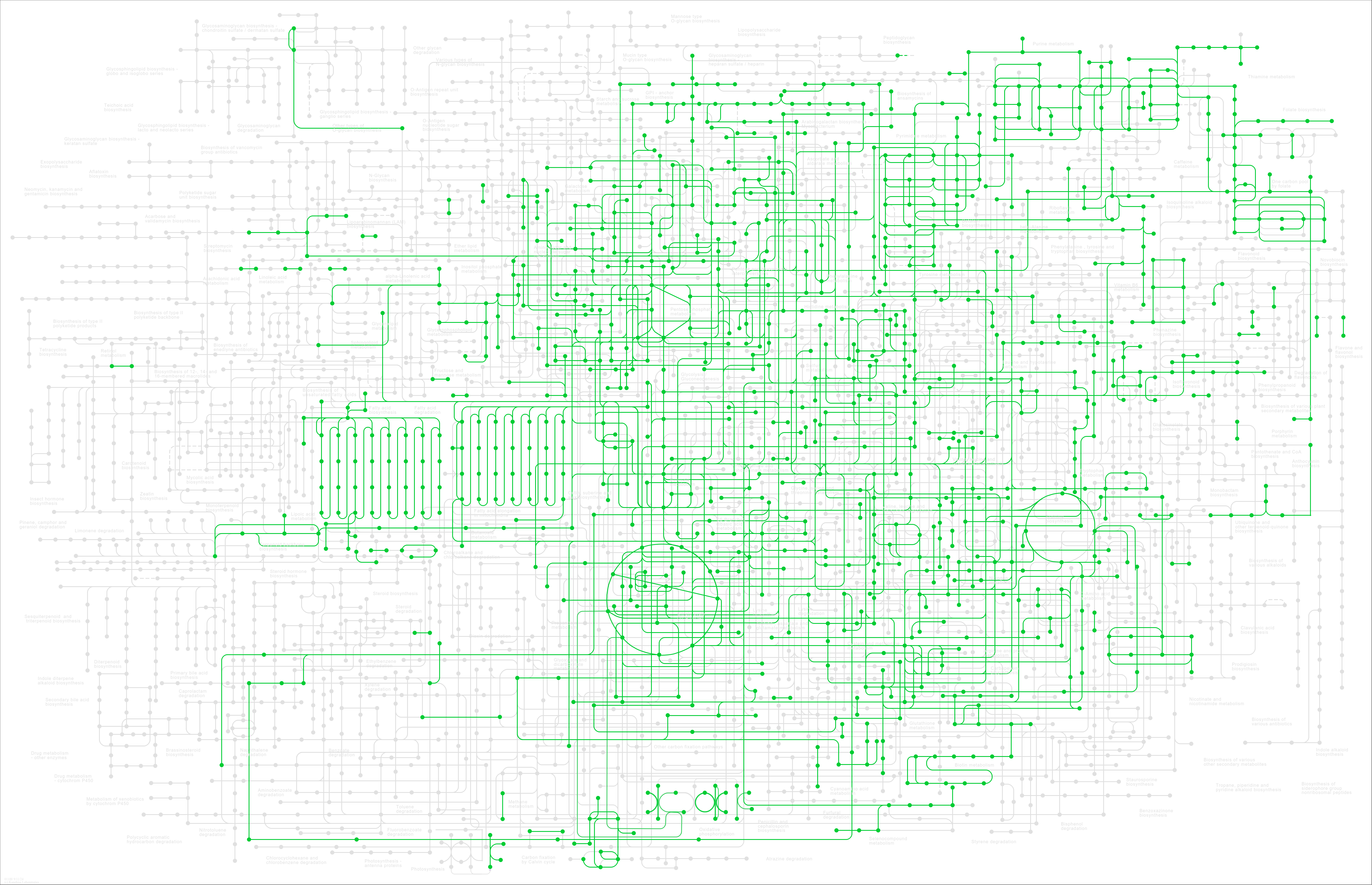
Basically all the other functions of the cell? I think you might be hung up on the term "dogma". It is not the sole key element, just one that we understand better. So well that the term dogma of molecular biology was coined to highlight information flow in the cell. And now we know that even that is inaccurate. So we have metabolism, molecule turnover, sensing and all the other elements that makes a living cell. I keep repeating myself a bit here but essentially we know one part well and we don't even know how many parts we do not know. If we did, we would be able to create an artificial cell. The fact that we can't suggests that we don't understand it. Just for illustration, even if we only talk genes and ignore the increasing complexity resulting from the proteome and metabolome, Escherichia coli is probably the best studied organism out there. Every single gene has been investigated over decades. In the end, we only have an idea of the function of roughly 50% of its genome. Among the genes that have been annotated a sizable proportion the functions are still not fully clear. What I am saying is that functionally we are still unable to fully understand what a a cell needs to work. To take my previous analogy, it is like saying that we are able to build rockets, so why are we not settling other star systems yet? There is a big gap between these two challenges. Take a look at that. This is simplified diagram of the pathways in E. coli as far as we understand it. The nodes are metabolites with enzymes catalyzing the associated reaction. Each of the nodes has a layer of complex regulations (not depicted) to ensure that they move in the right way without seizing up and react to dynamic changes in their internal composition (we can ignore external challenges if we assume highly artificial conditions). Also missing are posttranslational activities that modulate the activities (plus other layers of control). This map, to be clear, does not represent all what the bacterium is doing, only the parts we figured out in the last 3-4 decades or so. And we are nowhere close to replicate that artificially because as it turns out, even if we created a soup with all these enzymes, it still won't work. There are more layers (one of which is regulation, as hinted above) and likely some not yet discovered elements that play important roles. My guess is that it might take decades to get to the point where we start to understand what we are missing. My timeline obviously can be wrong, but for the last decade or so I have not come across breakthrough research that would make me believe that we have overcome some of the fundamental challenges yet. Bacteriophages have never played much of a role in controlling diseases. From a competition viewpoint control for nutrients is likely a bigger factor in settling for niches, rather than phage resistance. It is not nothing, but I would not pick it out as as the key element shaping bacterial evolution and ecology. Even as targeted therapeutics they are much less useful than antibiotics. There are attempts to make them more useful due to the threat of increasing resistance, but it is unclear to me what level of impact it ultimately will have.

-
Among the many explanation why we have a capital-based economy which promotes an upward movement of wealth (Marx, anyone?), I also found an interesting observation regarding non-essential consumption. There was an argument that folks have more things than ever before (e.g. comparing to our parents and grand-parents) as many goods (especially electronics) are now mass consumed. To produce these goods, cost cutting and efficiency has spread through all levels of the support chain, leaving essentially labor cost as a non-reducible unit. There are therefore strong incentives to keep salaries low and companies successful in cutting costs this way are getting incentivized by shareholders as well as consumers.
-
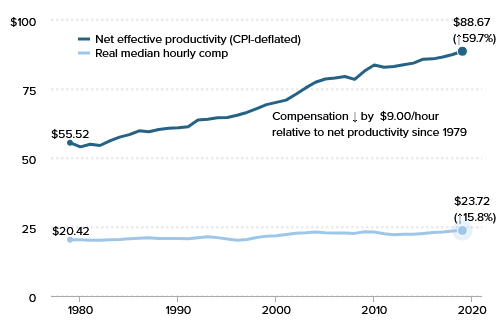
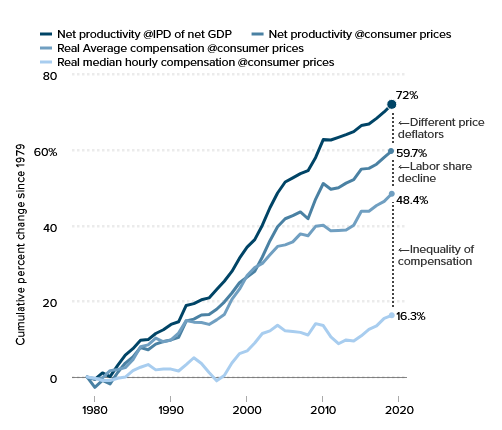
The US Bureau of labor statistics has those data available, but I think the gap is widely recognized. Edit, some figures also from the EPI, slightly updated