

CharonY
Moderators
-
Joined
-
Last visited
Everything posted by CharonY
-
You have different physical properties in your own body alone. Your left arm does not have the exact same composition as your right, for example.
-
RE: IDE, what often happens is that reviewers request additional info which will extend the timeline, especially if there is any potential risk to the participants. Likewise the timeline for EUAs cannot be easily generalized, as it depends on too many factors. If the application is straightforward, documentation is great and the need is high, it will be on the lower end of the spectrum. Conversely, if the application is risky/novel and/or poorly documented then emergency use might be delayed significantly. Generally panels have to decide based on available data and past experiences (if applicable) and each case can be very different and has to be treated differently. It is not like a simple checklist.
-
Apologies for taking this off-topic a bit, but nope. Territorial and group behaviour has been with us for a long time. However, the principles of race and racism is a somewhat modern development stemming from the enlightenment period where naturalists like Carl Linnaeus starting to organize nature into categories, such as species. These ideas where then eventually also applied to humans, which created the rough categories we still use to this day (typically white, black and Asian which really does not capture our genetic diversity, but that is a side point of an already off-topic post). Before, folks might have been discriminated based on looks or, perhaps more commonly, origin. However, the general assumption is that is less a system which we would associate with racism in the moderns sense but more a rejection of others, which is related, but not really the same. I will say that there is at least one work (I forgot the author, but can find it out) that argues that in antiquity we already found something akin to proto-racism which might even be the precursor of the modern form of racism. That book is slightly controversial, as it goes against the common mainstream historic thought of attitudes in that era (e.g. based on how Romans and Greek would describe other ethnicities). But assuming that everyone had always a sense of race throughout human history is just not really evidenced.
-
Actually they do spread a fair bit (mostly mosquitos) and mosquitos are present in most parts of the world. The spread of disease depends a fair bit on the pathogens and human/animal reservoirs in which they reproduce. Since there is no human-to-human spread, travel does not factor in like it does e.g. with influenza or SARS-CoV-2. However, it is very wrong to assume that those diseases are only found in Africa as a lot of mosquito-borne diseases are present on several continents. Malaria which is caused by Plasmidium palcifarum is found in Africa, South America and throughout South Asia, for example. The Dengue virus has a similar distribution, but there are occasional outbreaks in the continental US (though often travel-related). West Nile virus is found in Africa, Europe, Middle East and North America and West Asia. While most limited to the more Southern parts, due to global Warming their territory is creeping Northward. Tropical climate does benefit mosquito life cycles and often provides abundant reservoirs for a given disease, but again, they
-
They have characteristic mycolic acids which really makes them tough little buggers: https://en.wikipedia.org/wiki/Mycolic_acid
-
I told you. First read the two papers for which I have provided references. This teaches you how to find known literature. Then, for the review, you go to the back and look at the references. These are papers that are described in the review. Take those references and search for them on pubmed. This is how you find additional literature. Then look at the older paper I referenced. Then go to pubmed (or google scholar if you prefer) and check out which newer papers have referenced that paper. This teaches you how to look for new papers which are based on previous work. Learning requires work and effort. It is not a passive process.
-
Doesn't that actually indicate that kids should learn more about Critical Race Theory, even if only to not to believe in such falsehoods? And it is especially funny considering that critical race theory is in part a direct refutation of the modernist race theories.
-
This is not a satisfactory effort on your end. As mentioned, there is an abundance of studies out there. If you are not even willing to read the two I provided, what makes you think that folks would be willing to sacrifice their time to do work for you?
-
Of course you can. And if you are just looking for the existence of such studies I suggest you hop on Pubmed and look for them, as there too many to list, especially if you want to include animal models. I suggest that you start with a review looking at animal models for a specific pathogen (say influenza) and then go through the references to find the work. An example is Margine et al. Pathogens 2014, 3, 845–874 For influenza in humans the oldest one I am aware of is Alford et al. Proceedings of the Society for Experimental Biology and Medicine 1966, Volume: 122 issue: 3, page(s): 800-804. Here, you can also check reference citing it (rather than those cited) in order to see who might have done similar work.
-
... why?
-
Pandemic does not refer to severity, it refers to spread of a disease across the globe. As such it is clear that we are still very much in the pandemic and assertions that the pandemic is behind us is factually wrong. One could speculate whether the deadliest parts are behind us, but even that is difficult to ascertain. The ongoing Omicron wave has been the deadliest in many regions of the world, mostly because it infected so many people. Data also suggests that waning immunity might be an issue and if not up to date on vaccines, elderly still disproportionately die. While the death rate is still much lower among vaccinated and especially boosted individuals compared to the unvaccinated, it is not correct to assume that only the unvaccinated are going to die. On top there are the issues of post-viral infection syndromes. While these are nothing new (some folks have severe long-term issues due to influenza and other infections, for example), few infections swept in that number through the population. Research is ongoing to assess the magnitude but we are still very much in the data collecting phase. I.e. the impact of a disease is not only measured in deaths, but also overall loss of quality of life/health and it is premature to declare that things are over. After all, the expectation of an end was done in the past multiple times, but what is actually needed is an action plan going forward. I will also pre-empt some assumptions based on other endemic diseases with seasonal outbreaks by saying that COVID-19 has different characteristics, since Omicron it is circulating almost constantly at a relative high rate in the population, almost regardless of the season. There will be regional differences, but things like less time outdoors, start of school/university and so on, can favour new outbreaks (as might new variants). In contrast, we see almost no measurable circulation of flu outside the flu season, suggesting that a mix of lifestyle and immunity (vaccinated or otherwise) is capable of limiting outbreaks for most of the year.
-
Ethanol is not that great for large surface contamination as the contact time required for many bacteria is on average around 20 mins, for more robust ones it could be an hour. Instruments can be submerged in it and kept for the required time, but it tends to evaporate from surfaces before quantitative sterilization. Mycobacterium species have rather robust cell hulls, which makes them more resilient than many other species. They are also somewhat acid resistant, so vinegar is unlikely going to work well.
-
There were also older studies trying to figure out whether temperature had an effect on rhinovirus infections (it did not). But I think much of the research has moved precisely due to the unfavourable effort/cost to insight ratio.
-
According to a report Scholz suggested a neutral status for Ukraine with guarantees from Russia and the US. Zelensky responded that Putin could not be trusted to uphold such an agreement and seemingly with good reason. Before that, in the meeting between Scholz and Putin, Putin again reiterated the one people claim of Russians, Ukrainians and Belarusians. As such his motivation does not seem to be borne out of fear of the West, but rather a desire of the creation of an USSR style Russia in his image.
-
A few things to that. Those studies usually aim to establish the minimal infectious dose and only establish limited, dose-response relationships. I.e. you can have dose escalation, but you would want to keep levels overall low and mostly monitor binary outcomes. I.e. you do not want the patients to get very sick for very obvious reasons. Another study goal can be to evaluate protective properties drugs to prevent disease and here different treatment groups would be exposed to an infectious dose of the pathogen. However, these studies are not very common a) due to the need to mitigate risk, b) are often fairly expensive, but also b) because for certain diseases somewhat decent animal models have been established that mimic human exposure and are used instead. That being said there are quite a few studies around. For influenza you can go back to at least the 60s and there are occasional updates when new variants come around, for example. For more harmless diseases these study might also exist, but are less likely to get funded, if they there is not some kind of public health interest behind them (e.g. for the development of antivirals or other drugs).
-
I think the laws are fairly strong in Canada (at least superficial they look somewhat similar to Germany, though Germany is probably a bit stronger in job security for certain parts of the public sector). That being said, I think that misconduct and incompetence are actually one of the few reasons that are grounds for dismissal. Performance might be a bit iffy, depending on how they are measured. Regarding serfdom, I may be misremembering but IIRC serfdom was on the decline well before the plague throughout Western Europe. Mostly in England, the drop in number of servile peasants does fit the timing of the black death better. Interestingly, a book (written by Mark Bailey) has specifically studied the decline of serfdom in medieval England actually called out the overemphasis of the Black Death. Conversely, in Eastern Europe serfdom increased after the the Black Death and in other parts. So it is potentially one of those things where one event had likely an impact on the other, but the precise relationship is likely somewhat more complicated than assumed, once one starts looking into it in detail.
-
Or ligament issues. As you mentioned, biological systems are complex and they have the annoying tendency not to work precisely as predicted.
-
The theoretical answer is probably yes, the practical almost certainly no. The effects of exercise are very complex and while there is some rough understanding on the macro level (e.g. on average what level of exercise seems to correlate with a certain outcome) but what is really happening mechanistically is barely understood. Pretty much the same can be said for respiration rate, generation of ROS and all the factors that may account not only for individual differences but potentially also day-to-day differences in a given person. Slept badly? It may or may not influence your metabolism in terms of ROS generation. Moreover, we also do not understand relative contribution to a given factor very well. Are exercise benefits on cardiovascular health offset by eating bacon once? How about twice? Weekly? Again, individual differences are huge and as we age, or get stressed, a lot in our physiology changes. Trying to achieve the level of desired precision with the lack of data we have got is simply put impossible. Only folks like Dr. Oz and their ilk will tell you that we have clear and definite answers to that. What we do have are rough guidelines which apply to some degree to a population with a given set of characteristics. Pretty much everything beyond that is extrapolation.
-
Uh, since we all came from Africa, how is it possible that we only have fragments of what you call African DNA? Do you think our DNA goes becomes something else once we move out of a region? The way to think about it is pretty much all our DNA is shared with our African ancestors, but Eurasian populations have lost some of the diversity (bottleneck effect). While there are new alleles that are more prevalent or even exclusive to non-African populations, they are just relatively small bits of our shared genetic backbone. That is a bit problematic if the given information is not based on mainstream information and therefore makes it impossible for folks to join the dots in a correct way.
-
What? Are you referring to the holocaust? There, early computers were used to facilitate the genocide. https://en.wikipedia.org/wiki/IBM_and_the_Holocaust Not sure why switching over to some nebulous AI would make things better. Policies and global strategies matter. Tools are subservient to those and can make things better or worse. Also, I note that you keep using "AI" and "algorithm" similar to the term "magic wand". As in, it seems to magically solve the problem without exactly being clear how. And no, we just calculate something is not an explanation. It is just using different words to explain nothing. Can more data help? Sure, but it depends on exactly how we use it. But if we are not willing to either mitigate climate change or develop policies to address its impact or develop some sort of strategy to help each other, the AI might as well tell us to run in circles until we die, for all the good it will be doing.
-
As with virtually all biological systems an one-dimensional view is not helpful. Yes, higher metabolic rate means higher rate of ROS generation. It also means that the system needs to ramp up its antioxidative defenses to cope. How much it can do so, is dependent on many, many factors. Then if the defenses are overwhelmed and damages happen on the cellular level, you then would have to look at how much of the tissue can be repaired. And then you go even higher to the systemic level and ask about health detriment/benefit, you then need to balance out those damages with all the benefits you get from activity. Ultimately oxidative damages will accumulate, regardless of exercise level. But we also know that without exercise the risk of cardiovascular and other failures increase. Extreme exercise can be detrimental, but I suspect it is less due to oxidative damages but more to injuries and other effects of regular overexertion.
-
I do not understand the comparison with Germany, to be honest. Germany has or had fairly strong trade unions, and the strike rate is the closest there is within OECD countries to the UK (21 strike days per 1000 employees UK vs 16 Germany between 2008-2017). Compare that to US (5) or Canada (74). France is of course top of the list (118).
-
Well, to me that looks a typical distraction. Instead of negotiating for higher wages, just limit immigration? Hey here is a bad situation, let's not address it, but instead blame something else. Meanwhile, the effects of immigration on the UK labor market have been relatively small and mostly affect the segment of wages that are occupied by immigrants in the first place. https://migrationobservatory.ox.ac.uk/resources/briefings/the-labour-market-effects-of-immigration/ In 2021 about 240k work visa were approved (which seems a bit of a far cry from the claim of unrestricted immigration, especially compared to, say, Canada). Even assuming that all of those are unskilled workers the impact on salaries would be miniscule. And this is under the most favourable assumption. Also, I thought the discussion is about essential workers. Also based on the OP, are you assuming that essential work is only (or mostly) done by unskilled and predominant immigrant workers? Because other groups appear to benefit salary-wise from immigration.
-
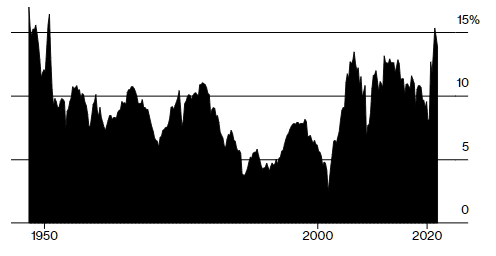
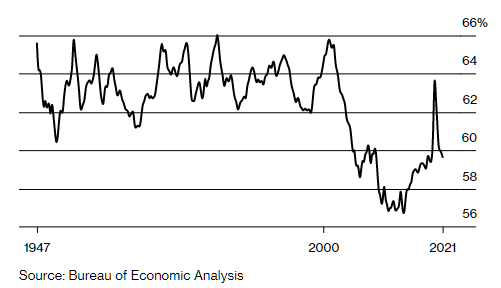
There is a good point in there as wage increases can increase inflation. That being said, some companies have made record profits for their shareholders and that is not in line with keeping wages flat. https://www.bloomberg.com/news/articles/2022-03-30/2021-was-best-year-for-u-s-corporation-profits-since-1950 Here you can see the profit margin of companies and compare that to the wage development. Since around 2000 there has been quite a separation of these values and after a pandemic bump employee compensation is dropping again. On the microlevel wage increases might not be ideal for certain businesses, but on the macrolevel it makes sense to push for wage increases when shareholders are having record profits. Otherwise we are just redistributing money upward.
-
! Moderator Note Trashed.